
Science
NASA’s Perseverance Rover Captures Sounds of Lightning on Mars

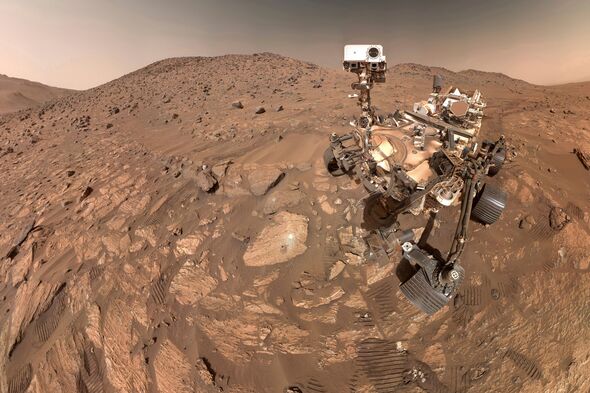
NASA’s Perseverance rover has made a significant discovery by recording crackling sounds on Mars, which scientists believe originate from lightning. This marks the first time potential lightning strikes have been documented on the Martian surface, although researchers have long theorized about the existence of such phenomena on the planet. The findings were detailed by a French-led team in a report released on July 26, 2023.
The unusual sounds were captured by a microphone on the rover while it was monitoring wind patterns. Over the course of two Martian years, the team recorded what they describe as “mini lightning” occurrences 55 times, primarily during dust storms and dust devils. Most of these instances were noted on the windiest days, with electrical discharges happening within approximately 6 feet (2 meters) of the microphone, located at the top of the rover’s tall mast.
According to the lead author of the study, Baptiste Chide from the Institute for Research in Astrophysics and Planetology in Toulouse, the crackling sounds are likely caused by electrical discharges. These noises, reminiscent of static electricity on Earth, were clearly audible despite the strong wind gusts and swirling dust particles. Chide stated, “It opens a completely new field of investigation for Mars science. It’s like finding a missing piece of the puzzle.”
While the evidence supporting the presence of lightning on Mars is compelling, some scientists urge caution. Daniel Mitchard of Cardiff University, who was not involved in the research, emphasized that the findings rely on a single instrument designed primarily for other purposes, such as recording laser zaps on rocks. He remarked, “It really is a chance discovery to hear something else going on nearby, and everything points to this being Martian lightning.”
The team spent considerable time analyzing 28 hours of recordings that included the perceived “mini lightning.” The electrical discharges from dust devils were short-lived, lasting only a few seconds, while those from the larger dust storms could be heard for up to 30 minutes. Chide likened the phenomenon to a thunderstorm on Earth, though much less visible and characterized by faint electrical zaps.
Chide also noted that the Martian atmosphere may be more conducive to electrical discharges than that of Earth. Nevertheless, Mitchard reassured that the likelihood of a human being struck by lightning while walking on Mars remains extremely low. He stated, “The current evidence suggests it is extremely unlikely that the first person to walk on Mars could, as they plant a flag on the surface, be struck down by a bolt of lightning.”
Despite this, Mitchard cautioned that the “small and frequent static-like discharges could prove problematic for sensitive equipment” on future missions. As research continues, these findings could pave the way for deeper investigations into Martian weather phenomena and their implications for future exploration.

Robinhood Stock Surges 2.5% in Early Trading on March 17

Israel Intensifies Strikes as Global Energy Crisis Looms

CALV Offers Class on Communication Skills for Real Estate Professionals

Historic Bideford Pub Reopens as The Patch Wine Bar & Kitchen

Oscar Night Celebrations: Winners, Guests, and Exclusive After-Parties

Samsung Galaxy Watch 9 Set for Larger Battery Boost, Report Reveals

Kibble vs. Fresh Dog Food: What’s Best for Your Dog’s Health?

Acclaimed San Francisco Pizzeria Del Popolo to Close in May

‘Invincible’ Season 4 Launches on Prime Video with Epic Action

ALMA Discovers Companion Orbiting Giant Red Star π 1 Gruis

Doctoral Candidate Trivanni Yadav Advances Battery Research at UTulsa

Global Air Forces Ranked by Annual Defense Budgets in 2025

Rev. Bry Shields to Retire as McGill-Toolen President in 2026

Mass Production of F-35 Fighter Jet Drives Down Costs

Tucson Celebrates Life and Remembrance at 36th Annual All Souls Procession

Gold Investment Surge: Top Mutual Funds and ETF Alternatives

DirecTV to Launch AI-Driven Ads with User Likenesses in 2026

Paul Giamatti Reveals Villainous Role in Star Trek: Starfleet Academy
-
 Science9 months ago
ALMA Discovers Companion Orbiting Giant Red Star π 1 Gruis
-
 Science9 months ago
Doctoral Candidate Trivanni Yadav Advances Battery Research at UTulsa
-
 World10 months ago
Global Air Forces Ranked by Annual Defense Budgets in 2025
-
 Lifestyle10 months ago
Rev. Bry Shields to Retire as McGill-Toolen President in 2026
-
 World10 months ago
Mass Production of F-35 Fighter Jet Drives Down Costs
-
 Lifestyle9 months ago
Tucson Celebrates Life and Remembrance at 36th Annual All Souls Procession
-
 Business10 months ago
Gold Investment Surge: Top Mutual Funds and ETF Alternatives
-
 Top Stories10 months ago
DirecTV to Launch AI-Driven Ads with User Likenesses in 2026
-
 Entertainment10 months ago
Paul Giamatti Reveals Villainous Role in Star Trek: Starfleet Academy
-

 Lifestyle8 months ago
Maumee’s Shop With a Hero Event Delivers Joy to Local Children
-

 Top Stories10 months ago
New ‘Star Trek: Voyager’ Game Demo Released, Players Test Limits
-

 Lifestyle8 months ago
Cape May Shines as New Jersey’s Only Entry on Beach Town List