
Top Stories
CEOs Embrace AI NOW: Transforming Workflows and Lives

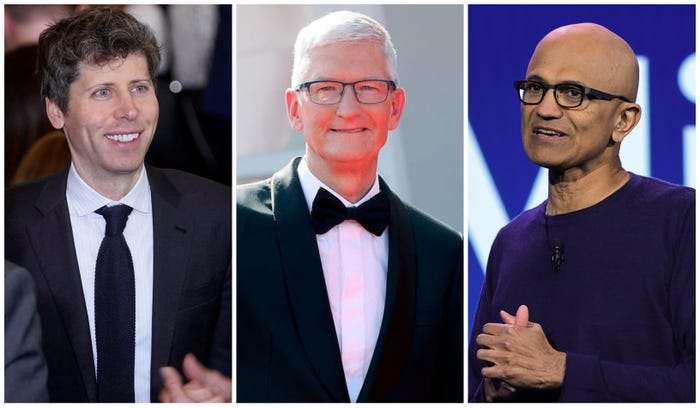
UPDATE: CEOs across major tech firms are rapidly integrating artificial intelligence (AI) into their daily routines, revolutionizing both personal and professional landscapes. This trend is gaining momentum as AI technologies become more sophisticated, with the market projected to surge to $4.8 trillion by 2033.
In a world where AI is increasingly ubiquitous, leading figures like Satya Nadella of Microsoft and Tim Cook of Apple are utilizing these tools to enhance productivity and streamline tasks. Just this week, Nadella revealed that he uses AI to summarize Outlook messages and prepare for meetings, stating, “I’m an email typist,” highlighting the technology’s role in his workflow.
Meanwhile, Sam Altman, CEO of OpenAI, shared his own experiences with AI. He openly admitted using AI to manage emails and assist in parenting, noting, “I don’t know how I would have done that” after welcoming his first child. His reliance on AI underscores its growing role in everyday life, particularly for high-profile leaders.
Another prominent player, Jensen Huang of Nvidia, has taken a hands-on approach to learning with AI. Huang described using AI as a “tutor” for acquiring new knowledge, illustrating how technology can bridge the information gap in complex fields. He emphasized that AI’s ability to communicate in various languages makes it accessible to everyone, regardless of technical skill.
As these CEOs adapt their workflows, Tim Cook has introduced Apple Intelligence, a generative AI system aimed at optimizing email management. Cook expressed the profound impact of AI on his daily life, stating, “If I can save time here and there, it adds up to something significant.” His insights reflect a broader trend among executives who are keen to leverage AI for efficiency.
In the real estate sector, Jeremy Wacksman of Zillow is advocating for experimentation with AI tools among his staff. He noted the value of tailored summaries from AI, which can save time and enhance understanding of critical information.
The cryptocurrency world is not left behind, as Brian Armstrong from Coinbase is pioneering AI applications in trading. Armstrong recently highlighted a groundbreaking “AI to AI crypto transaction,” showcasing how AI can streamline complex financial operations.
LinkedIn’s Ryan Roslansky has found AI indispensable for drafting important communications, likening it to having “a second brain.” He emphasizes using AI to ensure clarity and professionalism in high-stakes emails, which is crucial for maintaining executive relationships.
In the healthcare space, David Ricks of Eli Lilly is tapping into AI’s potential for drug discovery. His company is developing a powerful supercomputer with Nvidia that promises to revolutionize pharmaceutical research. Ricks stated that he relies on AI during meetings to stay informed and engaged, showcasing its critical role in the healthcare sector.
These developments highlight an urgent shift in how top executives are embracing AI as a tool for efficiency and innovation. As this trend continues to evolve, the implications for industries worldwide are profound.
What’s Next: Observers are keenly watching how these AI integrations will reshape productivity patterns and decision-making processes. With AI set to contribute an estimated $15.7 trillion to the global economy by 2030, the urgency for organizations to adopt AI technologies has never been greater. Stay tuned for further updates on how leaders are navigating this AI-driven landscape and what it means for the future of work.
This ongoing evolution in leadership practices signals a transformative phase in business strategy, one where AI is not just an accessory but a core element of daily operations. Share this now to keep your network informed on the latest in AI and leadership!

Fed Chair Powell to Speak Tonight, No Monetary Policy Insights Expected

NSW Government Orders Shutdown of Pokies After 4 AM, 670 Venues Affected

Virginia Tech Struggles in Loss to No. 17 Virginia: Key Insights

Oxford University Press Declares “Rage Bait” Word of the Year 2025

GEEKOM Launches GeekBook X14 Pro: The Lightest Windows Laptop

Aquarius Faces Introspection and Growth in December 2025

Alarming Rise in Invasive Breast Cancer Cases Among Younger Women

Urgent Update: NYC’s Next Mayor Number in Question, Historians Say

Urgent Update: Indulge in Homemade Ding Dong Cake Recipe Today

New ‘Star Trek: Voyager’ Game Demo Released, Players Test Limits

Global Air Forces Ranked by Annual Defense Budgets in 2025

ALMA Discovers Companion Orbiting Giant Red Star π 1 Gruis

Mass Production of F-35 Fighter Jet Drives Down Costs

Electrification Challenges Demand Advanced Multiphysics Modeling

Gold Investment Surge: Top Mutual Funds and ETF Alternatives

Time Crystals Revolutionize Quantum Computing Potential

DirecTV to Launch AI-Driven Ads with User Likenesses in 2026

Freeport Art Gallery Transforms Waste into Creative Masterpieces
-
 Top Stories2 months ago
New ‘Star Trek: Voyager’ Game Demo Released, Players Test Limits
-
 World2 months ago
Global Air Forces Ranked by Annual Defense Budgets in 2025
-
 Science2 weeks ago
ALMA Discovers Companion Orbiting Giant Red Star π 1 Gruis
-
 World2 months ago
Mass Production of F-35 Fighter Jet Drives Down Costs
-
 World2 months ago
Electrification Challenges Demand Advanced Multiphysics Modeling
-
 Business2 months ago
Gold Investment Surge: Top Mutual Funds and ETF Alternatives
-
 Science2 months ago
Time Crystals Revolutionize Quantum Computing Potential
-
 Top Stories2 months ago
DirecTV to Launch AI-Driven Ads with User Likenesses in 2026
-
 Entertainment2 months ago
Freeport Art Gallery Transforms Waste into Creative Masterpieces
-

 Business2 months ago
US Government Denies Coal Lease Bid, Impacting Industry Revival Efforts
-

 Health2 months ago
Gavin Newsom Critiques Trump’s Health and National Guard Plans
-

 Lifestyle2 months ago
Discover Reese Witherspoon’s Chic Dining Room Style for Under $25