
Science
Korean Researchers Develop Eco-Friendly Heat-Dissipating Material

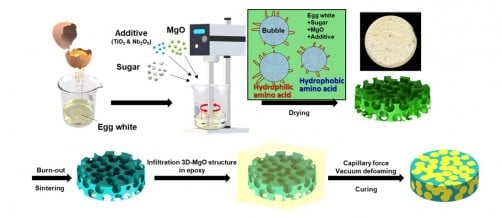
A research team from the Korea Institute of Materials Science (KIMS), led by Dr. Hyun-Ae Cha, has successfully developed a new heat-dissipating composite material that balances environmental sustainability with cost-effective processing. This innovation utilizes a protein foaming technique inspired by egg whites to create a three-dimensional structure of magnesium oxide (MgO), which significantly enhances thermal conductivity.
The new composite material exhibits a thermal conductivity of 17.19 W/m·K, which is up to 2.6 times greater than conventional heat-dissipating composites. As electronic devices become more powerful and compact, they generate increasing amounts of heat, necessitating advanced thermal management solutions. This is particularly critical in electric vehicles (EVs), where inadequate battery cooling can lead to performance issues and safety hazards, including fires.
Typically, thermal interface materials (TIMs) are produced by mixing thermally conductive fillers into a polymer matrix. This traditional method often results in irregular filler dispersion, disrupting thermal pathways and limiting performance. Increasing filler content to enhance conductivity can complicate processing and escalate costs, thus hampering scalability.
To overcome these limitations, the KIMS team employed a novel protein foaming method. By taking advantage of the properties of egg-white proteins that expand under heat, they created a dense and uniform network of interconnected particles. This innovation allows for uninterrupted thermal pathways, resulting in superior heat dissipation capabilities.
The development of this composite not only outperforms widely used materials such as aluminum oxide (Al2O3) but also outstrips nitride-based alternatives. Furthermore, by integrating the material with epoxy resin, typically utilized to improve adhesion with thermal fillers, the team has produced a composite that is practical for real-world applications.
With Korea’s domestic market for TIMs projected to exceed KRW 200 billion annually, the potential impact of this technology is substantial. Currently, the market relies heavily on imports, making this advancement crucial for enhancing Korea’s technological self-reliance in thermal management materials.
Dr. Cha emphasized the significance of this research, stating, “Through the protein foaming–based process, we can produce high–thermal–conductivity materials in an eco-friendly and cost-effective way.” She further noted, “This study serves as a strong example demonstrating the feasibility of developing lightweight, high-performance heat-dissipating materials.”
The findings from this research were published on May 28, 2023, in the esteemed journal Advanced Science, which has an impact factor of 15.1. The article was also selected as the cover piece for Volume 12, Issue 33, highlighting its relevance and importance in the field.
The research received funding from the National Research Foundation of Korea (NRF) under the Nano Materials Technology Development Program, underscoring the support for innovative materials research within the country.

Robinhood Stock Surges 2.5% in Early Trading on March 17

Israel Intensifies Strikes as Global Energy Crisis Looms

CALV Offers Class on Communication Skills for Real Estate Professionals

Historic Bideford Pub Reopens as The Patch Wine Bar & Kitchen

Oscar Night Celebrations: Winners, Guests, and Exclusive After-Parties

Samsung Galaxy Watch 9 Set for Larger Battery Boost, Report Reveals

Kibble vs. Fresh Dog Food: What’s Best for Your Dog’s Health?

Acclaimed San Francisco Pizzeria Del Popolo to Close in May

‘Invincible’ Season 4 Launches on Prime Video with Epic Action

ALMA Discovers Companion Orbiting Giant Red Star π 1 Gruis

Doctoral Candidate Trivanni Yadav Advances Battery Research at UTulsa

Global Air Forces Ranked by Annual Defense Budgets in 2025

Rev. Bry Shields to Retire as McGill-Toolen President in 2026

Mass Production of F-35 Fighter Jet Drives Down Costs

Tucson Celebrates Life and Remembrance at 36th Annual All Souls Procession

Gold Investment Surge: Top Mutual Funds and ETF Alternatives

DirecTV to Launch AI-Driven Ads with User Likenesses in 2026

Paul Giamatti Reveals Villainous Role in Star Trek: Starfleet Academy
-
 Science9 months ago
ALMA Discovers Companion Orbiting Giant Red Star π 1 Gruis
-
 Science9 months ago
Doctoral Candidate Trivanni Yadav Advances Battery Research at UTulsa
-
 World10 months ago
Global Air Forces Ranked by Annual Defense Budgets in 2025
-
 Lifestyle10 months ago
Rev. Bry Shields to Retire as McGill-Toolen President in 2026
-
 World10 months ago
Mass Production of F-35 Fighter Jet Drives Down Costs
-
 Lifestyle9 months ago
Tucson Celebrates Life and Remembrance at 36th Annual All Souls Procession
-
 Business10 months ago
Gold Investment Surge: Top Mutual Funds and ETF Alternatives
-
 Top Stories10 months ago
DirecTV to Launch AI-Driven Ads with User Likenesses in 2026
-
 Entertainment10 months ago
Paul Giamatti Reveals Villainous Role in Star Trek: Starfleet Academy
-

 Lifestyle8 months ago
Maumee’s Shop With a Hero Event Delivers Joy to Local Children
-

 Top Stories10 months ago
New ‘Star Trek: Voyager’ Game Demo Released, Players Test Limits
-

 Lifestyle8 months ago
Cape May Shines as New Jersey’s Only Entry on Beach Town List