
Science
New Method Simplifies Production of Copper-64 for Medical Use

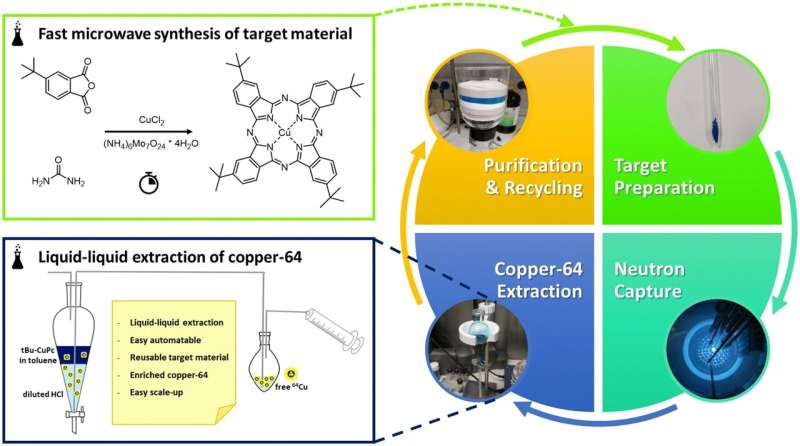
A breakthrough at the Vienna University of Technology is set to transform the production of the copper isotope Cu-64, crucial for medical imaging and potential cancer therapy. Researchers have developed a method that simplifies the creation of Cu-64, making it more accessible and cost-effective for medical applications.
Historically, Cu-64 has been produced by bombarding nickel atoms with protons, a process requiring specialized equipment like cyclotrons and enriched nickel isotopes, which are rare and expensive. The conventional method is effective but poses significant logistical and financial challenges. The new approach, detailed in the journal Dalton Transactions, uses neutron irradiation of Cu-63, a more readily available isotope.
Innovative Recoil Chemistry
The innovative technique leverages a phenomenon known as “recoil chemistry.” When Cu-63 atoms are irradiated with neutrons, they can be transformed into Cu-64. The challenge has been in separating the newly formed Cu-64 from the abundant Cu-63. Traditionally, this separation has proven difficult and often results in a mixture that is primarily ordinary copper, with Cu-64 present only in trace amounts.
Researchers at TU Wien have found a solution by embedding Cu-63 atoms into specially designed molecules. When a Cu-63 atom absorbs a neutron and becomes Cu-64, it releases excess energy as gamma radiation. This release causes the Cu-64 atom to recoil and eject from the molecule, allowing for clean separation from Cu-63.
Veronika Rosecker, a lead researcher, explained, “When a Cu-63 atom within such a molecule absorbs a neutron and becomes Cu-64, it briefly holds a large amount of excess energy, which it releases as gamma radiation.” This recoil effect facilitates the separation, making it easier to isolate and collect Cu-64 for medical use.
Designing Effective Molecules
A significant aspect of this research involved identifying suitable molecules that could endure the demanding conditions in a nuclear reactor while being soluble for subsequent chemical processing. The team developed a metal-organic complex similar to heme, the molecule found in human blood, which is stable enough for reactor use yet soluble enough for effective extraction of Cu-64.
Martin Pressler noted the advancements made, stating, “We achieved this using a metal-organic complex that resembles heme—the molecule found in human blood.” This complex was chemically modified to enhance its solubility, facilitating the recovery of Cu-64 post-irradiation.
The new method also offers additional benefits. It can be automated, allows for the reuse of the molecules without loss of efficiency, and eliminates the need for a cyclotron. Instead, researchers can utilize a research reactor, such as the one at TU Wien, significantly reducing costs and improving accessibility for medical facilities.
The implications of this research are substantial. By lowering production costs and simplifying the process, Cu-64 could become more widely available, enhancing its use in medical imaging and therapy. As researchers continue to refine this method, the potential for improved patient care through increased access to important medical isotopes is on the horizon.
For further details, refer to the original study: Martin Pressler et al, “Fast and easy reactor-based production of copper-64 with high molar activities using recoil chemistry,” published in Dalton Transactions on December 5, 2025.

Robinhood Stock Surges 2.5% in Early Trading on March 17

Israel Intensifies Strikes as Global Energy Crisis Looms

CALV Offers Class on Communication Skills for Real Estate Professionals

Historic Bideford Pub Reopens as The Patch Wine Bar & Kitchen

Oscar Night Celebrations: Winners, Guests, and Exclusive After-Parties

Samsung Galaxy Watch 9 Set for Larger Battery Boost, Report Reveals

Kibble vs. Fresh Dog Food: What’s Best for Your Dog’s Health?

Acclaimed San Francisco Pizzeria Del Popolo to Close in May

‘Invincible’ Season 4 Launches on Prime Video with Epic Action

ALMA Discovers Companion Orbiting Giant Red Star π 1 Gruis

Doctoral Candidate Trivanni Yadav Advances Battery Research at UTulsa

Global Air Forces Ranked by Annual Defense Budgets in 2025

Rev. Bry Shields to Retire as McGill-Toolen President in 2026

Mass Production of F-35 Fighter Jet Drives Down Costs

Tucson Celebrates Life and Remembrance at 36th Annual All Souls Procession

Gold Investment Surge: Top Mutual Funds and ETF Alternatives

DirecTV to Launch AI-Driven Ads with User Likenesses in 2026

Paul Giamatti Reveals Villainous Role in Star Trek: Starfleet Academy
-
 Science9 months ago
ALMA Discovers Companion Orbiting Giant Red Star π 1 Gruis
-
 Science9 months ago
Doctoral Candidate Trivanni Yadav Advances Battery Research at UTulsa
-
 World10 months ago
Global Air Forces Ranked by Annual Defense Budgets in 2025
-
 Lifestyle10 months ago
Rev. Bry Shields to Retire as McGill-Toolen President in 2026
-
 World10 months ago
Mass Production of F-35 Fighter Jet Drives Down Costs
-
 Lifestyle9 months ago
Tucson Celebrates Life and Remembrance at 36th Annual All Souls Procession
-
 Business10 months ago
Gold Investment Surge: Top Mutual Funds and ETF Alternatives
-
 Top Stories10 months ago
DirecTV to Launch AI-Driven Ads with User Likenesses in 2026
-
 Entertainment10 months ago
Paul Giamatti Reveals Villainous Role in Star Trek: Starfleet Academy
-

 Lifestyle8 months ago
Maumee’s Shop With a Hero Event Delivers Joy to Local Children
-

 Top Stories10 months ago
New ‘Star Trek: Voyager’ Game Demo Released, Players Test Limits
-

 Lifestyle8 months ago
Cape May Shines as New Jersey’s Only Entry on Beach Town List