
Science
Scientists Uncover Ancient Secrets and Cosmic Wonders This Week

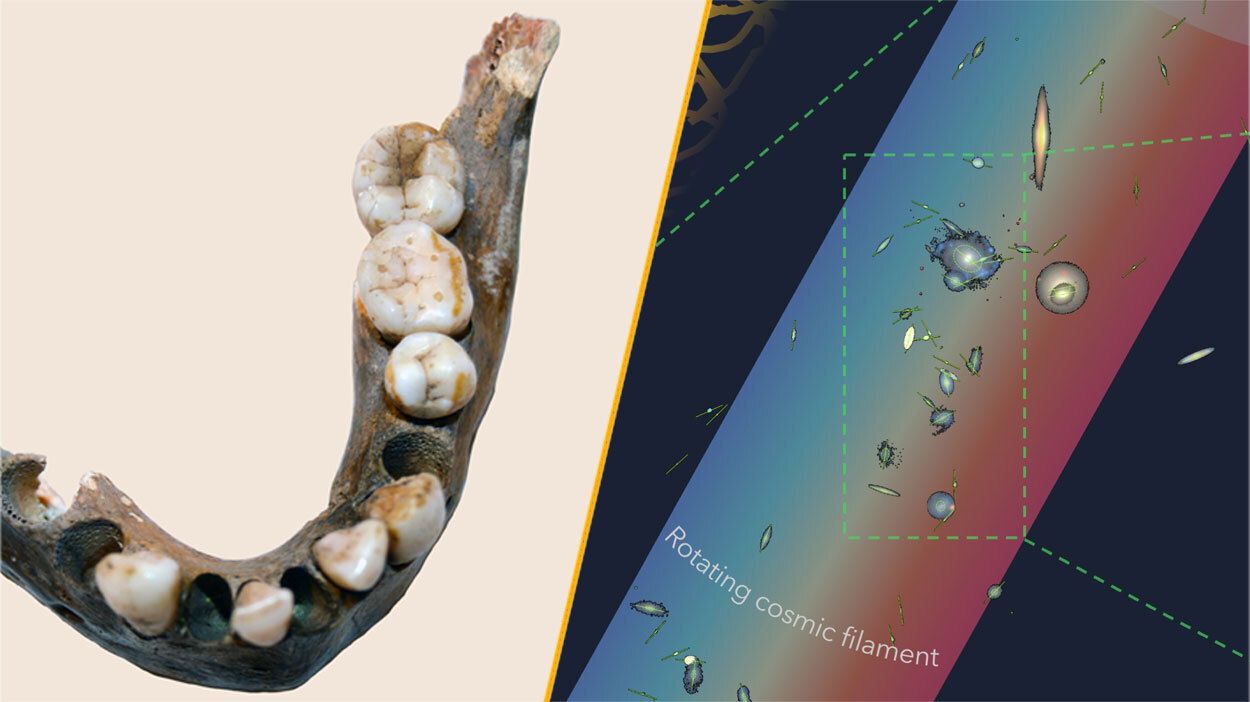
This week, significant discoveries have emerged in both cosmic and earthly realms, showcasing the breadth of human exploration and understanding. Notable findings include a massive cosmic structure located 140 million light-years away, revelations about a genetically isolated human population in southern Africa, and mysterious archaeological sites in China and Greece.
Largest Spinning Structure Discovered in the Universe
Astronomers have identified the largest known spinning object in the universe, a colossal filament linking 14 galaxies. This structure, measured to be wider than the Milky Way, is rotating at approximately 110 kilometers per second (68 miles per second). The discovery was made possible through advanced observational techniques, emphasizing the continuous expansion of our understanding of the cosmos.
Closer to Earth, researchers studying human genetics revealed that a population in southern Africa has remained genetically isolated for around 100,000 years. Analysis of skeletons dating back up to 10,000 years from an area south of the Limpopo River shows a dramatically different genetic makeup compared to contemporary humans. This unique genetic diversity illustrates the extensive evolutionary paths that different human groups have taken.
Mysterious Archaeological Finds and Environmental Challenges
In a striking find, archaeologists excavating outside a 4,000-year-old city in China unearthed a pit containing numerous skulls, predominantly male. This discovery deviates from typical human sacrificial patterns observed in nearby settlements, prompting further investigation into the cultural practices of ancient civilizations in this region.
In Greece, an elaborate tomb dating back 2,700 years contained a woman adorned with an upside-down crown, adding another layer of intrigue to archaeological research within the area.
Meanwhile, a long-term ecosystem project in China known as the Great Green Wall has yielded unintended consequences. Although the initiative aimed to combat desertification through extensive tree planting, recent analyses indicate alterations in rainfall and evaporation patterns. Consequently, some densely populated regions are experiencing lowered water levels, highlighting the complexities of large-scale environmental interventions.
In a different vein, new research suggests that the world record for the hottest temperature, recorded in Death Valley in 1913, may have been influenced by human error. This revelation adds a new dimension to ongoing discussions about climate measurement.
Innovative Developments in Technology and Science
In technological advancements, researchers at the Massachusetts Institute of Technology (MIT) have developed a method to extract drinking water from the air. This innovative technique, which employs sound waves to draw water from spongy materials, is reported to be 45 times more efficient than traditional evaporation-based systems. While the device requires a power source, researchers are optimistic about pairing it with solar cells to enhance its viability in arid regions.
Additionally, the interstellar comet 3I/ATLAS has captured public imagination since its discovery. Recent observations using the Joan Oró Telescope in Spain show the comet displaying spiral jets, suggesting the presence of “ice volcanoes.” These findings indicate that the comet’s surface is sublimating as it approaches the sun, aligning it more closely with other known celestial bodies.
As the week unfolds, the scientific community continues to pursue answers to complex questions, from the ancient history of humanity to the mysteries of the universe. The interplay between these discoveries underscores the ongoing quest for knowledge and understanding that defines human existence.

Robinhood Stock Surges 2.5% in Early Trading on March 17

Israel Intensifies Strikes as Global Energy Crisis Looms

CALV Offers Class on Communication Skills for Real Estate Professionals

Historic Bideford Pub Reopens as The Patch Wine Bar & Kitchen

Oscar Night Celebrations: Winners, Guests, and Exclusive After-Parties

Samsung Galaxy Watch 9 Set for Larger Battery Boost, Report Reveals

Kibble vs. Fresh Dog Food: What’s Best for Your Dog’s Health?

Acclaimed San Francisco Pizzeria Del Popolo to Close in May

‘Invincible’ Season 4 Launches on Prime Video with Epic Action

ALMA Discovers Companion Orbiting Giant Red Star π 1 Gruis

Doctoral Candidate Trivanni Yadav Advances Battery Research at UTulsa

Global Air Forces Ranked by Annual Defense Budgets in 2025

Rev. Bry Shields to Retire as McGill-Toolen President in 2026

Mass Production of F-35 Fighter Jet Drives Down Costs

Tucson Celebrates Life and Remembrance at 36th Annual All Souls Procession

Gold Investment Surge: Top Mutual Funds and ETF Alternatives

DirecTV to Launch AI-Driven Ads with User Likenesses in 2026

Paul Giamatti Reveals Villainous Role in Star Trek: Starfleet Academy
-
 Science9 months ago
ALMA Discovers Companion Orbiting Giant Red Star π 1 Gruis
-
 Science9 months ago
Doctoral Candidate Trivanni Yadav Advances Battery Research at UTulsa
-
 World10 months ago
Global Air Forces Ranked by Annual Defense Budgets in 2025
-
 Lifestyle10 months ago
Rev. Bry Shields to Retire as McGill-Toolen President in 2026
-
 World10 months ago
Mass Production of F-35 Fighter Jet Drives Down Costs
-
 Lifestyle9 months ago
Tucson Celebrates Life and Remembrance at 36th Annual All Souls Procession
-
 Business10 months ago
Gold Investment Surge: Top Mutual Funds and ETF Alternatives
-
 Top Stories10 months ago
DirecTV to Launch AI-Driven Ads with User Likenesses in 2026
-
 Entertainment10 months ago
Paul Giamatti Reveals Villainous Role in Star Trek: Starfleet Academy
-

 Top Stories10 months ago
New ‘Star Trek: Voyager’ Game Demo Released, Players Test Limits
-

 Lifestyle8 months ago
Maumee’s Shop With a Hero Event Delivers Joy to Local Children
-

 Lifestyle8 months ago
Cape May Shines as New Jersey’s Only Entry on Beach Town List