
Politics
Protest Erupts Against Professor Michael Ben-Gad at London University

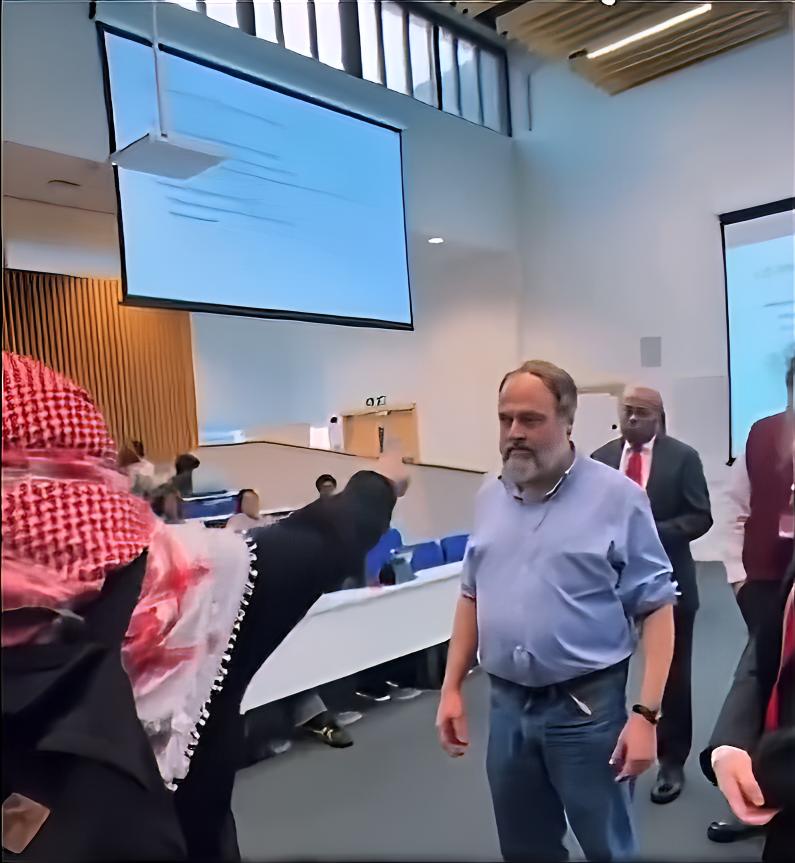
A significant protest unfolded outside City St George’s University in London against Professor Michael Ben-Gad, an economist known for his controversial academic background and views. The protest, orchestrated by a group calling itself “City Action for Palestine,” was sparked by Ben-Gad’s past service in the Israel Defense Forces (IDF) during the early 1980s—a common obligation for Jewish Israelis. The demonstration coincided with the release of footage by Iranian and Turkish state television, highlighting disruptions during one of Ben-Gad’s lectures.
The protestors branded Ben-Gad a “terrorist” and “war criminal,” demanding his immediate dismissal and an apology to Arab and Muslim students. This campaign also targeted Sir Anthony Finkelstein, the university president, accusing him and the institution of complicity in what they termed occupation and genocide. Despite facing intense pressure, Ben-Gad, whose family suffered during the Holocaust, maintained his intention to continue teaching and fulfilling his academic responsibilities.
The protest against Ben-Gad is part of a broader trend affecting academic freedom in the UK, particularly surrounding discussions on contentious issues such as the Israeli-Palestinian conflict. The incident also reflects wider tensions around free speech within universities, particularly following the October 7, 2023 attacks by Hamas against Israeli civilians, which have intensified debates over academic discourse related to Israel.
Responses and Wider Implications for Academic Freedom
In response to the protests, Finkelstein swiftly expressed support for Ben-Gad, reaching out to other Israeli academics within the institution. This proactive approach stands in contrast to many previous incidents where universities failed to protect their staff. The situation drew significant media attention and prompted discussions in Westminster. Politicians from both the Labour and Conservative parties, as well as many of Ben-Gad’s students, have shown solidarity with him.
A statement of support for Ben-Gad garnered over 1,610 signatories, including 97 from City St George’s University, illustrating widespread concern among academics. Yet, the incident raises critical questions about the increasing hostility towards Jewish academics and their supporters in UK higher education. Previous incidents, such as the forced resignation of Kathleen Stock from the University of Sussex, highlight a pattern of academic cancellations linked to differing views on sensitive topics.
While many Muslim students reportedly do not share the extreme views expressed by protestors, the hostility appears to stem from a minority of activists within academic circles and student unions. Reports have indicated rising levels of antisemitism on UK campuses, particularly since the recent escalation in violence. This trend is compounded by the growing politicization of academic discourse, where dissenting voices are often marginalized.
A Culture Shift Needed in Academia
Ben-Gad has contextualized the campaign against him within a larger movement to silence those who challenge prevailing academic narratives on issues like colonialism, gender, and race. The push to “decolonise the curriculum” and the establishment of bureaucracies focused on equity and diversity have contributed to a culture that often stifles rigorous debate.
The introduction of the Higher Education (Freedom of Speech) Act 2023 aims to address these challenges by safeguarding free speech within universities. Nevertheless, there are concerns that the Act’s implementation may not sufficiently protect academics facing backlash for their views. The current academic landscape, particularly in the arts and social sciences, often favors specific ideological perspectives, especially regarding Israel-Palestine issues.
In light of these developments, it is crucial for universities to foster an environment that encourages diverse viewpoints and debates, rather than suppressing them. As the situation around Professor Ben-Gad illustrates, the need for a cultural shift in academia is urgent to prevent further erosion of academic freedom and to ensure that all scholars can engage in open discourse without fear of retribution.

Hit-Boy Reveals Top 20 Nas Songs, Celebrating Hip-Hop’s Revival

Trump Issues Ultimatum to Maduro; Venezuela Closes Airspace

Evanescence Announces 2026 World Tour, Bay Area Date Set!

World CopperSmith and Anna Dinger Unveil Stunning Kitchen Renovation

Fever’s Candlelight Concerts Offer Up to 30% Off for Cyber Monday

Prepare for Tooth Extraction: Key Steps for a Smooth Process

Thomas University Celebrates New Inductees into Beta Beta Beta Honor Society

NYPD Officer Accidentally Maced During Immigration Protests in NYC

Macaque Monkeys Prove They Can Tap to the Beat of Music

New ‘Star Trek: Voyager’ Game Demo Released, Players Test Limits

Global Air Forces Ranked by Annual Defense Budgets in 2025

ALMA Discovers Companion Orbiting Giant Red Star π 1 Gruis

Mass Production of F-35 Fighter Jet Drives Down Costs

Electrification Challenges Demand Advanced Multiphysics Modeling

Gold Investment Surge: Top Mutual Funds and ETF Alternatives

Time Crystals Revolutionize Quantum Computing Potential

DirecTV to Launch AI-Driven Ads with User Likenesses in 2026

Freeport Art Gallery Transforms Waste into Creative Masterpieces
-
 Top Stories2 months ago
New ‘Star Trek: Voyager’ Game Demo Released, Players Test Limits
-
 World2 months ago
Global Air Forces Ranked by Annual Defense Budgets in 2025
-
 Science2 weeks ago
ALMA Discovers Companion Orbiting Giant Red Star π 1 Gruis
-
 World2 months ago
Mass Production of F-35 Fighter Jet Drives Down Costs
-
 World2 months ago
Electrification Challenges Demand Advanced Multiphysics Modeling
-
 Business2 months ago
Gold Investment Surge: Top Mutual Funds and ETF Alternatives
-
 Science2 months ago
Time Crystals Revolutionize Quantum Computing Potential
-
 Top Stories2 months ago
DirecTV to Launch AI-Driven Ads with User Likenesses in 2026
-
 Entertainment2 months ago
Freeport Art Gallery Transforms Waste into Creative Masterpieces
-

 Business2 months ago
US Government Denies Coal Lease Bid, Impacting Industry Revival Efforts
-

 Health2 months ago
Gavin Newsom Critiques Trump’s Health and National Guard Plans
-

 Politics1 month ago
SEVENTEEN’s Mingyu Faces Backlash Over Alcohol Incident at Concert