
Politics
Native Hawaiians Join Advisory Council on Military Land Leases

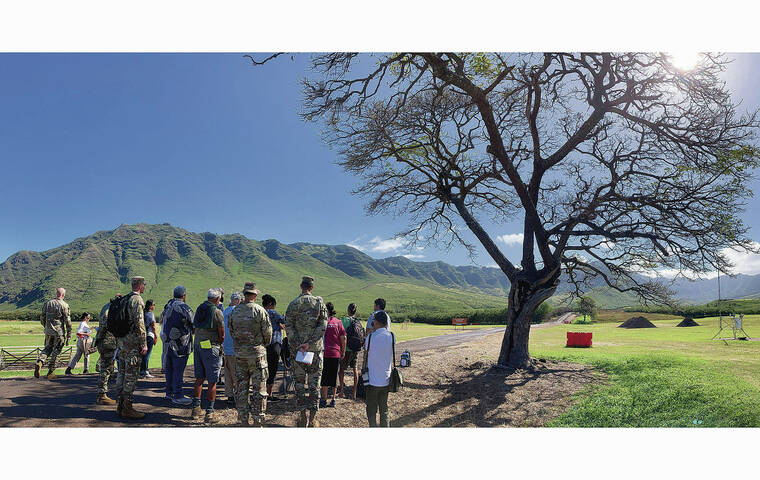
An advisory council primarily composed of Native Hawaiians has been established to assist Governor Josh Green in negotiating Army leases on Oahu and Hawaii Island that are due to expire in 2029. The members of this council were announced on Thursday and include representatives from various sectors, such as state government, nonprofit organizations, and the private sector.
Key figures on the council include William Aila Jr., a member of Hui Malama ‘O Makua; Scott Glenn, a senior adviser to Governor Green; and Ryan Kanaka‘ole, the deputy director of the state Department of Land and Natural Resources. Other notable members are Kuhio Lewis, CEO of the Hawaiian Council; Laurie McAllister Moore, executive director of the Military and Community Relations Office; and Mahina Paishon-Duarte, co-founder of the Waiwai Collective.
The leases in question were originally acquired by the Army in 1964 for the nominal fee of $1 and cover various locations, including Kahuku, Kawailoa-Poamoho, and Makua Valley. Governor Green has proposed a deal valued at $10 billion if the federal government opts for condemnation to extend military use of these state lands rather than pursuing new leases through the state Board of Land and Natural Resources. This alternative would bypass the requirement for environmental reviews and public input, which have been contentious issues in the past.
The state has already seen the Board of Land and Natural Resources reject the Army’s final environmental impact statements this year. Following this, Dan Driscoll, Secretary of the Army, indicated a possible shift towards condemnation, prompting consultations between his office and the U.S. Department of Justice regarding the Army’s legal rights to training lands in Hawaii.
Aila, who previously served as chair of the Board of Land and Natural Resources, is advocating for the federal government to return Makua Valley to the state and to fund its cleanup and management. He expressed concern that executive orders from former President Donald Trump could potentially seize state land for national security purposes.
On October 29, Governor Green’s office submitted a formal proposal to Secretary Driscoll that included a variety of initiatives. These proposals suggest giving the state an underutilized federal detention center in Honolulu, aiding in the expansion of housing in Hawaii by 6,500 new units, and increasing Medicare reimbursements. The proposal also emphasizes the need for energy solutions, such as investing in geothermal and liquefied natural gas projects to lower electricity costs in Hawaii.
The advisory council’s formation comes amid a broader discussion about the balance between military requirements and cultural preservation. In a statement, Governor Green highlighted the need for a dialogue that respects both national security and cultural stewardship. He stated, “Hawai‘i stands at an important crossroads — between national security and cultural stewardship; between federal authority and our responsibility to care for cultural and natural resources.”
In a recent letter dated November 7, Kaiali‘i Kahele, chair of the Office of Hawaiian Affairs (OHA) board of trustees, urged Governor Green to engage in “genuine consultation” with the Native Hawaiian community. Kahele emphasized that such discussions would enhance the state’s negotiating position and help ensure fair compensation for the use of public lands. He noted that the expiration of the current military leases represents a unique opportunity to restore balance and address historical inequities.
The OHA board has voted to ask the state legislature to propose a constitutional amendment for the 2026 ballot to prohibit live-fire military training on public trust lands, while still allowing other compatible training activities. Additionally, OHA plans to hold community meetings to gauge public sentiment regarding military lease negotiations, with the first meeting scheduled for November 26 at the University of Hawaii at Hilo.
Kahele asserted the importance of including Native Hawaiians in discussions about land use, stating, “The state constitution requires that Native Hawaiians and OHA not only be considered and consulted but also compensated for any use of lands of the public lands trust.”
In line with this initiative, OHA has established a website where individuals can learn about the history and context of military land leases in Hawaii. The site allows for anonymous input on military land leases, with the goal of fostering a more inclusive dialogue around this critical issue. For more information, individuals can visit oha.org/aloha-aina.

Hit-Boy Reveals Top 20 Nas Songs, Celebrating Hip-Hop’s Revival

Trump Issues Ultimatum to Maduro; Venezuela Closes Airspace

Evanescence Announces 2026 World Tour, Bay Area Date Set!

World CopperSmith and Anna Dinger Unveil Stunning Kitchen Renovation

Fever’s Candlelight Concerts Offer Up to 30% Off for Cyber Monday

Prepare for Tooth Extraction: Key Steps for a Smooth Process

Thomas University Celebrates New Inductees into Beta Beta Beta Honor Society

NYPD Officer Accidentally Maced During Immigration Protests in NYC

Macaque Monkeys Prove They Can Tap to the Beat of Music

New ‘Star Trek: Voyager’ Game Demo Released, Players Test Limits

Global Air Forces Ranked by Annual Defense Budgets in 2025

ALMA Discovers Companion Orbiting Giant Red Star π 1 Gruis

Mass Production of F-35 Fighter Jet Drives Down Costs

Electrification Challenges Demand Advanced Multiphysics Modeling

Gold Investment Surge: Top Mutual Funds and ETF Alternatives

Time Crystals Revolutionize Quantum Computing Potential

DirecTV to Launch AI-Driven Ads with User Likenesses in 2026

Freeport Art Gallery Transforms Waste into Creative Masterpieces
-
 Top Stories2 months ago
New ‘Star Trek: Voyager’ Game Demo Released, Players Test Limits
-
 World2 months ago
Global Air Forces Ranked by Annual Defense Budgets in 2025
-
 Science2 weeks ago
ALMA Discovers Companion Orbiting Giant Red Star π 1 Gruis
-
 World2 months ago
Mass Production of F-35 Fighter Jet Drives Down Costs
-
 World2 months ago
Electrification Challenges Demand Advanced Multiphysics Modeling
-
 Business2 months ago
Gold Investment Surge: Top Mutual Funds and ETF Alternatives
-
 Science2 months ago
Time Crystals Revolutionize Quantum Computing Potential
-
 Top Stories2 months ago
DirecTV to Launch AI-Driven Ads with User Likenesses in 2026
-
 Entertainment2 months ago
Freeport Art Gallery Transforms Waste into Creative Masterpieces
-

 Business2 months ago
US Government Denies Coal Lease Bid, Impacting Industry Revival Efforts
-

 Health2 months ago
Gavin Newsom Critiques Trump’s Health and National Guard Plans
-

 Politics1 month ago
SEVENTEEN’s Mingyu Faces Backlash Over Alcohol Incident at Concert