
Science
Darwin’s Address Book Reveals Hidden Aspects of His Life

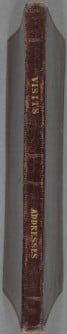
The National University of Singapore (NUS) has unveiled Charles Darwin’s personal Address Book, providing unprecedented insights into the life and work of the renowned scientist. Published for the first time, this small leather notebook, which spans just 48 pages, contains approximately 500 entries that chronicle Darwin’s personal and professional connections.
This Address Book, initiated by Darwin’s wife, Emma Darwin, shortly after their marriage in January 1839, serves as a window into the couple’s life in London. Following their relocation to Down in 1842, Darwin continued to add entries throughout his lifetime. The project has meticulously transcribed and edited Darwin’s often difficult-to-read handwriting, making these details more accessible to the public.
Rich Historical Context
What sets this Address Book apart is its inclusion of entries that do not appear in the extensive Darwin correspondence, which comprises around 15,000 letters. Although many letters have survived, it is essential to recognize that numerous others have been lost over time. This new publication reveals a network that includes not only scientists and intellectuals but also tradespeople and businesses, enriching our understanding of Darwin’s social interactions.
Among the notable entries are references to articles from the Gardeners’ Chronicle, recipes for rat poison and cleaning animal skeletons, and even a request for a fireworks display for his village. The Address Book also holds entries for medical treatments, a lawn mower, and a washing machine, showcasing the practical aspects of Darwin’s daily life.
Connections to Prominent Figures
The notebook reveals connections to significant historical figures. Entries include details about pigeon breeders, Darwin’s tailors, and even the optician who supplied eyewear to Queen Victoria. One particularly intriguing entry is for Alfred Russel Wallace’s shipping agent in Singapore, highlighting Wallace’s role in the development of evolutionary theory alongside Darwin.
This connection is especially poignant, as Wallace independently formulated a similar theory of evolution by natural selection. Their ideas were presented together to the scientific community in 1858, marking a pivotal moment in the history of science.
Dr. John van Wyhe, a historian of science at NUS, emphasized the importance of this discovery, noting that it reveals fascinating new insights into Darwin’s life and methodology. He remarked, “It’s incredible that this little treasure-trove of details by Darwin has remained unpublished until now.”
The Address Book has been preserved since Darwin’s death, initially kept within the family and later transferred to the Cambridge University Library in 1942. In 1948, it was deemed more suitable for public exhibition at Down House, where it remains today.
Since 2005, the Darwin Online project, originally based at the University of Cambridge and now at NUS, has worked diligently to digitize Darwin’s extensive archive. The Address Book is now available for public viewing, further enriching our understanding of one of history’s most influential scientists.
For those interested in exploring Darwin’s Address Book, it can be accessed online through the Darwin Online project. This publication offers not just a list of names and addresses, but an intimate portrayal of the personal and professional network that shaped Charles Darwin’s life and work.

Uber Driver Shot in Head Released from Hospital, Police Confirm

Orono Seeks Public Input on Urgent $11.6M Funding Plan

USDA Reviews All Programs to Restrict Food Stamp Access

Ancient Shell Trumpets Unveil Prehistoric Communication Methods

Lane Kiffin Leaves Ole Miss for LSU Amid Fan Backlash

Pope Leo XIV Visits Turkey and Lebanon, Promotes Faith and Unity

Chicago Homeowners Face Rising Property Taxes as Deadline Nears

Judi Dench Shares Struggles with Vision Loss Due to AMD

Seagate Unveils 6.9TB Platters, Promises 69TB Drives by 2030

New ‘Star Trek: Voyager’ Game Demo Released, Players Test Limits

Global Air Forces Ranked by Annual Defense Budgets in 2025

ALMA Discovers Companion Orbiting Giant Red Star π 1 Gruis

Mass Production of F-35 Fighter Jet Drives Down Costs

Electrification Challenges Demand Advanced Multiphysics Modeling

Gold Investment Surge: Top Mutual Funds and ETF Alternatives

Time Crystals Revolutionize Quantum Computing Potential

DirecTV to Launch AI-Driven Ads with User Likenesses in 2026

Freeport Art Gallery Transforms Waste into Creative Masterpieces
-
 Top Stories2 months ago
New ‘Star Trek: Voyager’ Game Demo Released, Players Test Limits
-
 World2 months ago
Global Air Forces Ranked by Annual Defense Budgets in 2025
-
 Science2 weeks ago
ALMA Discovers Companion Orbiting Giant Red Star π 1 Gruis
-
 World2 months ago
Mass Production of F-35 Fighter Jet Drives Down Costs
-
 World2 months ago
Electrification Challenges Demand Advanced Multiphysics Modeling
-
 Business2 months ago
Gold Investment Surge: Top Mutual Funds and ETF Alternatives
-
 Science2 months ago
Time Crystals Revolutionize Quantum Computing Potential
-
 Top Stories2 months ago
DirecTV to Launch AI-Driven Ads with User Likenesses in 2026
-
 Entertainment2 months ago
Freeport Art Gallery Transforms Waste into Creative Masterpieces
-

 Politics1 month ago
SEVENTEEN’s Mingyu Faces Backlash Over Alcohol Incident at Concert
-

 Business2 months ago
US Government Denies Coal Lease Bid, Impacting Industry Revival Efforts
-

 Health2 months ago
Gavin Newsom Critiques Trump’s Health and National Guard Plans