
Lifestyle
Nevada Red Fir Makes History as U.S. Capitol Christmas Tree

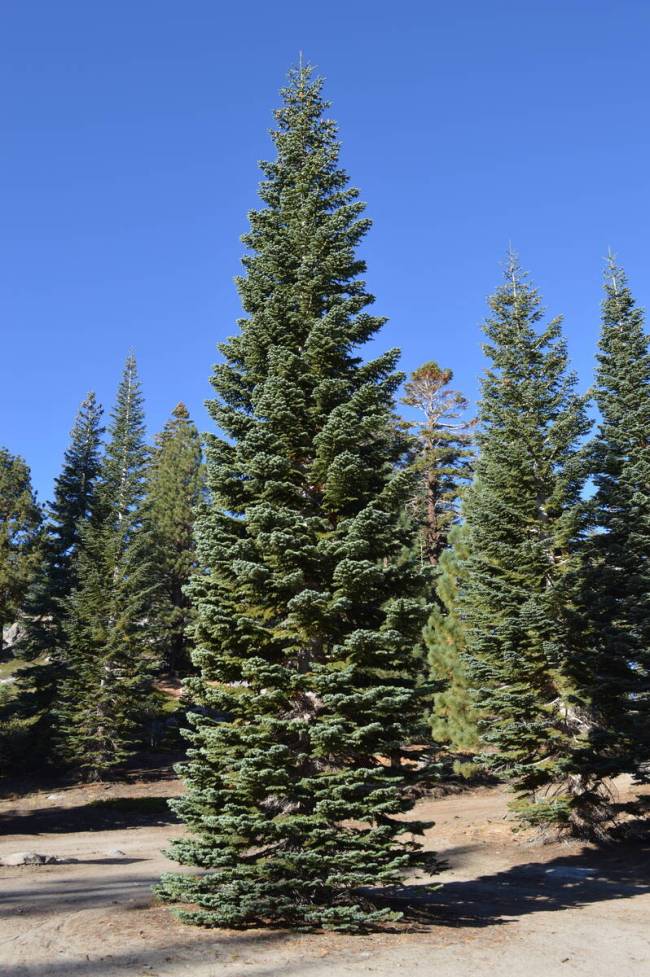
This holiday season, for the first time in its 55-year history, the U.S. Capitol Christmas tree will feature a Nevada red fir, affectionately named “Silver Belle.” Standing at an impressive 53 feet tall and estimated to be around 100 years old, this tree was harvested from the Carson Ranger District of the Humboldt-Toiyabe National Forest, which spans over 400,000 acres in northern Nevada and eastern California.
The selection of “Silver Belle” comes after a careful consideration process led by Jim Kaufmann, executive director of the Capitol Grounds and Arboretum at the Architect of the Capitol. The tree was chosen for its striking blue-green foliage and robust branches, ideal for displaying ornaments. Kaufmann also evaluated several trees from the Spring Mountains near Las Vegas before finalizing the decision.
The harvesting of the tree took place at the end of October, specifically from the Mount Rose area near Reno, which sits at an elevation of approximately 8,000 feet. Mark Amodei, the representative for Nevada’s 2nd Congressional District, participated in the early selection stages. He expressed his excitement, stating, “It was like, ‘There you go. That’s a perfect Christmas tree right there.’”
The history of this red fir tree is deeply intertwined with Nevada’s past. According to Amodei, logging in the region began more than 160 years ago, spurred by the discovery of the Comstock Lode. This led to significant deforestation, primarily for railroad construction, which was largely facilitated by Chinese immigrants. Today, the forest around “Silver Belle” has rebounded, featuring not only red firs but also other species such as Western white pine and sugar pine.
Symbol of Collaboration and Environmental Stewardship
The selection of “Silver Belle” highlights a collaborative effort among various stakeholders, including state, federal, tribal, and local partners. Kacey KC, Nevada’s state forester and firewarden, emphasized the importance of these partnerships in caring for the state’s landscapes. “Thanks to our Shared Stewardship Agreement, these partnerships are stronger than ever,” she said, underscoring their role in protecting the area from recent wildfires.
Professor Megan Lahti from Truckee Meadows Community College noted that red firs are not only significant during the holiday season but also serve ecological functions. The trees provide habitat and food for various wildlife, including martens, woodpeckers, and deer. Despite their resilience, red firs face threats from climate change, drought, and human encroachment.
The tree was transported to Washington, D.C., on a custom-built trailer designed to keep it healthy and hydrated during its journey. It first made its public appearance at the Nevada Day celebration in Carson City on November 1, before touring several other cities, including Lovelock and Las Vegas.
Festive Celebrations and Community Engagement
“Silver Belle” will be adorned with 10,000 locally crafted ornaments and will be officially lit on December 2, 2023, during a ceremony on the West Lawn of the U.S. Capitol. This year’s lighting ceremony will feature Grady Armstrong, a fourth-grade student from Virginia City, who won the U.S. Capitol Christmas tree essay contest. He will join Speaker of the House Mike Johnson to read his winning essay, which reflects the spirit of Nevada.
As the holiday season unfolds, the selection of a Nevada tree as the U.S. Capitol Christmas tree serves as a reminder of the importance of public lands. Olivia Tanager, director of the Sierra Club’s Toiyabe Chapter, remarked, “This tree should remind our leaders that the movement to protect our forests, waters, and open spaces is vast, growing, and unstoppable.”
The tradition of the U.S. Capitol Christmas tree began in 1963, initially featuring a live tree planted on the Capitol grounds. However, after a windstorm damaged the original Douglas fir in 1967, the program transitioned to selecting trees from national forests across the country.
As Nevada celebrates the presence of “Silver Belle” in Washington, it not only highlights the beauty of the state’s natural resources but also brings attention to the ongoing efforts needed to protect and preserve them for future generations.

USTR Confirms Urgent Agreement on Pharma Pricing with UK

Transform: Auto Launches in Europe to Drive Supplier Decarbonization

CD Projekt Red Reveals Disappointing Update on The Witcher 4

Researchers Discover New Material to Treat Urinary Incontinence

dōTERRA Launches Together Touch Blend to Boost Global Giving

Researchers Develop Advanced Algorithm for Spacecraft Control

Virginia High School Football Semifinals Scheduled for Saturday

Central Indiana Faces Hazardous Snowfall: 2-4 Inches Expected Tonight

CSS Women’s Hockey Falls 3-1 to UW-Eau Claire in Urgent Showdown

New ‘Star Trek: Voyager’ Game Demo Released, Players Test Limits

Global Air Forces Ranked by Annual Defense Budgets in 2025

ALMA Discovers Companion Orbiting Giant Red Star π 1 Gruis

Mass Production of F-35 Fighter Jet Drives Down Costs

Electrification Challenges Demand Advanced Multiphysics Modeling

Gold Investment Surge: Top Mutual Funds and ETF Alternatives

Time Crystals Revolutionize Quantum Computing Potential

DirecTV to Launch AI-Driven Ads with User Likenesses in 2026

Freeport Art Gallery Transforms Waste into Creative Masterpieces
-
 Top Stories2 months ago
New ‘Star Trek: Voyager’ Game Demo Released, Players Test Limits
-
 World2 months ago
Global Air Forces Ranked by Annual Defense Budgets in 2025
-
 Science2 weeks ago
ALMA Discovers Companion Orbiting Giant Red Star π 1 Gruis
-
 World2 months ago
Mass Production of F-35 Fighter Jet Drives Down Costs
-
 World2 months ago
Electrification Challenges Demand Advanced Multiphysics Modeling
-
 Business2 months ago
Gold Investment Surge: Top Mutual Funds and ETF Alternatives
-
 Science2 months ago
Time Crystals Revolutionize Quantum Computing Potential
-
 Top Stories2 months ago
DirecTV to Launch AI-Driven Ads with User Likenesses in 2026
-
 Entertainment2 months ago
Freeport Art Gallery Transforms Waste into Creative Masterpieces
-

 Business2 months ago
US Government Denies Coal Lease Bid, Impacting Industry Revival Efforts
-

 Health2 months ago
Gavin Newsom Critiques Trump’s Health and National Guard Plans
-

 Lifestyle2 months ago
Discover Reese Witherspoon’s Chic Dining Room Style for Under $25