
Politics
North Dakota Governor Calls for Sabotage Vigilance Amid War Declaration

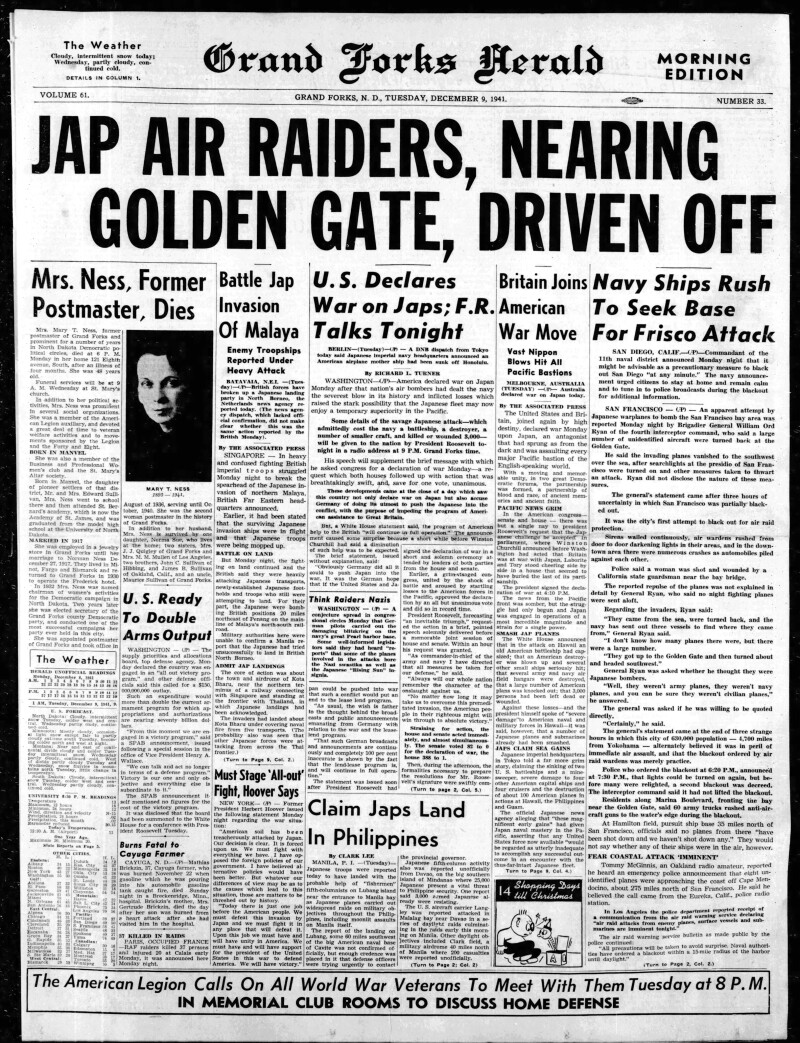
On December 9, 1941, North Dakota Governor John Moses urged citizens to remain vigilant against potential sabotage by Japanese agents following Japan’s formal declaration of war against the United States. In a statement reflecting the gravity of the situation, Moses emphasized the importance of unity and preparedness in the face of threats to transportation facilities and vital infrastructure.
In response to the war declaration, Moses swiftly took action by deploying members of the state highway patrol to guard critical structures, including the Bismarck-Mandan bridge. He also coordinated with Thomas Moodie, the North Dakota administrator of the Works Progress Administration (WPA), to secure Bismarck airport, where approximately $60,000 worth of materials were allocated for improvement projects.
Immediate Defense Measures Launched
Governor Moses highlighted the necessity for immediate defense measures, stating, “While there is no indication of any sabotage attempts likely to be made at present in North Dakota by Japanese agents, we should realize that in the past Japan has struck without warning.” Citing historical precedents, he noted that Japan’s military actions during the Russo-Japanese War and its invasion of Manchuria occurred without prior announcements.
In light of the growing threat, Moses announced plans to establish a voluntary Home Guard to protect essential wartime facilities. He indicated that he would consult with Adjutant General Heber L. Edwards regarding the formation of this guard, especially since the state had been without one since the national guard was called into service.
Coordination with Federal Authorities
The urgency of the situation was underscored by a communication from Secretary of War Henry L. Stimson, who advised Moses to prepare state guard forces to cooperate with federal troops in safeguarding critical infrastructure. This included transportation facilities that are essential to national defense efforts.
Adjutant General Edwards confirmed that plans were underway to organize a guard quickly, emphasizing that enlistment would be voluntary. He stated, “We will ask federal troops to guard transportation facilities as was done in 1917.” Discussions about the state guard organization involved various officials, including C. E. Dresser, state commander of the Veterans of Foreign Wars, and Brigadier General L. R. Baird, executive officer of the state defense council.
As North Dakota mobilized its resources in response to the escalating war, Governor Moses’s call to action highlighted the critical need for community vigilance and preparedness. The measures taken on this day served as a reminder of the broader implications of global conflict, even in the heart of the American prairies.

Germany’s Trade Surplus Soars to €16.9 Billion in October

Urgent: New Berkeley Jewelry Studio Hit by $10K Burglary

Recognizing Dementia Signs While Shopping: Key Symptoms to Watch For

Navigating Friendships and Gift-Giving in Challenging Times

North Dakota Governor Calls for Sabotage Vigilance Amid War Declaration

Mars Time Dilation: How Your Clock Would Tick Faster on the Red Planet

Eagles Fall to Chargers 22-19 as Hurts Struggles in Overtime

Victorian Premier Apologizes to First Peoples for Colonization

Viewing and Funeral for Officer Andy Chan Scheduled Next Week

ALMA Discovers Companion Orbiting Giant Red Star π 1 Gruis

New ‘Star Trek: Voyager’ Game Demo Released, Players Test Limits

SEVENTEEN’s Mingyu Faces Backlash Over Alcohol Incident at Concert

Global Air Forces Ranked by Annual Defense Budgets in 2025

Mass Production of F-35 Fighter Jet Drives Down Costs

Electrification Challenges Demand Advanced Multiphysics Modeling

Gold Investment Surge: Top Mutual Funds and ETF Alternatives

Time Crystals Revolutionize Quantum Computing Potential

DirecTV to Launch AI-Driven Ads with User Likenesses in 2026
-
 Science4 weeks ago
ALMA Discovers Companion Orbiting Giant Red Star π 1 Gruis
-
 Top Stories2 months ago
New ‘Star Trek: Voyager’ Game Demo Released, Players Test Limits
-
 Politics2 months ago
SEVENTEEN’s Mingyu Faces Backlash Over Alcohol Incident at Concert
-
 World2 months ago
Global Air Forces Ranked by Annual Defense Budgets in 2025
-
 World2 months ago
Mass Production of F-35 Fighter Jet Drives Down Costs
-
 World2 months ago
Electrification Challenges Demand Advanced Multiphysics Modeling
-
 Business2 months ago
Gold Investment Surge: Top Mutual Funds and ETF Alternatives
-
 Science2 months ago
Time Crystals Revolutionize Quantum Computing Potential
-
 Top Stories2 months ago
DirecTV to Launch AI-Driven Ads with User Likenesses in 2026
-

 Entertainment2 months ago
Freeport Art Gallery Transforms Waste into Creative Masterpieces
-

 Business2 months ago
US Government Denies Coal Lease Bid, Impacting Industry Revival Efforts
-

 Health2 months ago
Gavin Newsom Critiques Trump’s Health and National Guard Plans