
Science
Interstellar Comet 3I/ATLAS Approaches Earth, Revealing New Details

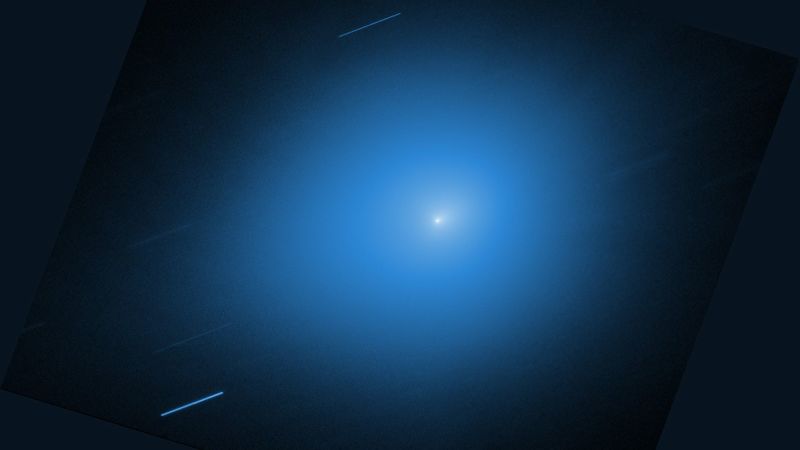
The interstellar comet 3I/ATLAS is making headlines as it nears its closest approach to Earth, scheduled for December 19, 2023. Recent observations from the Hubble Space Telescope and the European Space Agency‘s Juice mission have provided new images and insights into this fascinating celestial object, which was discovered in July 2023 while traveling through our solar system.
Discovered just a few months ago, 3I/ATLAS is only the third confirmed interstellar object to be observed in our celestial neighborhood. This has led astronomers to focus multiple missions on the comet to gather critical data regarding its trajectory and composition. Notably, Hubble captured images of 3I/ATLAS shortly after its discovery, revealing its distinctive teardrop shape.
New Observations Shed Light on the Comet’s Features
On November 30, 2023, Hubble observed the comet again when it was approximately 178 million miles (about 286 million kilometers) from Earth. Utilizing its Wide Field Camera 3, astronomers were able to obtain an even clearer image of the comet. The data from these observations are crucial for understanding the comet’s behavior and its interaction with solar radiation.
The Juice mission, which launched in April 2023 and is en route to study Jupiter and its largest moons, also took advantage of its position to capture images of 3I/ATLAS. At the beginning of November, Juice was around 41 million miles (approximately 66 million kilometers) from the comet. The spacecraft employed five scientific instruments, including its onboard Navigation Camera, to gather data on the comet’s activity, especially during its close pass by the sun.
Despite the distance, Juice managed to transmit a portion of an image showcasing the comet’s coma—a glowing halo of gas—and two distinct tails: a plasma tail made of electrically charged gas and a faint dust tail of solid particles. This activity underlines the dynamic nature of comets as they approach the sun, where heat causes volatile materials to sublimate.
Safe Approach and Future Insights
Comet 3I/ATLAS will not pose any threat to Earth during its closest approach, which will occur on the opposite side of the sun, at a distance of 167 million miles (around 270 million kilometers). For perspective, Earth is located about 93 million miles (approximately 150 million kilometers) from the sun.
NASA anticipates that the comet will remain visible to telescopes and space missions for several months before it exits our solar system. The complete data set from Juice, including images from its high-resolution optical camera and information about the comet’s composition, is expected to arrive on Earth between February 18 and 20, 2024. This data could provide further insights into the origins of this intriguing interstellar visitor.
As scientists continue to study 3I/ATLAS, they hope to glean knowledge not only about the comet itself but also about the conditions of the early solar system and beyond. The ongoing observations from both Hubble and Juice mark a significant moment in our understanding of interstellar objects and their role in cosmic history.

U.S. Proposes New Social Media Disclosure for Visa Waiver Travelers

Mars’ Influence on Earth’s Climate Revealed in New Research

Urgent: Man Arrested for Attempted Murder in Gilroy Safeway Stabbing

Urgent: 28 Dogs Rescued from Cruel Conditions in Windsor Home

OpenAI’s Sam Altman Claims He Can’t Parent Without ChatGPT

Verdigris Falls to Holland Hall in First-Round Playoff Loss

49ers Eye Playoffs: The Winning Formula for Final Games

Bali Police Arrest British Sex Worker Bonnie Blue Amid Controversy

Biggby Coffee Recognizes Barista of the Year: A Story of Connection

ALMA Discovers Companion Orbiting Giant Red Star π 1 Gruis

New ‘Star Trek: Voyager’ Game Demo Released, Players Test Limits

SEVENTEEN’s Mingyu Faces Backlash Over Alcohol Incident at Concert

Global Air Forces Ranked by Annual Defense Budgets in 2025

Mass Production of F-35 Fighter Jet Drives Down Costs

Electrification Challenges Demand Advanced Multiphysics Modeling

Gold Investment Surge: Top Mutual Funds and ETF Alternatives

Time Crystals Revolutionize Quantum Computing Potential

DirecTV to Launch AI-Driven Ads with User Likenesses in 2026
-
 Science4 weeks ago
ALMA Discovers Companion Orbiting Giant Red Star π 1 Gruis
-
 Top Stories2 months ago
New ‘Star Trek: Voyager’ Game Demo Released, Players Test Limits
-
 Politics2 months ago
SEVENTEEN’s Mingyu Faces Backlash Over Alcohol Incident at Concert
-
 World2 months ago
Global Air Forces Ranked by Annual Defense Budgets in 2025
-
 World2 months ago
Mass Production of F-35 Fighter Jet Drives Down Costs
-
 World2 months ago
Electrification Challenges Demand Advanced Multiphysics Modeling
-
 Business2 months ago
Gold Investment Surge: Top Mutual Funds and ETF Alternatives
-
 Science2 months ago
Time Crystals Revolutionize Quantum Computing Potential
-
 Top Stories2 months ago
DirecTV to Launch AI-Driven Ads with User Likenesses in 2026
-

 Entertainment2 months ago
Freeport Art Gallery Transforms Waste into Creative Masterpieces
-

 Health2 months ago
Gavin Newsom Critiques Trump’s Health and National Guard Plans
-

 Business2 months ago
US Government Denies Coal Lease Bid, Impacting Industry Revival Efforts