
Science
Korea Sets First National Standards for Ultra High-Voltage DC Systems

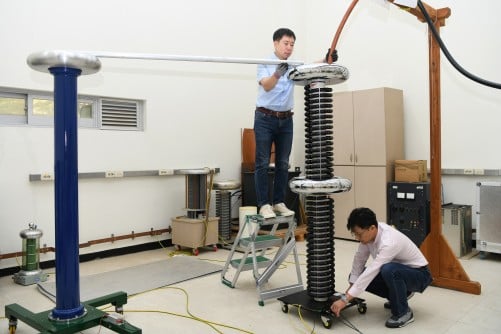
The Korea Research Institute of Standards and Science (KRISS) has made a significant advancement by establishing Korea’s first national standards for High Voltage Direct Current (HVDC) transmission systems. This initiative aims to enhance the reliability of performance verification for these systems, which are crucial for the nation’s energy infrastructure.
With the new standards in place, KRISS will commence calibration and testing services for national power authorities and related industries. HVDC technology is pivotal for transmitting electricity over long distances and large capacities, offering improved efficiency compared to conventional systems. Voltage levels are classified into three categories: high voltage (30–220 kV), extra-high voltage (300–1000 kV), and ultra-high voltage (above 1000 kV).
Korea’s newly established measurement standards encompass significant voltage classes, including 600-kV for high-voltage direct current, 800-kV for lightning impulse testing, and 700-kV for switching impulse measurements. These benchmarks not only facilitate accurate evaluations of ultra-high-voltage power equipment but are also expected to bolster the manufacturing quality and export competitiveness of domestic heavy electrical equipment companies.
The introduction of these standards comes at a crucial time as the Korean government, during the first National Power Grid Committee meeting in October 2023, identified the development of the HVDC industry as a core strategy for creating an “energy superhighway.” This initiative aims to efficiently deliver electricity from non-metropolitan regions to high-demand urban centers.
Historically, the lack of national measurement standards for ultra-high-voltage testing has hindered Korean companies from certifying product performance and entering global markets. All heavy electrical equipment necessary for HVDC systems must comply with performance tests stipulated by the International Electrotechnical Commission (IEC). Without domestic standards, local firms often relied on overseas calibration bodies for necessary evaluations, complicating their market access.
To overcome these barriers, the Quantum Electricity and Magnetism Metrology Group at KRISS has developed new ultra-high-voltage measurement standards specifically designed for HVDC systems. This initiative involved expanding the existing DC high-voltage standard from 200 kV to 600 kV, effectively tripling the measurement range available for performance testing.
These standards serve as critical references for withstand voltage tests, which ascertain whether power equipment can maintain stability under voltages exceeding normal operational conditions for specified durations. Additionally, KRISS has instituted standards for 800-kV lightning impulse tests and 700-kV switching impulse tests. Lightning impulse testing simulates the extreme voltages caused by lightning strikes, while switching impulse tests replicate the transient overvoltages occurring during the operation of large power equipment.
The establishment of these standards allows for testing and calibration of ultra-high-voltage equipment according to IEC specifications. This capability enables companies to perform tests at their convenience, significantly reducing the time required for product commercialization and facilitating quicker responses to market demands.
Dr. Lee Hyung Kew, Head of the Quantum Electricity and Magnetism Metrology Group at KRISS, highlighted the importance of this development. He stated, “Based on the newly established standards, KRISS has begun providing calibration services for HVDC testing equipment at KEPCO’s Gochang Electric Power Testing Center and at ILJIN Electric. We will continue to develop the ultra-high-voltage measurement standards needed by Korea’s power industry, contributing to the stability of the national grid and strengthening industrial competitiveness.”
This initiative has received support from the Ministry of Science and ICT (MSIT) under the national R&D program aimed at establishing a top-level measurement system and standard framework for intelligent power grids. As Korea positions itself at the forefront of energy transmission technology, these standards play a vital role in enhancing the nation’s electrical infrastructure and economic competitiveness in the global market.

Dallas Pension Vote Sparks Outrage Among First Responders

Urgent: Winter Weather Advisory Issued for South Central PA

ECB Confirms Current Interest Rates Are Appropriate as Year Ends

Debate Dynamics: Bregman and Haaland Gear Up for Gubernatorial Race

University of Arizona Identifies Key Immune Cell Linked to Fibrosis

Titans Lead 2026 NFL Draft Race, Raiders and Saints Lurk Behind

Delta A350 Diverts to Tokyo After Hydraulic Emergency Mid-Flight

Zacks Research Lowers Earnings Forecast for Avanos Medical

“All’s Fair Season 1 Episode 7 to Release on December 2, 2025”

New ‘Star Trek: Voyager’ Game Demo Released, Players Test Limits

Global Air Forces Ranked by Annual Defense Budgets in 2025

ALMA Discovers Companion Orbiting Giant Red Star π 1 Gruis

Mass Production of F-35 Fighter Jet Drives Down Costs

Electrification Challenges Demand Advanced Multiphysics Modeling

Gold Investment Surge: Top Mutual Funds and ETF Alternatives

Time Crystals Revolutionize Quantum Computing Potential

DirecTV to Launch AI-Driven Ads with User Likenesses in 2026

Freeport Art Gallery Transforms Waste into Creative Masterpieces
-
 Top Stories2 months ago
New ‘Star Trek: Voyager’ Game Demo Released, Players Test Limits
-
 World2 months ago
Global Air Forces Ranked by Annual Defense Budgets in 2025
-
 Science2 weeks ago
ALMA Discovers Companion Orbiting Giant Red Star π 1 Gruis
-
 World2 months ago
Mass Production of F-35 Fighter Jet Drives Down Costs
-
 World2 months ago
Electrification Challenges Demand Advanced Multiphysics Modeling
-
 Business2 months ago
Gold Investment Surge: Top Mutual Funds and ETF Alternatives
-
 Science2 months ago
Time Crystals Revolutionize Quantum Computing Potential
-
 Top Stories2 months ago
DirecTV to Launch AI-Driven Ads with User Likenesses in 2026
-
 Entertainment2 months ago
Freeport Art Gallery Transforms Waste into Creative Masterpieces
-

 Business2 months ago
US Government Denies Coal Lease Bid, Impacting Industry Revival Efforts
-

 Health2 months ago
Gavin Newsom Critiques Trump’s Health and National Guard Plans
-

 Lifestyle2 months ago
Discover Reese Witherspoon’s Chic Dining Room Style for Under $25