
Science
Mars’ Influence on Earth’s Climate Revealed in New Research

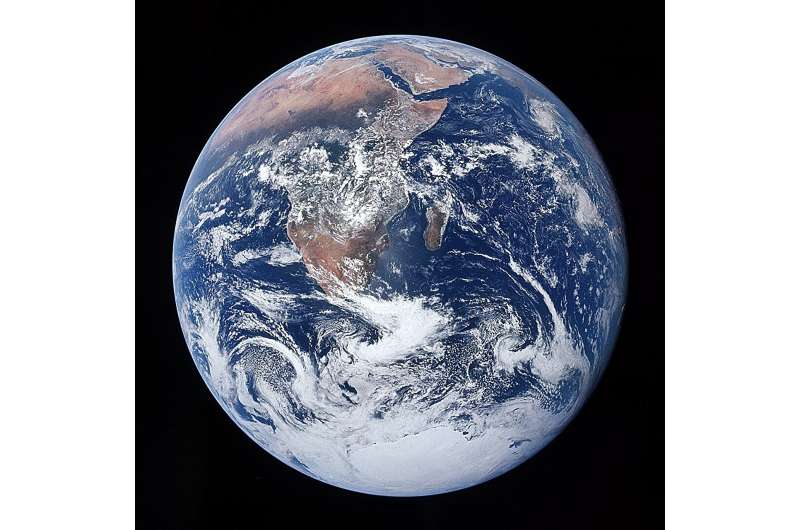
Researchers have uncovered new insights into how Mars influences Earth’s climate, revealing that the Red Planet plays a significant role in the delicate balance of climate cycles on our planet. A study led by Stephen Kane utilized computer simulations to explore the effects of varying Mars’s mass on Earth’s orbital variations over millions of years. The findings, released on December 10, 2025, highlight the importance of Mars alongside larger planets such as Jupiter and Venus in shaping Earth’s climate patterns.
Understanding the Role of Mars
The study focuses on the Milankovitch cycles, which describe the natural variations in Earth’s orbit and axial tilt that drive climate changes, including ice ages and warmer periods. These cycles are influenced by the gravitational forces exerted by other celestial bodies. While the effects of Jupiter and Venus have been well-documented, Kane’s research reveals that Mars, despite its smaller size, has a surprisingly potent impact on Earth’s climate rhythms.
The researchers varied Mars’s mass in their simulations, ranging from zero to ten times its current mass, to observe how these changes affected the climate cycles on Earth. The most consistent feature across all simulations was the 405,000-year eccentricity cycle, primarily driven by interactions between Venus and Jupiter. This cycle serves as a foundational rhythm for Earth’s climate variations.
However, the simulations indicated that the shorter cycles, approximately 100,000 years in duration, which correlate with ice age transitions, are significantly influenced by Mars’s mass. As Mars’s mass increases in the models, the length and intensity of these cycles also increase, indicating a stronger gravitational coupling among the inner planets.
Long-Term Climate Patterns and Implications
Perhaps the most striking finding was the disappearance of a crucial climate pattern when Mars’s mass was reduced to zero. The 2.4 million-year “grand cycle,” which governs long-term climate shifts, only exists due to Mars’s gravitational resonance. This cycle, tied to the slow rotation of Earth’s and Mars’s orbits, affects the amount of sunlight Earth receives over extensive periods.
Additionally, the research highlighted the influence of Mars on Earth’s axial tilt, or obliquity. The familiar 41,000-year cycle noted in geological records lengthens as Mars becomes more massive. With a Mars ten times its current weight, this cycle could shift to a dominant period of 45,000 to 55,000 years, significantly altering the patterns of ice sheet growth and retreat.
The implications of this research extend beyond Earth, offering valuable insights into the habitability of exoplanets. A terrestrial planet with a substantial neighboring body in the right orbital configuration may experience climate variations that could either prevent extreme conditions or facilitate environments conducive to life.
In conclusion, this study underscores that Earth’s Milankovitch cycles are shaped not only by the interactions between our planet and the sun but also by the gravitational influences of its planetary neighbors, with Mars playing an unexpectedly vital role. The research was documented in the paper titled “The Dependence of Earth Milankovitch Cycles on Martian Mass,” available on the arXiv preprint server.

Krispy Kreme Offers Dozen Doughnuts for $1 on One Day Only

Stanley Roberts Discusses “People Behaving Badly” on 102.9 Radio

Identify Flu or COVID-19: Key Symptoms for Differentiation

Ohio Homeless Services Face Funding Cuts Despite Rising Demand

US Plans New Social Media Screening for Visa Waiver Travelers

Researchers Identify Protein Linked to Necroptosis, Paving Way for Treatments

New Social Media Screening for Visa-Free Travelers to the US

Electric School Bus Fire in Los Angeles Hospitalizes Driver

Alabama Thoroughbred Owners Push to Revive Racing After 30 Years

ALMA Discovers Companion Orbiting Giant Red Star π 1 Gruis

New ‘Star Trek: Voyager’ Game Demo Released, Players Test Limits

SEVENTEEN’s Mingyu Faces Backlash Over Alcohol Incident at Concert

Global Air Forces Ranked by Annual Defense Budgets in 2025

Mass Production of F-35 Fighter Jet Drives Down Costs

Electrification Challenges Demand Advanced Multiphysics Modeling

Gold Investment Surge: Top Mutual Funds and ETF Alternatives

Time Crystals Revolutionize Quantum Computing Potential

DirecTV to Launch AI-Driven Ads with User Likenesses in 2026
-
 Science4 weeks ago
ALMA Discovers Companion Orbiting Giant Red Star π 1 Gruis
-
 Top Stories2 months ago
New ‘Star Trek: Voyager’ Game Demo Released, Players Test Limits
-
 Politics2 months ago
SEVENTEEN’s Mingyu Faces Backlash Over Alcohol Incident at Concert
-
 World2 months ago
Global Air Forces Ranked by Annual Defense Budgets in 2025
-
 World2 months ago
Mass Production of F-35 Fighter Jet Drives Down Costs
-
 World2 months ago
Electrification Challenges Demand Advanced Multiphysics Modeling
-
 Business2 months ago
Gold Investment Surge: Top Mutual Funds and ETF Alternatives
-
 Science2 months ago
Time Crystals Revolutionize Quantum Computing Potential
-
 Top Stories2 months ago
DirecTV to Launch AI-Driven Ads with User Likenesses in 2026
-

 Entertainment2 months ago
Freeport Art Gallery Transforms Waste into Creative Masterpieces
-

 Business2 months ago
US Government Denies Coal Lease Bid, Impacting Industry Revival Efforts
-

 Health2 months ago
Gavin Newsom Critiques Trump’s Health and National Guard Plans