
Science
New Grading System Enhances Prognosis for Pancreatic Cancer Patients

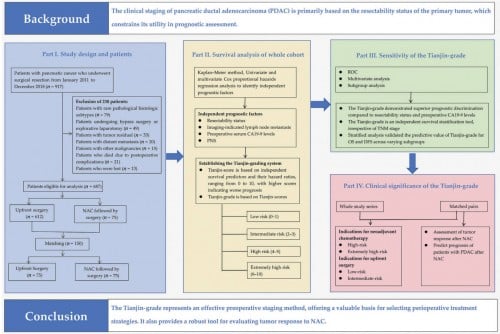
Pancreatic ductal adenocarcinoma (PDAC) presents significant challenges in treatment due to its aggressive nature and the limitations of existing prognostic tools. Traditional staging systems, such as the TNM classification, primarily focus on anatomical factors, leaving a gap in comprehensive patient prognosis. A new grading system developed by researchers at the Tianjin Medical University Cancer Institute & Hospital aims to fill this void by integrating anatomical, biological, and patient condition factors, offering a more nuanced approach to managing PDAC.
The Tianjin Grading System, published on March 15, 2025, in the journal Cancer Biology & Medicine, enhances patient risk stratification through the inclusion of critical elements like lymph node metastasis and serum CA19-9 levels. This holistic framework is based on a retrospective study involving 687 PDAC patients who underwent surgical resection, demonstrating its potential to refine clinical decision-making and improve survival outcomes.
Revolutionizing Patient Assessment
The Tianjin Grading System categorizes patients into four distinct risk groups: low-risk (0-1), intermediate-risk (2-3), high-risk (4-5), and extremely high-risk (6-10). Each group exhibits significantly divergent survival outcomes, underscoring the system’s capacity to predict overall survival (OS) and disease-free survival (DFS) more effectively than traditional methods. Notably, those classified as high- and extremely high-risk showed substantial benefits from neoadjuvant chemotherapy (NAC), which can be critical in tailoring treatment strategies.
Dr. Jihui Hao, a lead researcher on the project, stated, “The Tianjin Grading System offers a more accurate way of predicting outcomes for PDAC patients by integrating not just anatomical factors but also biological and patient-specific conditions.” This comprehensive assessment enables healthcare professionals to ascertain which patients are more likely to benefit from aggressive treatments, thereby paving the way for personalized care strategies.
The study highlighted that incorporating factors such as tumor resectability, imaging-detected lymph node metastasis, serum markers like CA19-9, and the Prognostic Nutritional Score (PNS) can significantly enhance the prognostic accuracy for patients. This multifaceted approach allows clinicians to better guide treatment decisions, ensuring that high-risk patients receive timely interventions while avoiding overtreatment for low-risk individuals.
Implications for Clinical Practice
The implications of the Tianjin Grading System extend beyond improved prognostication. By providing a clearer framework for assessing patient conditions, it can influence critical decisions regarding upfront surgery and the timing of NAC. The accessibility of the system, which relies on standard imaging and laboratory tests, makes it a practical tool for various clinical settings, including those with limited resources.
This innovative grading system represents a significant advancement in the personalized care of pancreatic cancer patients. By refining the assessment of PDAC, it has the potential to improve survival rates for high-risk individuals and enhance the overall quality of care. The research was supported by the Tianjin Natural Science Foundation, and the findings advocate for a shift towards more integrated approaches in cancer treatment.
As cancer research continues to evolve, the Tianjin Grading System stands out as a promising development, offering hope for better outcomes in one of the most challenging cancer types.

Trump’s Redistricting Push Fails as Indiana Senators Rebel

Tech Sector Declines Weighs on U.S. Stock Market Performance

Caitlin Clark Returns to Competitive Play with USA Basketball

U.S. Immigrant Faces Deportation After Documenting Uyghur Camps

Southwest Airlines Partners with Austin to Create 2,000 Local Jobs

Timothée Chalamet Sparks Rumors with EsDeeKid Connection

Caitlin Clark Returns to USA Basketball After 5-Month Absence

Urgent: Fatal Stabbing in Compton Leaves Community Reeling

Father Receives Son’s Brain in Error from San Jose Mortuary

ALMA Discovers Companion Orbiting Giant Red Star π 1 Gruis

SEVENTEEN’s Mingyu Faces Backlash Over Alcohol Incident at Concert

New ‘Star Trek: Voyager’ Game Demo Released, Players Test Limits

Global Air Forces Ranked by Annual Defense Budgets in 2025

Electrification Challenges Demand Advanced Multiphysics Modeling

Mass Production of F-35 Fighter Jet Drives Down Costs

Gold Investment Surge: Top Mutual Funds and ETF Alternatives

Time Crystals Revolutionize Quantum Computing Potential

DirecTV to Launch AI-Driven Ads with User Likenesses in 2026
-
 Science4 weeks ago
ALMA Discovers Companion Orbiting Giant Red Star π 1 Gruis
-
 Politics2 months ago
SEVENTEEN’s Mingyu Faces Backlash Over Alcohol Incident at Concert
-
 Top Stories2 months ago
New ‘Star Trek: Voyager’ Game Demo Released, Players Test Limits
-
 World2 months ago
Global Air Forces Ranked by Annual Defense Budgets in 2025
-
 World2 months ago
Electrification Challenges Demand Advanced Multiphysics Modeling
-
 World2 months ago
Mass Production of F-35 Fighter Jet Drives Down Costs
-
 Business2 months ago
Gold Investment Surge: Top Mutual Funds and ETF Alternatives
-
 Science2 months ago
Time Crystals Revolutionize Quantum Computing Potential
-
 Top Stories2 months ago
DirecTV to Launch AI-Driven Ads with User Likenesses in 2026
-

 Entertainment2 months ago
Freeport Art Gallery Transforms Waste into Creative Masterpieces
-

 Health2 months ago
Gavin Newsom Critiques Trump’s Health and National Guard Plans
-

 Business2 months ago
US Government Denies Coal Lease Bid, Impacting Industry Revival Efforts