
Science
Researchers Identify Promising Super-Earth for Life Search

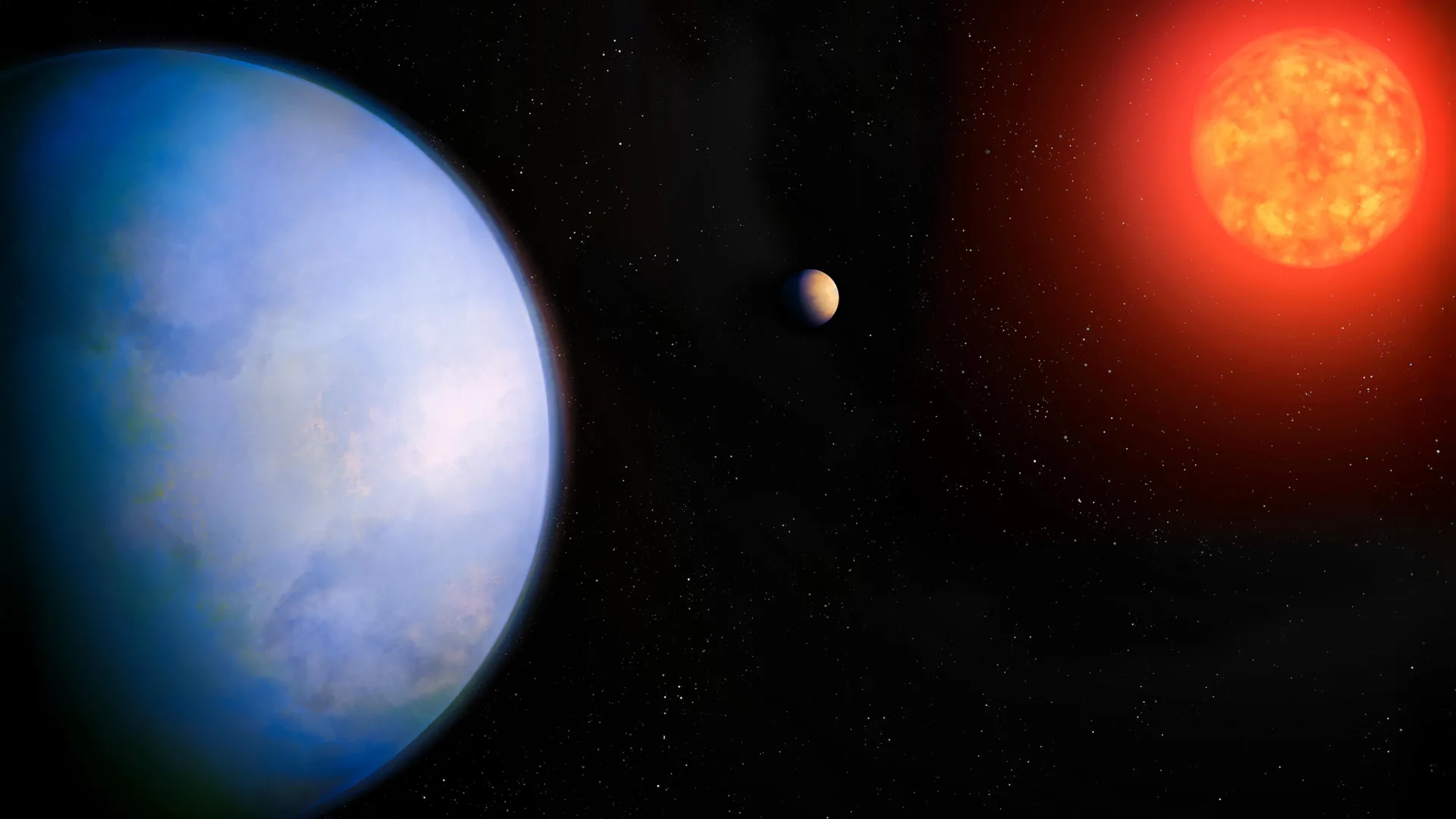
Researchers from the University of California, Irvine have identified a super-Earth, designated GJ 251 c, located within the habitable zone of an M-dwarf star just 18 light-years from Earth. This discovery, detailed in a recent paper published in The Astronomical Journal, suggests that the planet may possess the conditions necessary for liquid water, which is essential for life as we know it.
The habitable zone is the region around a star where temperatures are conducive to water remaining in liquid form. GJ 251 c, which is several times more massive than Earth, shows promise due to its rocky composition, similar to our planet. Co-author Paul Robertson, an associate professor of physics and astronomy at UC Irvine, emphasized the significance of the planet’s proximity, stating, “Cosmically speaking, it’s practically next door.”
Characteristics of GJ 251 c
GJ 251 c orbits a type of star that is both common and ancient in our galaxy—the M-dwarf. These stars are known for their stellar activity, which includes phenomena such as starspots and flares. Such activity can complicate the detection of orbiting planets by mimicking the subtle signals researchers typically seek. Despite these challenges, the planet’s close distance makes it a prime candidate for future observational studies.
The Thirty Meter Telescope, currently under development, aims to use its large mirrors to directly image distant exoplanets like GJ 251 c. Lead author Corey Beard, a data scientist at Design West Technologies and former graduate student in Robertson’s group, noted, “TMT will be the only telescope with sufficient resolution to image exoplanets like this one. It’s just not possible with smaller telescopes.”
Detection and Future Research
The research team utilized advanced instruments, including the Habitable-zone Planet Finder and NEID, to detect the gravitational influence of GJ 251 c on its star. These precision tools measure the minuscule changes in the star’s light caused by the planet’s pull. The Habitable-zone Planet Finder is particularly effective in observing in the infrared spectrum, where the disruptive signals from stellar activity are diminished.
Despite the promising data, the team acknowledges the need for advanced telescopes to confirm the planet’s characteristics. Beard expressed the importance of community support, stating, “While its discovery is quite statistically significant, we are still determining the status of the planet due to the uncertainty of our instruments and methods.”
The findings highlight the potential for GJ 251 c to be a focal point for future exoplanet research, especially as next-generation telescopes like the Thirty Meter Telescope approach operational status. Collaborators on this study include researchers from Pennsylvania State University, UCLA, and other respected institutions.
The research received funding from the National Science Foundation under grant number AST-2108493, as well as support from NASA and the NN-EXPLORE program. As astronomers continue to explore the cosmos, GJ 251 c stands out as a promising candidate in the ongoing search for extraterrestrial life.

Suspect Shot After Using Employee as Shield in Houston Robbery

Unlock Fitness Potential: Top Weighted Vest Deals for Cyber Monday

Essential Gear Guide for Night Photographers This Holiday Season

Pennsylvania Grant Fuels 40 New Affordable Homes in North Philadelphia

Researchers Spotlight Non-Timber Products to Fund Reforestation

UCLA’s Scooter Jackson Enters Transfer Portal as Offseason Begins

Study Reveals Spices Like Cinnamon and Turmeric Impact Medications

Tragic Crash Claims Life of 21-Year-Old in Comanche County

New York Governor Hochul Signs Bill for Holocaust Memorial Today

New ‘Star Trek: Voyager’ Game Demo Released, Players Test Limits

Global Air Forces Ranked by Annual Defense Budgets in 2025

ALMA Discovers Companion Orbiting Giant Red Star π 1 Gruis

Mass Production of F-35 Fighter Jet Drives Down Costs

Electrification Challenges Demand Advanced Multiphysics Modeling

Gold Investment Surge: Top Mutual Funds and ETF Alternatives

Time Crystals Revolutionize Quantum Computing Potential

DirecTV to Launch AI-Driven Ads with User Likenesses in 2026

Freeport Art Gallery Transforms Waste into Creative Masterpieces
-
 Top Stories2 months ago
New ‘Star Trek: Voyager’ Game Demo Released, Players Test Limits
-
 World2 months ago
Global Air Forces Ranked by Annual Defense Budgets in 2025
-
 Science2 weeks ago
ALMA Discovers Companion Orbiting Giant Red Star π 1 Gruis
-
 World2 months ago
Mass Production of F-35 Fighter Jet Drives Down Costs
-
 World2 months ago
Electrification Challenges Demand Advanced Multiphysics Modeling
-
 Business2 months ago
Gold Investment Surge: Top Mutual Funds and ETF Alternatives
-
 Science2 months ago
Time Crystals Revolutionize Quantum Computing Potential
-
 Top Stories2 months ago
DirecTV to Launch AI-Driven Ads with User Likenesses in 2026
-
 Entertainment2 months ago
Freeport Art Gallery Transforms Waste into Creative Masterpieces
-

 Business2 months ago
US Government Denies Coal Lease Bid, Impacting Industry Revival Efforts
-

 Politics1 month ago
SEVENTEEN’s Mingyu Faces Backlash Over Alcohol Incident at Concert
-

 Health2 months ago
Gavin Newsom Critiques Trump’s Health and National Guard Plans