
Science
Researchers Spotlight Non-Timber Products to Fund Reforestation

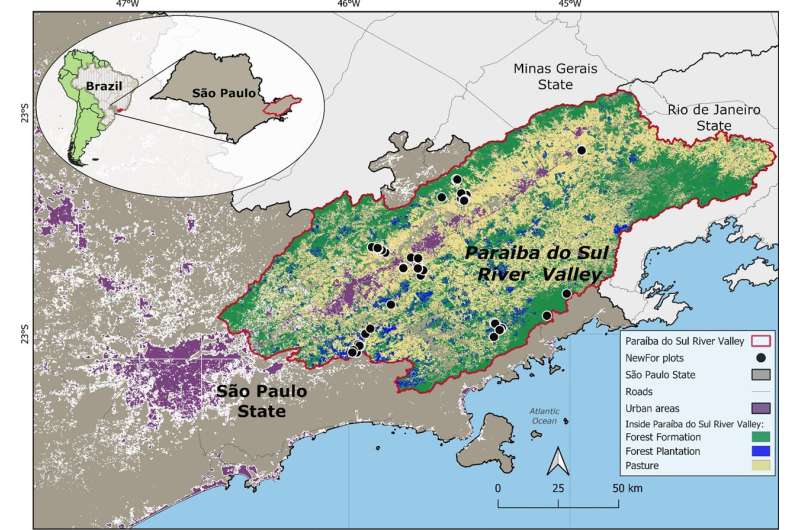
The growing cost of forest restoration has prompted researchers to explore innovative financing solutions. A study from a team at the University of São Paulo (USP) suggests that leveraging non-timber forest products can provide a viable income source for reforestation projects. Their findings, published in the journal Ambio, highlight the potential of these products to support sustainable forest management while preserving biodiversity.
In their analysis, the researchers focused on the Paraíba do Sul Valley, a region straddling the states of São Paulo, Minas Gerais, and Rio de Janeiro. They examined 46 forest plots, each measuring 900 square meters, totaling an area of 41,400 square meters. Their research identified 329 tree species, of which 283 were native. Remarkably, 59%, or 167 species, demonstrated significant bioeconomic potential.
According to Pedro Medrado Krainovic, the lead author of the study, “The advantage of non-timber product management is that it’s based on the collection of leaves, branches, seeds, and fruits, constituting non-destructive management.” This approach not only preserves the forest but also provides medium-term economic benefits.
The researchers highlighted that of the species with bioeconomic potential, 58% have medical uses, 12% serve cosmetic purposes, and 5% are suitable for food. However, only 13% of the studies have progressed to the final product stage. Prominent species studied included the araucaria (Araucaria angustifolia) and juçara (Euterpe edulis), both recognized for their food contributions.
The study also evaluated global patent registrations related to the identified species, revealing that 78 species have patents filed in 61 countries. However, only 8% of these patents are registered in Brazil. Krainovic noted, “The number of patents is evidence of the economic potential of these species.” This data suggests significant commercial interest and opportunities for further research and development.
Exploiting non-timber products can offset restoration costs, especially since valuable timber species require long growth periods. With strict regulations under the Brazilian Forest Code prohibiting timber extraction in permanent preservation areas, the sustainable management of non-timber resources can provide essential funding for reforestation efforts. This approach also enhances the multifunctionality of forests, which play critical roles in water supply, soil protection, carbon sequestration, and pollination.
The researchers emphasized that the ultimate goal of ecosystem restoration is to restore ecosystem services, which can also benefit agricultural activities. They argue that finding sustainable ways to finance these projects can make restoration efforts more appealing to rural producers.
Reforestation initiatives utilizing native species are known to create numerous jobs, many of which do not require formal qualifications. A 2022 study published in the People and Nature journal estimated that Brazil could generate 2.5 million jobs if it achieves the Paris Agreement target of restoring 12 million hectares by 2030. Some of the authors of the current study contributed to this earlier research.
While the exploitation of forest resources can offer economic benefits, it is crucial to manage these activities carefully to avoid overexploitation. For instance, the rosewood (Aniba rosaeodora), valued for its essential oil in perfumes, faced severe depletion in the mid-20th century and is now threatened with extinction.
The researchers propose additional measures such as public procurement, certification, and policy reforms to develop sustainable markets for non-timber products. They suggest cross-referencing data on species abundance, potential uses, and existing patents to guide future restoration projects across different Brazilian biomes.
In summary, the study presents non-timber forest products as a promising avenue for financing reforestation while promoting biodiversity and sustainable forest management. As Krainovic concludes, integrating economic and ecological values can enhance the effectiveness of restoration efforts.

Suspect Shot After Using Employee as Shield in Houston Robbery

Unlock Fitness Potential: Top Weighted Vest Deals for Cyber Monday

Essential Gear Guide for Night Photographers This Holiday Season

Pennsylvania Grant Fuels 40 New Affordable Homes in North Philadelphia

Researchers Spotlight Non-Timber Products to Fund Reforestation

UCLA’s Scooter Jackson Enters Transfer Portal as Offseason Begins

Study Reveals Spices Like Cinnamon and Turmeric Impact Medications

Tragic Crash Claims Life of 21-Year-Old in Comanche County

New York Governor Hochul Signs Bill for Holocaust Memorial Today

New ‘Star Trek: Voyager’ Game Demo Released, Players Test Limits

Global Air Forces Ranked by Annual Defense Budgets in 2025

ALMA Discovers Companion Orbiting Giant Red Star π 1 Gruis

Mass Production of F-35 Fighter Jet Drives Down Costs

Electrification Challenges Demand Advanced Multiphysics Modeling

Gold Investment Surge: Top Mutual Funds and ETF Alternatives

Time Crystals Revolutionize Quantum Computing Potential

DirecTV to Launch AI-Driven Ads with User Likenesses in 2026

Freeport Art Gallery Transforms Waste into Creative Masterpieces
-
 Top Stories2 months ago
New ‘Star Trek: Voyager’ Game Demo Released, Players Test Limits
-
 World2 months ago
Global Air Forces Ranked by Annual Defense Budgets in 2025
-
 Science2 weeks ago
ALMA Discovers Companion Orbiting Giant Red Star π 1 Gruis
-
 World2 months ago
Mass Production of F-35 Fighter Jet Drives Down Costs
-
 World2 months ago
Electrification Challenges Demand Advanced Multiphysics Modeling
-
 Business2 months ago
Gold Investment Surge: Top Mutual Funds and ETF Alternatives
-
 Science2 months ago
Time Crystals Revolutionize Quantum Computing Potential
-
 Top Stories2 months ago
DirecTV to Launch AI-Driven Ads with User Likenesses in 2026
-
 Entertainment2 months ago
Freeport Art Gallery Transforms Waste into Creative Masterpieces
-

 Business2 months ago
US Government Denies Coal Lease Bid, Impacting Industry Revival Efforts
-

 Politics1 month ago
SEVENTEEN’s Mingyu Faces Backlash Over Alcohol Incident at Concert
-

 Health2 months ago
Gavin Newsom Critiques Trump’s Health and National Guard Plans