
Science
Researchers Uncover Ancient Roman Stairway in Pompeii’s Ruins

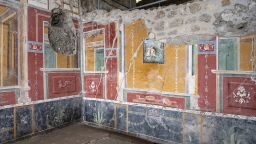
Nearly 2,000 years after the catastrophic eruption of Mount Vesuvius, researchers have made significant advancements in revealing the “lost Pompeii.” Using innovative digital archaeology techniques, a team has uncovered an ancient Roman stairway, shedding light on the architectural landscape of this once-thriving city. The eruption in AD 79 buried Pompeii under a thick layer of ash and debris, preserving it in a state that has fascinated archaeologists since excavations began in 1748.
Archaeological efforts have revealed numerous buildings and artifacts, yet many structures remain elusive. The recent findings, part of the Pompeii Reset project, combine remote sensing technology and traditional archaeological methods to explore previously hidden aspects of the city. As co-lead study author Dr. Susanne Muth from Humboldt University of Berlin noted, “By reconstructing the lost architecture, we gain a more nuanced and historically accurate understanding of the ancient city and life within it.”
Digital Techniques Unveil Hidden Structures
The Pompeii Reset project employs advanced techniques such as LiDAR (light detection and ranging) technology and close-range photography to document the remains of Pompeii’s buildings. These methods allow researchers to create detailed 3D models of structures, revealing clues about missing components. For instance, in the Casa del Tiaso, also known as the House of the Thiasos, a monumental stone staircase leading to a second floor was discovered. Indentations on the walls suggested the existence of a second wooden staircase, possibly leading to a third floor, which researchers now believe may have functioned as a tower.
Gabriel Zuchtriegel, director of the Archaeological Park of Pompeii, emphasized the significance of these findings. He explained that volcanic debris buried Pompeii under approximately five meters of ash, with visible upper floors emerging from the surrounding material. Previous studies focused primarily on the ground floors, often overlooking the upper structures that housed wealthier citizens.
Reconstructing Pompeii’s Architectural Heritage
The Casa del Tiaso exemplifies the luxurious living conditions of the elite in Pompeii. This grand residence likely belonged to an influential family, featuring large banquet rooms and a private thermal bath complex. During the Roman era, towers were a common architectural feature in country villas, used for entertaining guests and providing panoramic views of the surrounding landscape. Pliny the Younger, a renowned Roman writer, described such towers in his own villa.
Despite the historical significance, towers have rarely been documented in urban settings like Pompeii, as houses were typically expansive rather than vertically oriented. The discovery of potential towers in the Casa del Tiaso challenges previous assumptions about the architectural landscape of Pompeii. Dr. Muth noted that these findings indicate that wealthy homeowners may have sought to replicate the grandeur of country villas within the city.
Further investigations revealed that residents returned to the ruins of Pompeii several decades after the eruption of AD 79. This subsequent occupation resulted in the establishment of makeshift structures, with former ground floors converted into cellars for ovens and mills. However, these later inhabitants ultimately abandoned the site following another eruption in the fifth century.
Digital archaeology has transformed the study of ancient structures, allowing researchers to create accurate reconstructions. The use of drones for scanning, along with photogrammetry, enables the production of detailed 3D models. This process is crucial for understanding how these buildings were constructed and how they functioned within the urban environment.
Dr. Muth described the meticulous nature of digital reconstruction, stating, “We proceed very cautiously, discuss a lot, test a proposal, reject it again, correct it, discover new clues…” This thorough approach ensures that the models created are not only visually accurate but also reflect the historical context of the site.
While the archaeological park has excavated over 13,000 rooms since 1748, approximately one-third of ancient Pompeii remains buried. Zuchtriegel emphasized the importance of preserving these sites for future generations, stating that the goal is not to excavate every aspect of Pompeii but to leave something for posterity. The application of digital tools is an essential strategy for monitoring conservation efforts and understanding how ancient structures were utilized.
The recent discoveries in Pompeii illustrate the dynamic interplay between technology and archaeology. By reconstructing the architectural heritage of this ancient city, researchers not only enhance our understanding of Roman life but also highlight the innovative spirit of its inhabitants. As Dr. Muth expressed, these findings will help to generate new questions and insights about daily life in Pompeii, enriching our knowledge of this remarkable civilization.

Kim Soo Hyun’s Fans Launch Urgent Support Effort Amid Crisis

Shedeur Sanders Shines With Historic Performance in NFL Debut

Flooding Damages Hundreds of Artifacts at Paris’s Louvre Museum

Respiree Gains Approval for AI Tool to Detect Patient Deterioration

Explore 10 Unforgettable Crime Epics That Redefine Cinema

Community Unites at Sun Santa Family Christmas Party to Spread Joy

Russian Official Praises Trump’s ‘Strong’ Strategy Amid Ukraine Talks

Trump Launches Unexpected Attack on Pardoned Democrat Cuellar

Two Arrested After High-Speed 120 MPH Chase in Osseo

ALMA Discovers Companion Orbiting Giant Red Star π 1 Gruis

New ‘Star Trek: Voyager’ Game Demo Released, Players Test Limits

SEVENTEEN’s Mingyu Faces Backlash Over Alcohol Incident at Concert

Global Air Forces Ranked by Annual Defense Budgets in 2025

Mass Production of F-35 Fighter Jet Drives Down Costs

Electrification Challenges Demand Advanced Multiphysics Modeling

Gold Investment Surge: Top Mutual Funds and ETF Alternatives

Time Crystals Revolutionize Quantum Computing Potential

DirecTV to Launch AI-Driven Ads with User Likenesses in 2026
-
 Science3 weeks ago
ALMA Discovers Companion Orbiting Giant Red Star π 1 Gruis
-
 Top Stories2 months ago
New ‘Star Trek: Voyager’ Game Demo Released, Players Test Limits
-
 Politics2 months ago
SEVENTEEN’s Mingyu Faces Backlash Over Alcohol Incident at Concert
-
 World2 months ago
Global Air Forces Ranked by Annual Defense Budgets in 2025
-
 World2 months ago
Mass Production of F-35 Fighter Jet Drives Down Costs
-
 World2 months ago
Electrification Challenges Demand Advanced Multiphysics Modeling
-
 Business2 months ago
Gold Investment Surge: Top Mutual Funds and ETF Alternatives
-
 Science2 months ago
Time Crystals Revolutionize Quantum Computing Potential
-
 Top Stories2 months ago
DirecTV to Launch AI-Driven Ads with User Likenesses in 2026
-

 Entertainment2 months ago
Freeport Art Gallery Transforms Waste into Creative Masterpieces
-

 Business2 months ago
US Government Denies Coal Lease Bid, Impacting Industry Revival Efforts
-

 Lifestyle2 months ago
Discover Reese Witherspoon’s Chic Dining Room Style for Under $25