
Science
Scientists Announce First Direct Evidence of Dark Matter via Gamma Rays

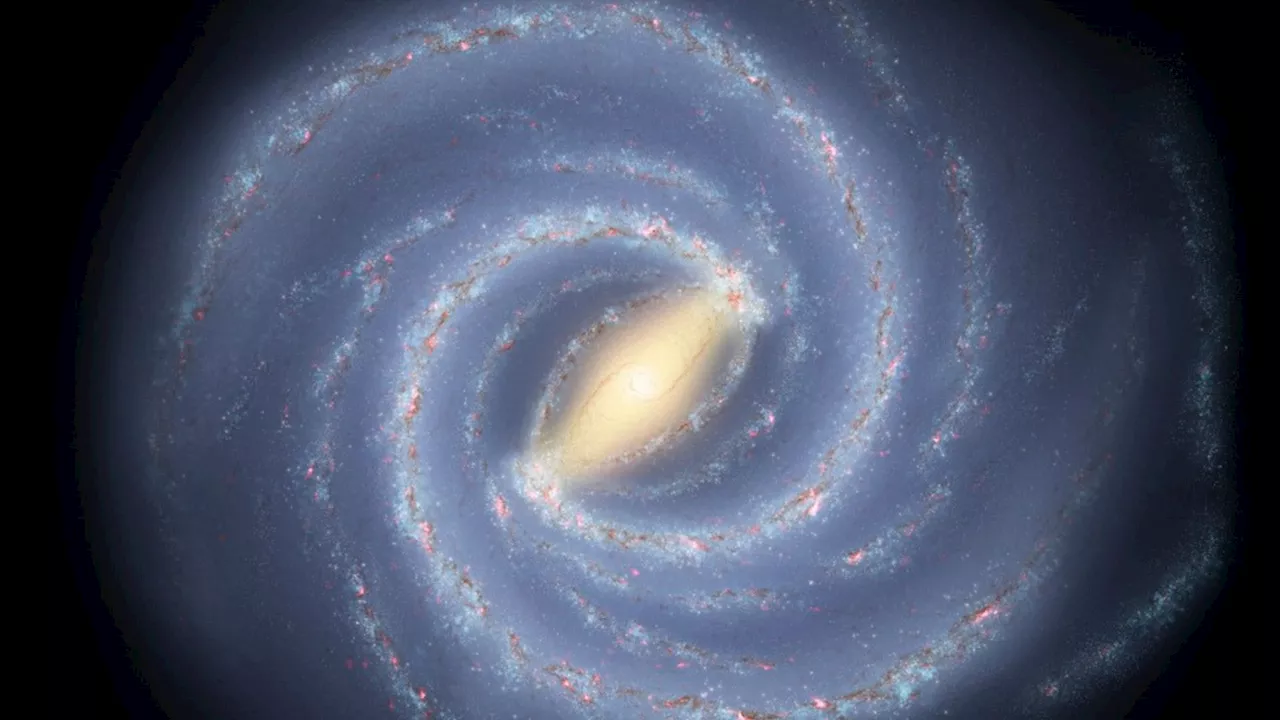
A groundbreaking discovery by a team from the University of Tokyo may have provided the first direct evidence of dark matter, a substance that has eluded scientists for decades. Using data from NASA’s Fermi Gamma-ray Space Telescope, the researchers identified gamma rays that align with predictions from theoretical models of dark matter particles, marking a potential milestone in our understanding of the universe.
Dark matter, which is thought to constitute approximately 85% of the universe’s mass, has long been inferred through its gravitational effects on visible matter. This invisible entity was first conceptualized in the early 1930s when Swiss astronomer Fritz Zwicky observed the unusual velocities of galaxies in the Coma cluster. He proposed the existence of “dunkle Materie,” or dark matter, to explain the missing gravitational forces necessary to hold galaxies together.
The recent findings, reported in the Journal of Cosmology and Astroparticle Physics on November 25, 2023, stem from an analysis of high-energy gamma rays detected from the center of the Milky Way. The observed gamma rays exhibited photon energy levels of 20 gigaelectronvolts, which the researchers believe to be indicative of interactions between Weakly Interacting Massive Particles (WIMPs), a leading candidate for dark matter composition.
Professor Tomonori Totani, from the Department of Astronomy at the University of Tokyo, emphasized the significance of this observation. “If this is correct, to the extent of my knowledge, it would mark the first time humanity has ‘seen’ dark matter,” he stated. The gamma-ray emissions were found to match the expected shape of a dark matter halo, reinforcing the hypothesis of its existence.
The implications of this research are profound. The energy spectrum observed not only aligns with theoretical predictions but also points to WIMPs having a mass around 500 times that of a proton. This correlation provides a precise fingerprint of the particles involved. Furthermore, the researchers noted that the radiation pattern does not readily correlate with known astronomical phenomena, such as supernovae or pulsars, adding weight to their claims of detecting dark matter.
Despite the excitement surrounding these findings, the scientific community approaches the results with caution. The data requires independent verification from other research groups to confirm the signals detected by the Fermi Telescope. Professor Totani has indicated that further validation may arise from detecting similar gamma-ray signals in other dark matter-rich areas, such as dwarf galaxies orbiting the Milky Way.
The prospect of finally uncovering the mysteries of dark matter could mark a significant advancement in both astronomy and physics. As scientists delve deeper into this enigmatic component of the universe, the potential to understand the fundamental structure of reality may be within reach.
For now, humanity stands on the brink of a new frontier in cosmic exploration, as the universe’s greatest secrets begin to reveal themselves.

Financial Stress Disrupts Sleep for Many Workers, Study Finds

TNA Poised to Announce New TV Deal with AMC for 2024

Obesity Linked to Accelerated Alzheimer’s Development via Blood Biomarkers

Local Families Seek Help This Holiday Season Through Christmas Fund

Veteran Protests Trump’s Flag Order by Burning Flag Near White House

Researchers Identify Key Mechanism in Human DNA Replication

Urgent: 5-Alarms Blaze Engulfs Homes in Queens, Injures Firefighter

Lexus Supercar Set for Unveiling This Friday in Japan

Connecticut State Police Urge Caution as Snow Hits Tuesday

ALMA Discovers Companion Orbiting Giant Red Star π 1 Gruis

New ‘Star Trek: Voyager’ Game Demo Released, Players Test Limits

Global Air Forces Ranked by Annual Defense Budgets in 2025

Mass Production of F-35 Fighter Jet Drives Down Costs

Electrification Challenges Demand Advanced Multiphysics Modeling

Gold Investment Surge: Top Mutual Funds and ETF Alternatives

Time Crystals Revolutionize Quantum Computing Potential

DirecTV to Launch AI-Driven Ads with User Likenesses in 2026

Freeport Art Gallery Transforms Waste into Creative Masterpieces
-
 Science3 weeks ago
ALMA Discovers Companion Orbiting Giant Red Star π 1 Gruis
-
 Top Stories2 months ago
New ‘Star Trek: Voyager’ Game Demo Released, Players Test Limits
-
 World2 months ago
Global Air Forces Ranked by Annual Defense Budgets in 2025
-
 World2 months ago
Mass Production of F-35 Fighter Jet Drives Down Costs
-
 World2 months ago
Electrification Challenges Demand Advanced Multiphysics Modeling
-
 Business2 months ago
Gold Investment Surge: Top Mutual Funds and ETF Alternatives
-
 Science2 months ago
Time Crystals Revolutionize Quantum Computing Potential
-
 Top Stories2 months ago
DirecTV to Launch AI-Driven Ads with User Likenesses in 2026
-
 Entertainment2 months ago
Freeport Art Gallery Transforms Waste into Creative Masterpieces
-

 Business2 months ago
US Government Denies Coal Lease Bid, Impacting Industry Revival Efforts
-

 Politics1 month ago
SEVENTEEN’s Mingyu Faces Backlash Over Alcohol Incident at Concert
-

 Health2 months ago
Gavin Newsom Critiques Trump’s Health and National Guard Plans