
World
Bill Gates Invests in Emission-Free Butter Production Breakthrough

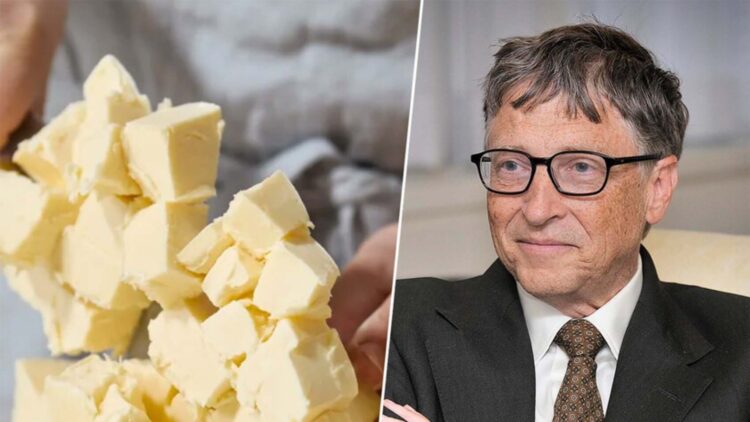
A revolutionary approach to food production has emerged with the introduction of lab-created butter, a project backed by investor Bill Gates. The company Savor, in partnership with Orca Sciences, has developed a method to produce butter that mirrors the taste and molecular structure of traditional butter while significantly reducing carbon emissions. This innovative process utilizes carbon dioxide from the air and hydrogen from water, aiming to create a sustainable alternative to conventional agriculture.
Researchers at the University of California, Irvine have validated this approach in their study published in the journal Nature Sustainability. Their findings indicate that this new method emits less than one-third of the greenhouse gases associated with traditional butter production. Lead author Steven Davis emphasized the potential environmental benefits, stating, “The synthesis of food without agricultural raw materials could prevent enormous amounts of emissions and protect the planet’s biodiverse lands.”
Transforming Food Production with Chemistry
Savor’s process not only aims to eliminate the need for livestock and farmland but also aspires to create a range of edible fats that could replace those found in meat, dairy, and palm oil. The production method is notable for its efficiency, converting CO2 and hydrogen into fats that are chemically identical to those derived from animals. This breakthrough could pave the way for a future where food is created without the adverse environmental impacts of conventional farming.
Bill Gates shared his enthusiasm for the project on his blog, highlighting that the production process “does not release greenhouse gases and uses less than one-thousandth of the water required by traditional agriculture.” He described it as a “sustainable, scalable, and delicious” alternative that could revolutionize how food is produced globally.
The vision behind Savor is to develop “farm-free” food, which would allow for the creation of fats and other foodstuffs using clean chemistry and scientific precision. As Professor Davis noted, “At any scale, this would ease the competition between ecosystems and agriculture,” suggesting a promising future where food production is decoupled from environmental degradation.
Challenges and Future Prospects
While the technology for this type of production is currently expensive, researchers remain optimistic about its potential for scalability. The process involves high pressures and temperatures, making the production of fats efficient, and if costs can be reduced, the global environmental and economic impact could be substantial.
The idea of producing food from air may once have seemed far-fetched, but advancements in biochemistry are making it a tangible reality. As Savor continues to refine its methods, the implications for sustainable food production are significant. If successful, this innovation could not only address food security issues but also contribute to a more sustainable future.
The potential of producing butter from CO2 raises intriguing possibilities for the future of food. With continued investment and research, lab-grown alternatives could become a staple in diets worldwide, reducing reliance on traditional agriculture and its associated environmental costs.

Japan’s PM Takaichi Vows Fiscal Management Amid Economic Shift

Bitcoin Plummets Below $88K Amid Tether Controversy

Tottenville Falls Short in PSAL 4A Title Game Against Erasmus

Shark Teeth Reveal Urgent Insights to Prevent Extinction Now

Englewood Church Members Rally After Thanksgiving Day Fire

Mayor Appoints Alan Wong as New District 4 Supervisor

UK Universities Embrace AI to Revolutionize Research Evaluation

Mikaela Shiffrin Claims 104th World Cup Victory at Copper Mountain

Trump Promises MRI Results Amid Uncertainty Over Scan Details

New ‘Star Trek: Voyager’ Game Demo Released, Players Test Limits

Global Air Forces Ranked by Annual Defense Budgets in 2025

Mass Production of F-35 Fighter Jet Drives Down Costs

ALMA Discovers Companion Orbiting Giant Red Star π 1 Gruis

Electrification Challenges Demand Advanced Multiphysics Modeling

Gold Investment Surge: Top Mutual Funds and ETF Alternatives

Time Crystals Revolutionize Quantum Computing Potential

DirecTV to Launch AI-Driven Ads with User Likenesses in 2026

Freeport Art Gallery Transforms Waste into Creative Masterpieces
-
 Top Stories2 months ago
New ‘Star Trek: Voyager’ Game Demo Released, Players Test Limits
-
 World2 months ago
Global Air Forces Ranked by Annual Defense Budgets in 2025
-
 World2 months ago
Mass Production of F-35 Fighter Jet Drives Down Costs
-
 Science2 weeks ago
ALMA Discovers Companion Orbiting Giant Red Star π 1 Gruis
-
 World2 months ago
Electrification Challenges Demand Advanced Multiphysics Modeling
-
 Business2 months ago
Gold Investment Surge: Top Mutual Funds and ETF Alternatives
-
 Science2 months ago
Time Crystals Revolutionize Quantum Computing Potential
-
 Top Stories2 months ago
DirecTV to Launch AI-Driven Ads with User Likenesses in 2026
-
 Entertainment2 months ago
Freeport Art Gallery Transforms Waste into Creative Masterpieces
-
 Business2 months ago
US Government Denies Coal Lease Bid, Impacting Industry Revival Efforts
-

 Health1 month ago
Gavin Newsom Critiques Trump’s Health and National Guard Plans
-

 Lifestyle1 month ago
Discover Reese Witherspoon’s Chic Dining Room Style for Under $25