
Science
Groundbreaking Discovery on Asteroid Bennu Reveals Life’s Building Blocks

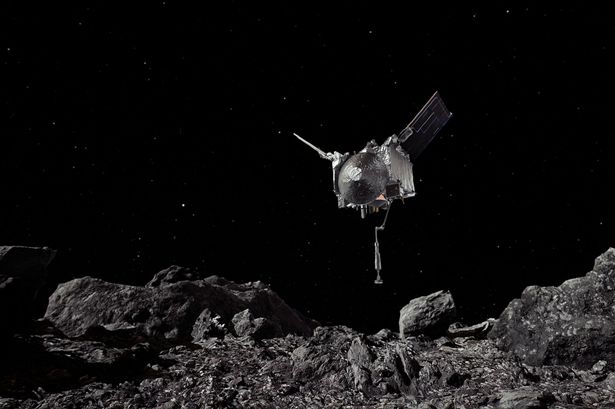
A recent analysis of samples retrieved from the asteroid Bennu has unveiled remarkable findings that could reshape our understanding of life’s origins in the universe. NASA successfully collected these samples approximately 63 million kilometers (or 39 million miles) away, revealing evidence of ancient water and organic compounds essential for life.
Astrophysicist and space communications expert Alexandra Doten shared this significant news through her popular TikTok channel, emphasizing the potential implications of these discoveries. Researchers from Tohoku University in Japan were instrumental in identifying sugars necessary for life within the asteroid sample, marking the first time such compounds have been detected in extraterrestrial material.
The findings indicate that the asteroid is rich in carbon and water, elements that suggest the presence of life’s building blocks. Doten elaborated on the composition of Bennu, stating, “They found some truly insane things. We already knew from this sample that the asteroid has high carbon content and water together – and together those indicate the building blocks for life as we know it.”
Key Discoveries on Bennu
Among the key findings, scientists discovered all five nucleotide bases that compose DNA and RNA. Additionally, they identified sugars crucial for biological processes, specifically ribose and glucose. Ribose is essential for RNA, indicating that Bennu may contain all necessary components for RNA formation. Doten noted, “This has huge implications – it could imply that RNA is more prevalent in the universe and could be the dominant form of early life.”
The asteroid’s surface also boasts a unique, flexible material, described by NASA as a “pliable substance similar to used gum or even a soft plastic.” This unexpected “space gum” was detailed in a study led by NASA’s Scott Sandford at the Ames Research Center in California, along with Zack Gainsforth from the University of California. The research highlights that exposure to radiation has rendered this material brittle, akin to a lawn chair left exposed to the sun.
Implications for Understanding Life in the Universe
In addition to the sugars and organic compounds, a third study led by Ann Nguyen from NASA’s Johnson Space Center in Houston revealed an unexpectedly high concentration of dust, traced back to supernova explosions predating our solar system. This dust could provide further insights into the conditions that led to the formation of planetary systems.
The implications of these discoveries extend beyond scientific curiosity; they may provide crucial information regarding the existence of life elsewhere in the universe. As Doten summarized, the findings from Bennu could revolutionize our understanding of how life began and evolved, not just on Earth, but potentially in other parts of the cosmos.
The results from these studies are published in the journal Natural Astronomy, showcasing the collaborative efforts of scientists dedicated to unraveling the mysteries of our universe. As researchers continue to analyze the samples from Bennu, the tantalizing possibility of uncovering more about the origins of life remains firmly on the horizon.

Robinhood Stock Surges 2.5% in Early Trading on March 17

Israel Intensifies Strikes as Global Energy Crisis Looms

CALV Offers Class on Communication Skills for Real Estate Professionals

Historic Bideford Pub Reopens as The Patch Wine Bar & Kitchen

Oscar Night Celebrations: Winners, Guests, and Exclusive After-Parties

Samsung Galaxy Watch 9 Set for Larger Battery Boost, Report Reveals

Kibble vs. Fresh Dog Food: What’s Best for Your Dog’s Health?

Acclaimed San Francisco Pizzeria Del Popolo to Close in May

‘Invincible’ Season 4 Launches on Prime Video with Epic Action

ALMA Discovers Companion Orbiting Giant Red Star π 1 Gruis

Doctoral Candidate Trivanni Yadav Advances Battery Research at UTulsa

Global Air Forces Ranked by Annual Defense Budgets in 2025

Rev. Bry Shields to Retire as McGill-Toolen President in 2026

Mass Production of F-35 Fighter Jet Drives Down Costs

Tucson Celebrates Life and Remembrance at 36th Annual All Souls Procession

Gold Investment Surge: Top Mutual Funds and ETF Alternatives

DirecTV to Launch AI-Driven Ads with User Likenesses in 2026

Paul Giamatti Reveals Villainous Role in Star Trek: Starfleet Academy
-
 Science9 months ago
ALMA Discovers Companion Orbiting Giant Red Star π 1 Gruis
-
 Science9 months ago
Doctoral Candidate Trivanni Yadav Advances Battery Research at UTulsa
-
 World10 months ago
Global Air Forces Ranked by Annual Defense Budgets in 2025
-
 Lifestyle10 months ago
Rev. Bry Shields to Retire as McGill-Toolen President in 2026
-
 World10 months ago
Mass Production of F-35 Fighter Jet Drives Down Costs
-
 Lifestyle9 months ago
Tucson Celebrates Life and Remembrance at 36th Annual All Souls Procession
-
 Business10 months ago
Gold Investment Surge: Top Mutual Funds and ETF Alternatives
-
 Top Stories10 months ago
DirecTV to Launch AI-Driven Ads with User Likenesses in 2026
-
 Entertainment10 months ago
Paul Giamatti Reveals Villainous Role in Star Trek: Starfleet Academy
-

 Lifestyle8 months ago
Maumee’s Shop With a Hero Event Delivers Joy to Local Children
-

 Top Stories10 months ago
New ‘Star Trek: Voyager’ Game Demo Released, Players Test Limits
-

 Lifestyle8 months ago
Cape May Shines as New Jersey’s Only Entry on Beach Town List