
Politics
Arundhati Roy Discusses New Memoir and Global Authoritarianism

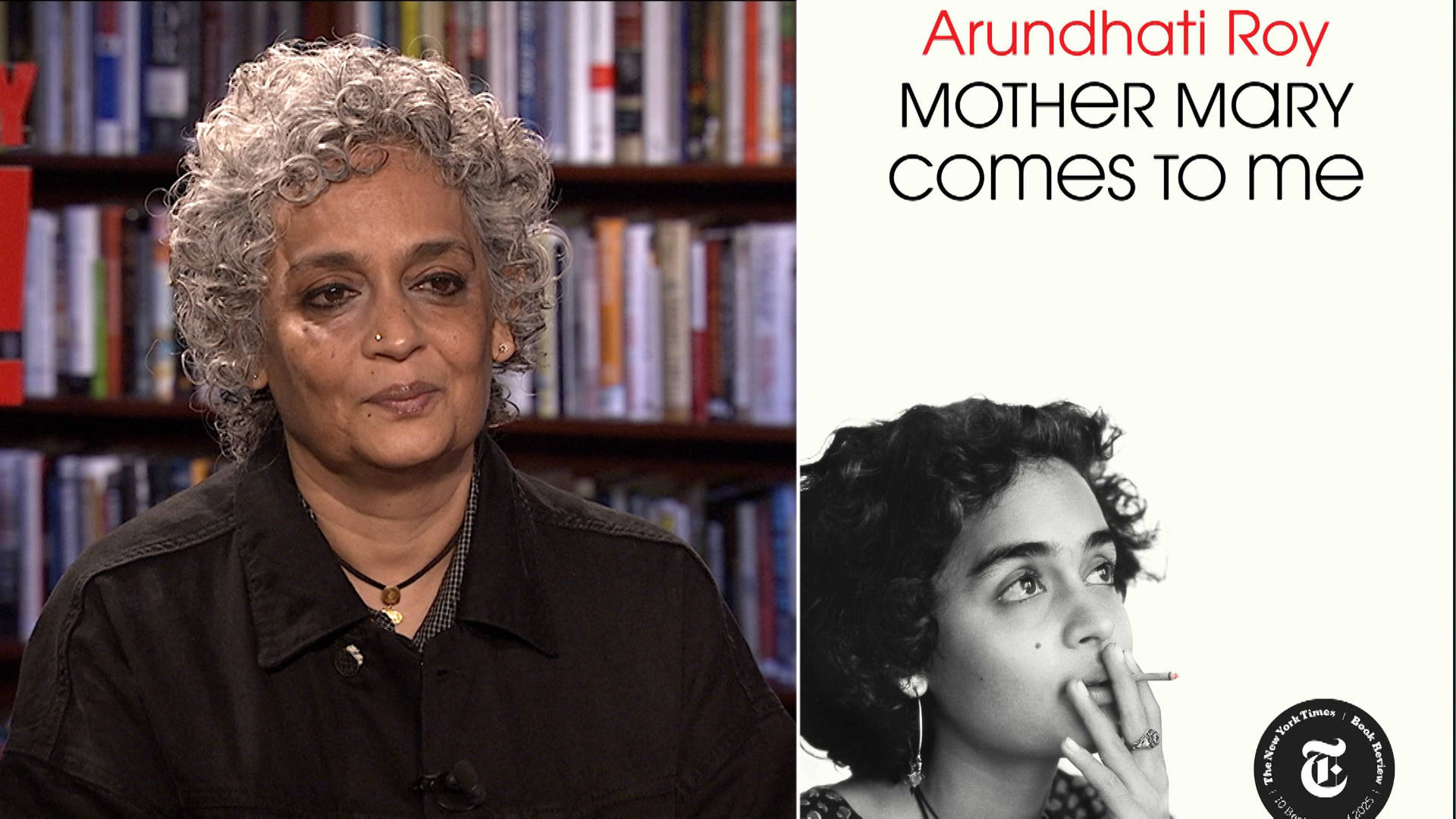
Acclaimed Indian author Arundhati Roy recently released her new memoir, Mother Mary Comes to Me, which delves into her complex relationship with her mother, Mary Roy. In a conversation with Democracy Now!, Roy discussed the impact of her mother’s life on her own and addressed pressing global issues, including the humanitarian crisis in Gaza and the rise of authoritarianism in India and the United States.
Roy’s memoir highlights the dual nature of her mother, both a source of inspiration and terror. Mary Roy, who was a celebrated educator, played a significant role in advocating for women’s rights, particularly in challenging discriminatory inheritance laws in India. The memoir captures how this formidable woman shaped Roy’s identity as a writer and activist, while also leaving lasting emotional scars. The New York Times described the book as “unsparing yet darkly funny,” emphasizing its exploration of a “fierce, asthmatic, impossible, inspirational woman.”
In her conversation, Roy reflected on the title of her book, inspired by a Beatles song. She described how music influenced her journey, saying, “The title, I think it chose me.” This connection to music underscores the memoir’s personal narrative, intertwining her life experiences with broader cultural themes.
During the interview, Roy also addressed the increasing authoritarianism she perceives in her home country of India under Prime Minister Narendra Modi. She stated that the events of January 6 in the United States mirrored those in India, where democratic principles have been undermined. “The attempted coup of January 6th over here succeeded in India,” she remarked, alluding to the normalization of violence and oppression in her country.
Roy’s criticism of the Modi administration is not new. She has been a vocal opponent of his far-right ruling BJP party, facing backlash and censorship for her views. Earlier this year, her collection of essays, Azadi: Freedom. Fascism. Fiction, was banned in Indian-occupied Kashmir, highlighting the government’s crackdown on dissenting voices.
Her activism extends beyond India, as she has also condemned the violence in Gaza. Roy expressed deep concern over the humanitarian crisis, describing the destruction of hospitals and the suffering of children as a “genocide” that the world must confront. She emphasized the disconnection between the will of the people and their governments, stating, “The whole charade of Western liberal democracy is as much of a corpse under the rubble as the tens of thousands of Palestinians.”
The interview also touched on the personal ramifications of her upbringing. Roy described her mother’s strong personality as both empowering and damaging, reflecting on the complexities of their relationship. “I could see it almost like a chemical experiment,” she said, explaining how her mother’s struggles with societal norms shaped her own worldview.
Reflecting on the impact of her mother’s actions, Roy noted that safety can often be an illusion. “Once you’ve been unsafe in that safest place, safety is very hard to find again,” she stated. This sentiment resonates throughout her writing, revealing the intricate balance between love and fear in her familial relationships.
As Roy continues to navigate her role as an author and activist, her memoir serves as both a personal reflection and a broader critique of the societal structures that shape our lives. Her work encourages readers to confront uncomfortable truths and recognize the interconnectedness of personal and political narratives.
In a world increasingly marked by authoritarianism and dissent, Arundhati Roy‘s voice remains a vital contribution to the discourse on freedom, justice, and the complexities of human relationships. Her memoir not only tells the story of a daughter and her mother but also invites readers to reflect on their own roles in the fight against oppression.

**Gavin Pritzkau Crowned MVP at Urgent 2026 Orlando FBU Camp**

Medline and TransEnterix: A Comparative Investment Analysis

First Federal of Greene County Celebrates Growth with New Office Launch

Urgent Update: Cardinal Mindszenty Sentenced 77 Years Ago Today

Upwork Set to Reveal Q4 2025 Earnings on February 9

Marin Graduate Enhances Aurora Borealis Research Using AI

Rosenblatt Securities Lowers QUALCOMM Price Target to $190

Colorado Residents Turn to Home Battery Backup Amid Power Outages

American Airlines Celebrates a Century of Aviation Excellence

ALMA Discovers Companion Orbiting Giant Red Star π 1 Gruis

Doctoral Candidate Trivanni Yadav Advances Battery Research at UTulsa

Global Air Forces Ranked by Annual Defense Budgets in 2025

New ‘Star Trek: Voyager’ Game Demo Released, Players Test Limits

Mass Production of F-35 Fighter Jet Drives Down Costs

NASCAR Faces Fan Backlash as Steve Phelps’ Texts Surface

Gold Investment Surge: Top Mutual Funds and ETF Alternatives

DirecTV to Launch AI-Driven Ads with User Likenesses in 2026

SEVENTEEN’s Mingyu Faces Backlash Over Alcohol Incident at Concert
-
 Science3 months ago
ALMA Discovers Companion Orbiting Giant Red Star π 1 Gruis
-
 Science3 months ago
Doctoral Candidate Trivanni Yadav Advances Battery Research at UTulsa
-
 World4 months ago
Global Air Forces Ranked by Annual Defense Budgets in 2025
-
 Top Stories4 months ago
New ‘Star Trek: Voyager’ Game Demo Released, Players Test Limits
-
 World4 months ago
Mass Production of F-35 Fighter Jet Drives Down Costs
-
 Sports3 months ago
NASCAR Faces Fan Backlash as Steve Phelps’ Texts Surface
-
 Business4 months ago
Gold Investment Surge: Top Mutual Funds and ETF Alternatives
-
 Top Stories4 months ago
DirecTV to Launch AI-Driven Ads with User Likenesses in 2026
-
 Politics4 months ago
SEVENTEEN’s Mingyu Faces Backlash Over Alcohol Incident at Concert
-

 Science4 months ago
Time Crystals Revolutionize Quantum Computing Potential
-
 Entertainment4 months ago
Freeport Art Gallery Transforms Waste into Creative Masterpieces
-

 Science4 months ago
Remembering David E. Brest: A Life Dedicated to Nature and Family