
Science
NASA Closes Chapter on Historic Test Stands in Huntsville

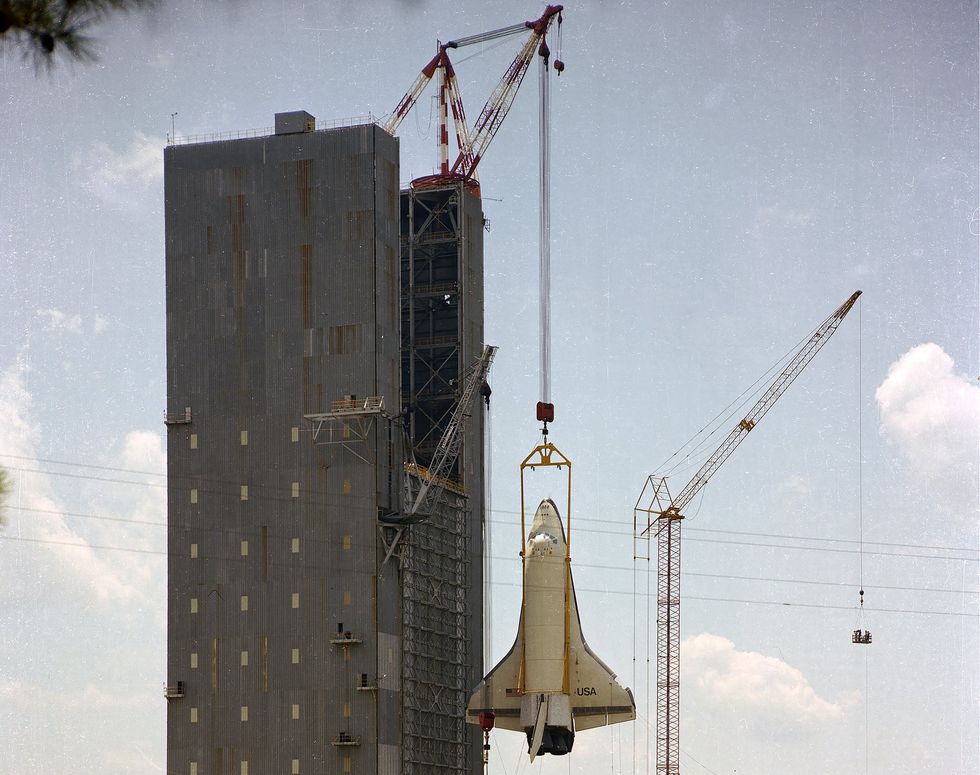
On January 10, 2024, the sound of controlled explosions marked a significant event in U.S. space history as NASA demolished two historic test stands at the Marshall Space Flight Center in Huntsville, Alabama. The Dynamic Test Stand and the Propulsion and Structural Test Facility, commonly referred to as the T-tower, were brought down in a series of carefully orchestrated implosions, ending decades of service that contributed to monumental achievements in space exploration.
Legacy of the T-tower and Dynamic Test Stand
Constructed in the late 1950s and early 1960s, these structures represented not only engineering marvels but also crucial facilities where pioneering rocket technology was tested. The T-tower, built in 1957 by the Army Ballistic Missile Agency, predates NASA’s establishment. Standing at over 50 meters tall, it was designed for static tests, allowing engineers to fire rockets while securely anchored to test their performance. Under the guidance of renowned engineer Wernher von Braun, the T-tower facilitated tests for the Saturn family of launch vehicles, including the powerful F-1 engines used in the Apollo missions. After being retired in the 1990s, it had already cemented its place in history.
In contrast, the Dynamic Test Stand, constructed in 1964, rose to over 105 meters, making it the tallest man-made structure in North Alabama. This facility was crucial for simulating the forces and vibrations that fully assembled Saturn V rockets would experience during launch. Engineers tested the rockets under conditions that mimicked flight, ensuring that everything functioned perfectly before the critical moment at the Kennedy Space Center launchpad. The stand also played a vital role in the evolution of the Space Shuttle program, integrating all shuttle components into one complete system in 1978. Its last mission involved supporting microgravity experiments in the early 2000s.
Both structures were recognized as National Historic Landmarks in 1985, underscoring their importance to human spaceflight. Their demolition signifies a bittersweet farewell to facilities that played pivotal roles in shaping America’s journey into space.
Transition to Modern Facilities
The decision to demolish these test stands was not taken lightly. According to Rae Ann Meyer, acting director of the Marshall Space Flight Center, “These facilities helped NASA make history. While it is hard to let them go, they’ve earned their retirement.” The age and condition of the structures made ongoing maintenance impractical, diverting resources from current missions and projects. As part of a broader transformation plan, NASA is removing 19 obsolete structures to create a modern, interconnected facility that aligns with its future objectives.
In an effort to preserve the legacy of these significant test stands, NASA has collaborated with educational institutions. Detailed architectural drawings, photographs, and written histories have been archived in the Library of Congress. Auburn University has also contributed by creating high-resolution digital models using LiDAR and 360-degree photography, capturing the intricate details of the structures before their demolition. These virtual archives serve to ensure that future generations can appreciate the engineering achievements and the historical significance of these test facilities, even after the steel has been cleared away.
The demolition of the Dynamic Test Stand and the T-tower not only marks the end of an era but also highlights the ongoing evolution of NASA’s mission. As the agency prepares for new challenges and opportunities in space exploration, the memories of these historic structures will continue to inspire future advancements in technology and engineering.

Upwork Set to Reveal Q4 2025 Earnings on February 9

Marin Graduate Enhances Aurora Borealis Research Using AI

Rosenblatt Securities Lowers QUALCOMM Price Target to $190

Colorado Residents Turn to Home Battery Backup Amid Power Outages

American Airlines Celebrates a Century of Aviation Excellence

Cupid Kannapolis Event Sparks Local Business Promotions

Carolina Artists Guild Launches Monthly Art Sales for Local Artists

Orlando High School Basketball Championships: Key Scores and Highlights

Four Arrested, Including Mastermind, in Islamabad Mosque Bombing

ALMA Discovers Companion Orbiting Giant Red Star π 1 Gruis

Doctoral Candidate Trivanni Yadav Advances Battery Research at UTulsa

Global Air Forces Ranked by Annual Defense Budgets in 2025

New ‘Star Trek: Voyager’ Game Demo Released, Players Test Limits

Mass Production of F-35 Fighter Jet Drives Down Costs

NASCAR Faces Fan Backlash as Steve Phelps’ Texts Surface

Gold Investment Surge: Top Mutual Funds and ETF Alternatives

DirecTV to Launch AI-Driven Ads with User Likenesses in 2026

SEVENTEEN’s Mingyu Faces Backlash Over Alcohol Incident at Concert
-
 Science3 months ago
ALMA Discovers Companion Orbiting Giant Red Star π 1 Gruis
-
 Science3 months ago
Doctoral Candidate Trivanni Yadav Advances Battery Research at UTulsa
-
 World4 months ago
Global Air Forces Ranked by Annual Defense Budgets in 2025
-
 Top Stories4 months ago
New ‘Star Trek: Voyager’ Game Demo Released, Players Test Limits
-
 World4 months ago
Mass Production of F-35 Fighter Jet Drives Down Costs
-
 Sports3 months ago
NASCAR Faces Fan Backlash as Steve Phelps’ Texts Surface
-
 Business4 months ago
Gold Investment Surge: Top Mutual Funds and ETF Alternatives
-
 Top Stories4 months ago
DirecTV to Launch AI-Driven Ads with User Likenesses in 2026
-
 Politics4 months ago
SEVENTEEN’s Mingyu Faces Backlash Over Alcohol Incident at Concert
-

 Science4 months ago
Time Crystals Revolutionize Quantum Computing Potential
-

 Entertainment4 months ago
Freeport Art Gallery Transforms Waste into Creative Masterpieces
-

 Science4 months ago
Remembering David E. Brest: A Life Dedicated to Nature and Family