
Science
Astronomers Discover Shifting Dynamics of Black Holes’ Surroundings

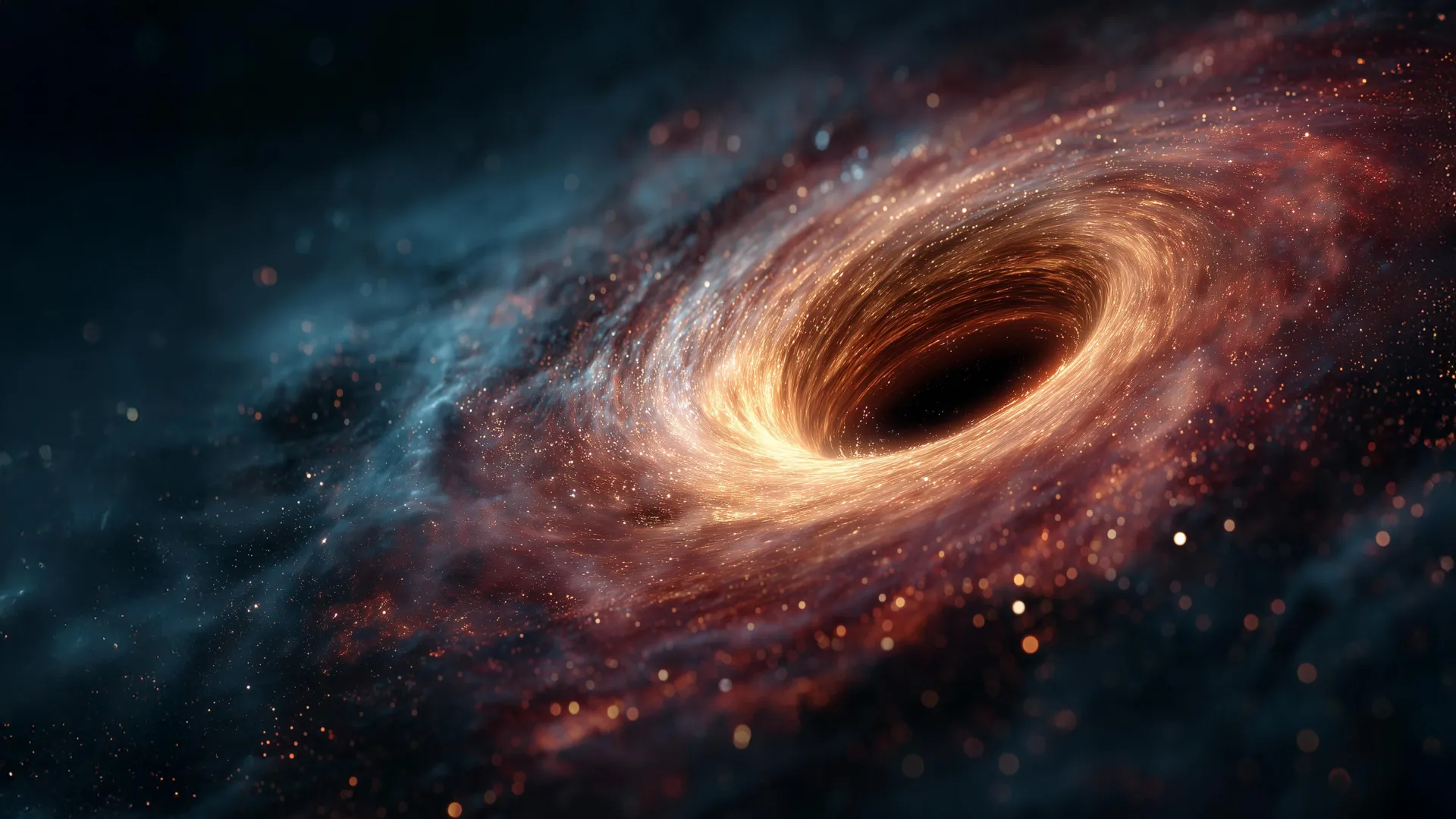
New research suggests that the material surrounding supermassive black holes may evolve over time, challenging long-held assumptions in astronomy. An international team of astronomers, led by the National Observatory of Athens, has discovered significant changes in the relationship between ultraviolet and X-ray light emitted by quasars over billions of years. The findings, published on December 27, 2025, in the Monthly Notices of the Royal Astronomical Society, indicate that the structure and behavior of matter around these black holes has not remained constant throughout the history of the universe.
Quasars: The Brightest Objects in the Universe
Quasars, which were first identified in the 1960s, rank among the most luminous entities known to science. They are powered by supermassive black holes that draw in surrounding matter, creating a rotating disk structure as this material spirals inward. The gravitational forces at play generate extreme heat due to friction, resulting in light emissions that can be 100 to 1,000 times brighter than an entire galaxy composed of around 100 billion stars. This remarkable brightness allows quasars to outshine their host galaxies, making them detectable across vast cosmic distances.
The glowing disk surrounding a black hole primarily emits ultraviolet light, which is believed to be crucial in producing powerful X-rays. As ultraviolet rays travel outward, they interact with energized particles in a region known as the “corona,” gaining energy and transforming into intense X-ray radiation detectable by space-based observatories.
Challenging Assumptions About Cosmic Relationships
Historically, astronomers have understood that the emissions of ultraviolet and X-ray light from quasars are closely linked. A brighter ultraviolet light typically correlates with stronger X-ray output. This relationship, established nearly five decades ago, has provided essential insights into the physical conditions near supermassive black holes. However, the recent study raises questions about the universality of this connection.
The research indicates that when the universe was younger—about half its current age—the relationship between ultraviolet and X-ray emissions differed significantly from what is observed in contemporary quasars. This suggests that the interaction between the accretion disk and the corona may have changed over the past 6.5 billion years. Dr. Antonis Georgakakis, one of the study’s authors, remarked, “Confirming a non-universal X-ray-to-ultraviolet relation with cosmic time is quite surprising and challenges our understanding of how supermassive black holes grow and radiate.”
The team utilized new X-ray observations from the eROSITA X-ray telescope alongside archival data from the XMM-Newton X-ray observatory. This combination of datasets enabled the analysis of a notably large sample of quasars, with the extensive sky coverage provided by eROSITA allowing for examinations of quasar populations that were previously unattainable.
The implications of these findings extend beyond theoretical discussions. The assumption that the ultraviolet and X-ray relationship in quasars is uniform has underpinned methods that use quasars as “standard candles” to map the universe’s structure and investigate dark matter and dark energy. The new results signal a need for caution in these methodologies, as the stability of black hole environments over cosmic time may not be as reliable as once thought.
Maria Chira, a postdoctoral researcher at the National Observatory of Athens and the study’s lead author, emphasized the methodological advancements that facilitated this discovery. “The eROSITA survey is vast but relatively shallow—many quasars are detected with only a few X-ray photons. By combining these data in a robust Bayesian statistical framework, we could uncover subtle trends that would otherwise remain hidden,” she stated.
Looking ahead, upcoming all-sky scans from eROSITA will allow astronomers to observe even fainter and more distant quasars. By integrating these future observations with next-generation X-ray and multiwavelength surveys, researchers aim to ascertain whether the observed changes reflect genuine physical evolution or are artifacts of the data collection processes. These efforts promise to enhance our understanding of how supermassive black holes power some of the brightest objects in the universe and reveal how their dynamics have transformed throughout cosmic history.

American Airlines Celebrates a Century of Aviation Excellence

Cupid Kannapolis Event Sparks Local Business Promotions

Carolina Artists Guild Launches Monthly Art Sales for Local Artists

Orlando High School Basketball Championships: Key Scores and Highlights

Four Arrested, Including Mastermind, in Islamabad Mosque Bombing

Transdermal HRT Significantly Enhances Bone Density in Women

Stony Brook Secures Victory Over Northeastern with 69-55 Win

Haiti’s Transitional Council Dissolves, PM Fils-Aime Takes Charge

Netanyahu to Meet Trump Next Week Amid Iran Negotiations

ALMA Discovers Companion Orbiting Giant Red Star π 1 Gruis

Doctoral Candidate Trivanni Yadav Advances Battery Research at UTulsa

Global Air Forces Ranked by Annual Defense Budgets in 2025

New ‘Star Trek: Voyager’ Game Demo Released, Players Test Limits

Mass Production of F-35 Fighter Jet Drives Down Costs

NASCAR Faces Fan Backlash as Steve Phelps’ Texts Surface

Gold Investment Surge: Top Mutual Funds and ETF Alternatives

DirecTV to Launch AI-Driven Ads with User Likenesses in 2026

SEVENTEEN’s Mingyu Faces Backlash Over Alcohol Incident at Concert
-
 Science3 months ago
ALMA Discovers Companion Orbiting Giant Red Star π 1 Gruis
-
 Science3 months ago
Doctoral Candidate Trivanni Yadav Advances Battery Research at UTulsa
-
 World4 months ago
Global Air Forces Ranked by Annual Defense Budgets in 2025
-
 Top Stories4 months ago
New ‘Star Trek: Voyager’ Game Demo Released, Players Test Limits
-
 World4 months ago
Mass Production of F-35 Fighter Jet Drives Down Costs
-
 Sports3 months ago
NASCAR Faces Fan Backlash as Steve Phelps’ Texts Surface
-
 Business4 months ago
Gold Investment Surge: Top Mutual Funds and ETF Alternatives
-
 Top Stories4 months ago
DirecTV to Launch AI-Driven Ads with User Likenesses in 2026
-
 Politics4 months ago
SEVENTEEN’s Mingyu Faces Backlash Over Alcohol Incident at Concert
-

 Science4 months ago
Time Crystals Revolutionize Quantum Computing Potential
-

 Entertainment4 months ago
Freeport Art Gallery Transforms Waste into Creative Masterpieces
-

 Science4 months ago
Remembering David E. Brest: A Life Dedicated to Nature and Family