
Top Stories
China Reshuffles Military Leadership Amid Rising Tensions Over Taiwan

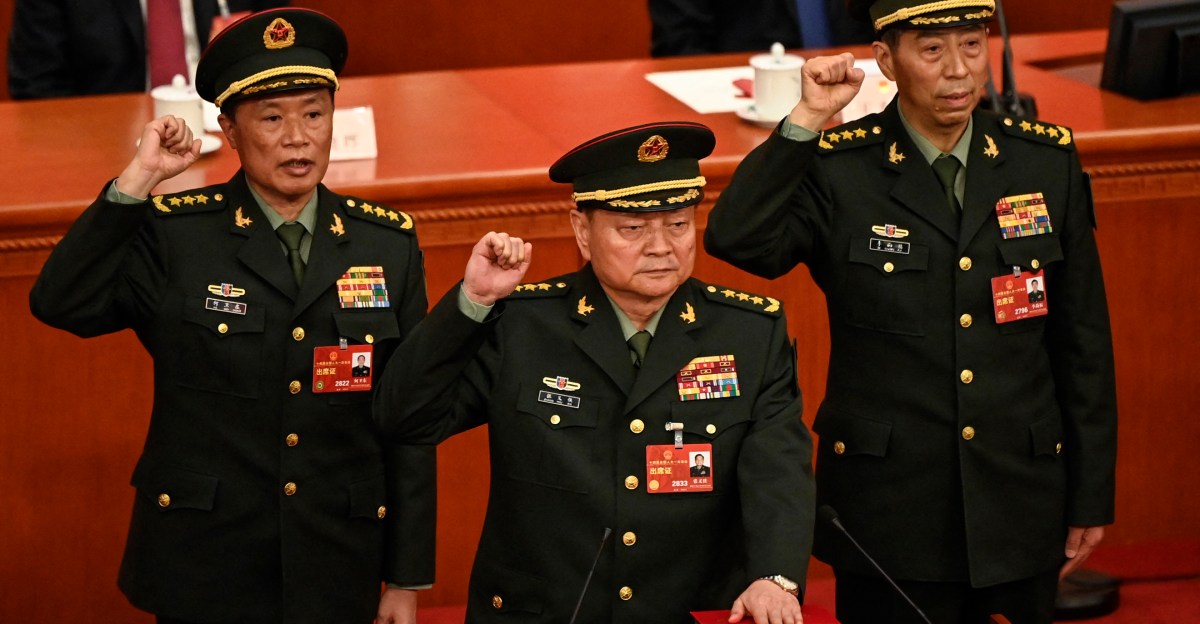
Chinese leader Xi Jinping is intensifying a campaign to consolidate power by purging senior military officials, including the recent investigation of Zhang Youxia, the vice chair of the Central Military Commission and a key figure in the People’s Liberation Army (PLA). This move, which comes amid concerns over a potential conflict regarding Taiwan, has raised eyebrows among analysts who interpret it as an effort to eliminate dissenting voices within the military.
Zhang, who has held significant influence and is regarded as a loyal ally to Xi, was placed under investigation for what officials described as “serious disciplinary and legal violations.” His ousting is part of a broader anti-corruption campaign that has seen approximately 200,000 officials punished since Xi assumed leadership, though many view it as a means of reinforcing Xi’s hold over the Chinese Communist Party.
Zhang’s removal is particularly notable given his extensive military background and past combat experience during China’s invasion of Vietnam in 1979. His loyalty to the party and longstanding relationship with Xi, whose families have historical ties dating back to the civil war, made him appear untouchable. Jason Hsu, a senior fellow at the Hudson Institute, stated, “This is not just another corruption case; this one is special.”
The official rationale for Zhang’s ouster, as reported in an editorial by the People’s Daily, cites his role in exacerbating political and corruption issues that threaten the party’s leadership over the military. The editorial highlighted that such issues have negatively impacted the military’s combat readiness and overall political environment.
The backdrop to this leadership upheaval is a massive increase in military spending, which has created ample opportunities for corruption. Reports have surfaced accusing Zhang of accepting bribes for promotions and potentially sharing sensitive information with the United States. Additionally, unverified rumors on social media have suggested involvement in a coup plot against Xi, although the credibility of these claims remains uncertain.
Internal Discontent and Regional Implications
The implications of Zhang’s removal extend beyond internal politics; they raise significant concerns regarding China’s military strategy toward Taiwan. While China officially maintains a stance of “peaceful reunification” with Taiwan, analysts believe Xi has set a military readiness goal for retaking the island by 2027. This timeline has increased tensions, particularly with the United States, which has pursued a policy of strategic ambiguity regarding military intervention in Taiwan.
The question of whether the U.S. would defend Taiwan in the event of an invasion remains unresolved, especially given mixed signals from previous administrations. Donald Trump has expressed a somewhat indifferent approach, suggesting any military action by Xi would be a personal decision. Yun Sun, director of the China Program at the Stimson Center, posited that Trump’s lack of engagement may encourage Xi to expedite his military plans.
Zhang was perceived as a moderating influence within the PLA, having previously disagreed with Xi on military action regarding Taiwan. His removal, along with other senior officers, could signify a shift towards a more aggressive military posture, as noted by analysts who believe this reduces resistance to Xi’s ambitions.
Future of Military Strategy and Global Relations
While the immediate future may not suggest an impending invasion, the long-term consequences of Zhang’s purge could reshape military strategies. Experts caution that a period of instability in the military hierarchy may not be the ideal moment for launching significant operations. Ming-Shih Shen, a researcher at Taiwan’s Institute for National Defense and Security Research, believes that barring provocative actions from Taiwan, China is unlikely to resort to force before 2027.
Nevertheless, the long-term outlook remains uncertain. The reduction of opposition within the military could enable Xi to pursue his vision of Taiwan reunification more aggressively. Brendan Mulvaney, director of the China Aerospace Studies Institute, remarked that Zhang likely represented a voice of caution, advocating for a more measured approach to military readiness.
Zhang’s personable nature and willingness to engage with international counterparts may also diminish, complicating communications between military leaders in China and the U.S. as tensions rise. The ongoing reshuffling of military leadership in China may lead to a “personalist world order” where decisions are made based on individual leaders’ ambitions rather than coherent national strategies.
As the situation continues to evolve, the international community watches closely, aware that Xi’s consolidation of power within the military may have profound implications for regional stability and global security. The elimination of voices capable of challenging Xi’s decisions raises concerns about the potential for miscalculation and conflict in one of the world’s most volatile regions.

Fayetteville Storage Facility Fire Erupts, Ramsey Street Closed

Grab the Wyze Cam OG Now at 50% Off for Enhanced Home Security

Big Bear’s Bald Eagles Capture Hearts as Social Media Sensations

Water Molecules Transform Prolinol Catalyst Structure, Study Finds

New York Times Bestsellers: Top Titles Revealed for January 24

Twin Capital Management Reduces Stake in Public Storage by Over 54%

Pennsylvania Republican Party Endorses Jason Richey for Lt. Governor

Lara Exploration Reaches New High: Is It Time to Invest?

**Gavin Pritzkau Crowned MVP at Urgent 2026 Orlando FBU Camp**

ALMA Discovers Companion Orbiting Giant Red Star π 1 Gruis

Doctoral Candidate Trivanni Yadav Advances Battery Research at UTulsa

Global Air Forces Ranked by Annual Defense Budgets in 2025

New ‘Star Trek: Voyager’ Game Demo Released, Players Test Limits

Mass Production of F-35 Fighter Jet Drives Down Costs

NASCAR Faces Fan Backlash as Steve Phelps’ Texts Surface

Gold Investment Surge: Top Mutual Funds and ETF Alternatives

DirecTV to Launch AI-Driven Ads with User Likenesses in 2026

SEVENTEEN’s Mingyu Faces Backlash Over Alcohol Incident at Concert
-
 Science3 months ago
ALMA Discovers Companion Orbiting Giant Red Star π 1 Gruis
-
 Science3 months ago
Doctoral Candidate Trivanni Yadav Advances Battery Research at UTulsa
-
 World4 months ago
Global Air Forces Ranked by Annual Defense Budgets in 2025
-
 Top Stories4 months ago
New ‘Star Trek: Voyager’ Game Demo Released, Players Test Limits
-
 World4 months ago
Mass Production of F-35 Fighter Jet Drives Down Costs
-
 Sports3 months ago
NASCAR Faces Fan Backlash as Steve Phelps’ Texts Surface
-
 Business4 months ago
Gold Investment Surge: Top Mutual Funds and ETF Alternatives
-
 Top Stories4 months ago
DirecTV to Launch AI-Driven Ads with User Likenesses in 2026
-
 Politics4 months ago
SEVENTEEN’s Mingyu Faces Backlash Over Alcohol Incident at Concert
-

 Science4 months ago
Time Crystals Revolutionize Quantum Computing Potential
-

 Entertainment4 months ago
Freeport Art Gallery Transforms Waste into Creative Masterpieces
-

 Science4 months ago
Remembering David E. Brest: A Life Dedicated to Nature and Family