
Science
Russian Rocket Launches Successfully Despite Launch Pad Damage

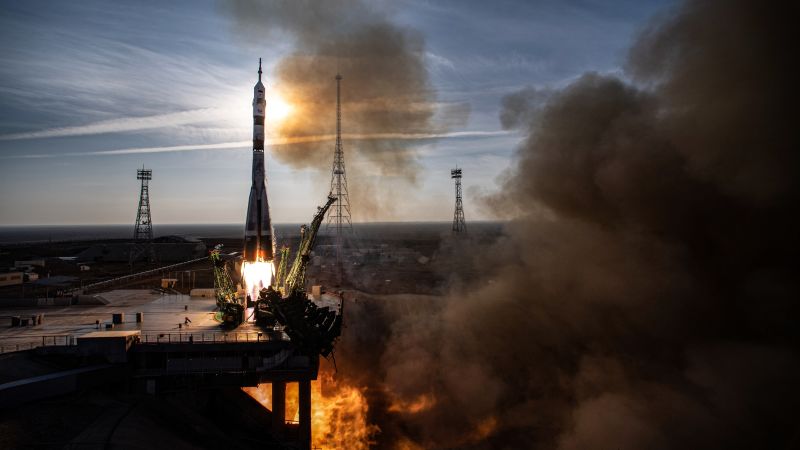
A launch pad at Russia’s primary space facility sustained damage during the launch of the Soyuz MS-28 spacecraft, which successfully transported two Russian cosmonauts and one American astronaut to the International Space Station (ISS). The incident occurred on Thursday at the Baikonur Cosmodrome in Kazakhstan, according to a statement from the Russian space agency, Roscosmos.
Following the successful docking of the spacecraft with the ISS, a post-launch inspection revealed “damage to several elements of the launch pad.” While all necessary components for repair are available, Roscosmos indicated that an assessment of the launch complex’s condition is ongoing. The agency assured that repairs would be conducted in the near future.
The launch pad plays a crucial role in supporting the rocket during liftoff and provides access for cosmonauts to their capsule. These structures are designed to endure extreme heat, air pressure, and vibrations during rocket launches. Experts noted that repairs to the damaged pad could take a week or longer, potentially impacting Russia’s ability to launch future missions to the ISS.
Georgy Trishkin, an analyst and blogger, expressed concerns on Telegram about the implications of the damage. He stated, “In the worst case, this could seriously affect the rotation of crewed missions and cargo flights to the ISS.” Traditionally, crewed missions are launched from Baikonur approximately every six months.
The Baikonur complex is currently the only launch pad used by Roscosmos for the ISS program. Vitaliy Egorov, a commentator on Telegram, highlighted the significance of this setback, remarking, “In effect, from this day, Russia has lost the ability to launch humans into space, something that has not happened since 1961.” He emphasized the urgency of repairing the launch pad or considering modernization of another facility.
In addition to Russia’s Soyuz spacecraft, NASA relies on SpaceX’s Dragon spacecraft to transport crew to the ISS. The three crew members aboard the recently launched mission join seven others currently orbiting the space station, with three scheduled to return to Earth by December 8, 2023.
The incident raises questions about the future of Russia’s manned space missions and its strategic capabilities in maintaining a steady presence on the ISS. As the global space race continues, the implications of this damage extend beyond immediate repairs, potentially affecting international partnerships and future explorations.

Burberry Group and Zumiez: A Comprehensive Investment Comparison

Celebrate Faith and Fun: Upcoming Events on EWTN and Beyond

Five Healthcare Stocks to Watch This February

Apple TV 4K Revolutionizes Home Viewing Experience for Users

Virginia Beach Launches Fundraiser with Custom Conversation Hearts

Schibsted ASA Reports Q3 Earnings with $0.14 EPS, Stock Reacts

Offworld Life Science Develops Medical-Grade Saline in Space

New Study Reveals Shifting Dynamics of Middle Class Earnings

Susquehanna Raises ConocoPhillips Price Target to $121 Amid Analyst Activity

ALMA Discovers Companion Orbiting Giant Red Star π 1 Gruis

Doctoral Candidate Trivanni Yadav Advances Battery Research at UTulsa

New ‘Star Trek: Voyager’ Game Demo Released, Players Test Limits

Global Air Forces Ranked by Annual Defense Budgets in 2025

Mass Production of F-35 Fighter Jet Drives Down Costs

NASCAR Faces Fan Backlash as Steve Phelps’ Texts Surface

DirecTV to Launch AI-Driven Ads with User Likenesses in 2026

Gold Investment Surge: Top Mutual Funds and ETF Alternatives

SEVENTEEN’s Mingyu Faces Backlash Over Alcohol Incident at Concert
-
 Science3 months ago
ALMA Discovers Companion Orbiting Giant Red Star π 1 Gruis
-
 Science3 months ago
Doctoral Candidate Trivanni Yadav Advances Battery Research at UTulsa
-
 Top Stories4 months ago
New ‘Star Trek: Voyager’ Game Demo Released, Players Test Limits
-
 World4 months ago
Global Air Forces Ranked by Annual Defense Budgets in 2025
-
 World4 months ago
Mass Production of F-35 Fighter Jet Drives Down Costs
-
 Sports3 months ago
NASCAR Faces Fan Backlash as Steve Phelps’ Texts Surface
-
 Top Stories4 months ago
DirecTV to Launch AI-Driven Ads with User Likenesses in 2026
-
 Business4 months ago
Gold Investment Surge: Top Mutual Funds and ETF Alternatives
-
 Politics4 months ago
SEVENTEEN’s Mingyu Faces Backlash Over Alcohol Incident at Concert
-
 Science4 months ago
Time Crystals Revolutionize Quantum Computing Potential
-

 Entertainment4 months ago
Freeport Art Gallery Transforms Waste into Creative Masterpieces
-

 Science4 months ago
Remembering David E. Brest: A Life Dedicated to Nature and Family