
Top Stories
Breakthrough in Carbon Recycling: Hybrid Catalysis Revealed

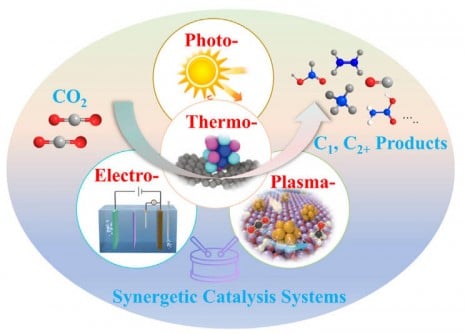
UPDATE: A groundbreaking review from the Shenzhen University of Advanced Technology has just been published, unveiling innovative pathways to enhance carbon dioxide (CO2) recycling. This urgent research, released in the May 2025 edition of the eScience journal, highlights the potential of hybrid catalytic systems to revolutionize CO2 reduction, a critical step toward achieving global carbon neutrality.
As the world grapples with climate change, the need for efficient CO2 reduction methods has never been more pressing. Traditional catalytic approaches, such as thermocatalysis and electrocatalysis, have faced significant limitations, including high energy consumption and low selectivity. This new study, co-authored by Professor Hui-Ming Cheng and Professor Xiaolong Zhang, emphasizes the necessity of exploring synergetic energy-coupled catalysis to overcome these hurdles.
The review categorizes advanced catalytic systems into three innovative types: photothermal, electrothermal, and plasma-thermal. These systems utilize multiple energy inputs—light, heat, and electricity—to enhance CO2 conversion efficiency significantly. For example, photothermal catalysis combines light and heat, maximizing solar energy use while reducing the high energy demands of standalone thermocatalysis.
Notably, catalysts like Au/ZnWO4-ZnO and Ni/TiO2 have exhibited impressive selectivity for CO2 hydrogenation under mild conditions, showcasing the effectiveness of this hybrid approach. Furthermore, electrothermal systems leverage resistive heating from electric currents, allowing catalysts to achieve necessary reaction temperatures in mere minutes, thus boosting efficiency and minimizing catalyst poisoning.
The research also highlights the potential of plasma-thermal coupling, which utilizes nonthermal plasmas to produce energetic electrons and radicals. This method, when combined with nanostructured catalysts, has achieved remarkable CO2 conversion rates at significantly lower energy costs. Case studies demonstrate that catalysts like β-Mo2C nanorods and plasma-assisted chemical looping can outperform conventional methods by threefold in conversion rates.
In a compelling statement, Professor Cheng remarked, “Single-mode catalytic strategies for CO2 reduction may have reached their performance limits. By leveraging the synergetic effects of combined energy inputs, we can access new reaction pathways, increase selectivity for valuable products, and significantly reduce energy consumption.” This innovative approach not only pushes the boundaries of catalytic science but also accelerates the deployment of technologies essential for carbon neutrality.
The implications of these findings are profound. By enhancing the efficiency and selectivity of CO2 reduction, these hybrid catalytic systems could lead to sustainable production of fuels like methanol and methane, as well as essential chemicals such as ethanol and acetic acid. If successfully scaled, they may bridge the gap between laboratory research and industrial application, providing a realistic solution to mitigate greenhouse gas emissions.
This research is not merely an academic exercise; it represents a critical step toward sustainable energy and carbon recycling solutions that could transform our approach to climate challenges. As governments and industries worldwide strive for long-term carbon neutrality goals, the integration of these advanced catalytic systems could hold the key to a cleaner, more sustainable future.
Stay tuned for more updates on this developing story as scientists continue to explore these innovative pathways for CO2 reduction. The future of carbon recycling is not just on the horizon; it’s unfolding right now.

Minneapolis Police Dismantle Anti-ICE Blockades Amid Tensions

Burberry Group and Zumiez: A Comprehensive Investment Comparison

Celebrate Faith and Fun: Upcoming Events on EWTN and Beyond

Five Healthcare Stocks to Watch This February

Apple TV 4K Revolutionizes Home Viewing Experience for Users

Virginia Beach Launches Fundraiser with Custom Conversation Hearts

Schibsted ASA Reports Q3 Earnings with $0.14 EPS, Stock Reacts

Offworld Life Science Develops Medical-Grade Saline in Space

New Study Reveals Shifting Dynamics of Middle Class Earnings

ALMA Discovers Companion Orbiting Giant Red Star π 1 Gruis

Doctoral Candidate Trivanni Yadav Advances Battery Research at UTulsa

Global Air Forces Ranked by Annual Defense Budgets in 2025

New ‘Star Trek: Voyager’ Game Demo Released, Players Test Limits

Mass Production of F-35 Fighter Jet Drives Down Costs

NASCAR Faces Fan Backlash as Steve Phelps’ Texts Surface

DirecTV to Launch AI-Driven Ads with User Likenesses in 2026

Gold Investment Surge: Top Mutual Funds and ETF Alternatives

SEVENTEEN’s Mingyu Faces Backlash Over Alcohol Incident at Concert
-
 Science3 months ago
ALMA Discovers Companion Orbiting Giant Red Star π 1 Gruis
-
 Science3 months ago
Doctoral Candidate Trivanni Yadav Advances Battery Research at UTulsa
-
 World4 months ago
Global Air Forces Ranked by Annual Defense Budgets in 2025
-
 Top Stories4 months ago
New ‘Star Trek: Voyager’ Game Demo Released, Players Test Limits
-
 World4 months ago
Mass Production of F-35 Fighter Jet Drives Down Costs
-
 Sports3 months ago
NASCAR Faces Fan Backlash as Steve Phelps’ Texts Surface
-
 Top Stories4 months ago
DirecTV to Launch AI-Driven Ads with User Likenesses in 2026
-
 Business4 months ago
Gold Investment Surge: Top Mutual Funds and ETF Alternatives
-
 Politics4 months ago
SEVENTEEN’s Mingyu Faces Backlash Over Alcohol Incident at Concert
-
 Science4 months ago
Time Crystals Revolutionize Quantum Computing Potential
-

 Entertainment4 months ago
Freeport Art Gallery Transforms Waste into Creative Masterpieces
-

 Science4 months ago
Remembering David E. Brest: A Life Dedicated to Nature and Family