
Science
Rare Deep-Sea Squid Captured Camouflaging as Ocean Stalks

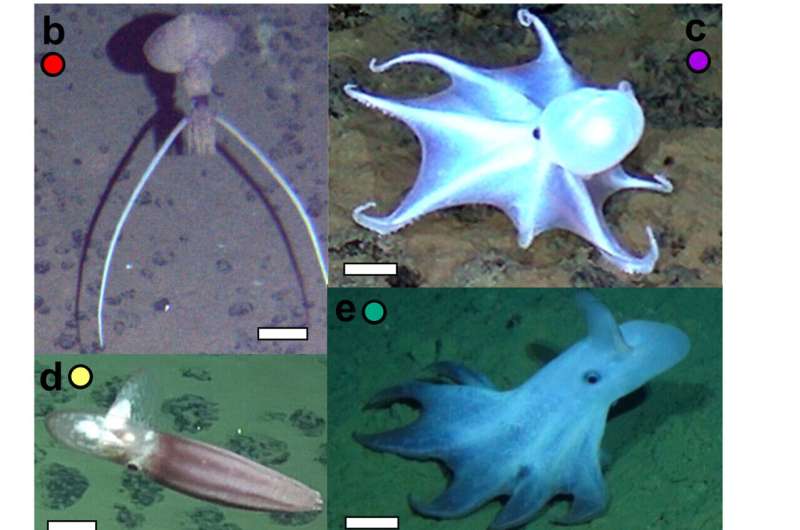
Researchers have documented a rare behavior in a deep-sea squid that appears to disguise itself as stalk-like structures on the ocean floor. This discovery was made in the Clarion-Clipperton Zone during a visual survey using a remotely operated vehicle (ROV) in March 2023. The findings were recently published in the journal Ecology.
Uncovering Hidden Behaviors
At a depth of approximately 4,100 meters, the ROV’s cameras initially captured what seemed to be biogenic stalks—organisms resembling glass sponges or tube worms. Moments later, a squid swam rapidly across the camera’s view, surprising the research team who had not detected its presence prior to this footage. Upon closer examination, the team realized the squid had been buried in mud among polymetallic nodules and only emerged just before being recorded.
“The squid only became obvious after it abandoned this behavior and swam away, disturbed by the proximity of the ROV,” the study authors explained. The squid exhibited short arms and elongated white tentacles, measuring about 10 centimeters in mantle length and 22 centimeters in tentacle length. It is believed to be a previously undescribed species from the family Mastigoteuthidae.
Masquerading in the Deep Sea
This behavior, referred to as “masquerading,” may serve a dual purpose: concealing the squid from predators, such as beaked whales, or ambushing prey. By remaining motionless, the squid conserves energy, a strategy that can be more efficient than active hunting. This observation marks the first documented instance of masquerading in a deep-sea cephalopod.
Historically, whiplash squids had been encountered only once in the Northeast Pacific abyss, with a total of only four cephalopods observed in the region since seabed surveying began in the 1970s. The scarcity of sightings has led researchers to believe that their populations are low. However, this recent discovery suggests they may simply be adept at remaining hidden.
The authors emphasize, “As with the number of genetic species, the occurrences and distributions we report here are most certainly an underestimate, since cephalopods can self-disguise as well as sense and potentially avoid underwater sampling vehicles.” Such vehicles have been the primary means of gathering ecological and taxonomic knowledge in the abyssal Pacific.
Understanding the behavior and diversity of deep-sea cephalopods is increasingly important as these ecosystems face threats from climate change and seabed mining. The study highlights the need for more targeted research utilizing unobtrusive camera platforms to explore these habitats further before they are irrevocably altered.
As the abyssal plains encompass more than half of Earth’s surface, this research underscores the vast unknowns that exist within these depths. By enhancing our knowledge of species like cephalopods, scientists can better inform conservation strategies in regions targeted for resource extraction.
This study, authored by Alejandra Mejía-Saenz and colleagues, illustrates the complex life habits of cephalopods in the abyss and signals a need for heightened awareness and research efforts as we navigate the challenges facing our oceans.
The article was written by Krystal Kasal, edited by Gaby Clark, and reviewed by Robert Egan, ensuring adherence to rigorous editorial standards.

Robinhood Stock Surges 2.5% in Early Trading on March 17

Israel Intensifies Strikes as Global Energy Crisis Looms

CALV Offers Class on Communication Skills for Real Estate Professionals

Historic Bideford Pub Reopens as The Patch Wine Bar & Kitchen

Oscar Night Celebrations: Winners, Guests, and Exclusive After-Parties

Samsung Galaxy Watch 9 Set for Larger Battery Boost, Report Reveals

Kibble vs. Fresh Dog Food: What’s Best for Your Dog’s Health?

Acclaimed San Francisco Pizzeria Del Popolo to Close in May

‘Invincible’ Season 4 Launches on Prime Video with Epic Action

ALMA Discovers Companion Orbiting Giant Red Star π 1 Gruis

Doctoral Candidate Trivanni Yadav Advances Battery Research at UTulsa

Global Air Forces Ranked by Annual Defense Budgets in 2025

Rev. Bry Shields to Retire as McGill-Toolen President in 2026

Mass Production of F-35 Fighter Jet Drives Down Costs

Tucson Celebrates Life and Remembrance at 36th Annual All Souls Procession

Gold Investment Surge: Top Mutual Funds and ETF Alternatives

DirecTV to Launch AI-Driven Ads with User Likenesses in 2026

Paul Giamatti Reveals Villainous Role in Star Trek: Starfleet Academy
-
 Science9 months ago
ALMA Discovers Companion Orbiting Giant Red Star π 1 Gruis
-
 Science8 months ago
Doctoral Candidate Trivanni Yadav Advances Battery Research at UTulsa
-
 World10 months ago
Global Air Forces Ranked by Annual Defense Budgets in 2025
-
 Lifestyle10 months ago
Rev. Bry Shields to Retire as McGill-Toolen President in 2026
-
 World10 months ago
Mass Production of F-35 Fighter Jet Drives Down Costs
-
 Lifestyle9 months ago
Tucson Celebrates Life and Remembrance at 36th Annual All Souls Procession
-
 Business10 months ago
Gold Investment Surge: Top Mutual Funds and ETF Alternatives
-
 Top Stories10 months ago
DirecTV to Launch AI-Driven Ads with User Likenesses in 2026
-
 Entertainment10 months ago
Paul Giamatti Reveals Villainous Role in Star Trek: Starfleet Academy
-

 Lifestyle8 months ago
Maumee’s Shop With a Hero Event Delivers Joy to Local Children
-

 Top Stories10 months ago
New ‘Star Trek: Voyager’ Game Demo Released, Players Test Limits
-

 Lifestyle8 months ago
Cape May Shines as New Jersey’s Only Entry on Beach Town List