
Science
Archaeologists Uncover Possible Remains of Noah’s Ark in Turkey

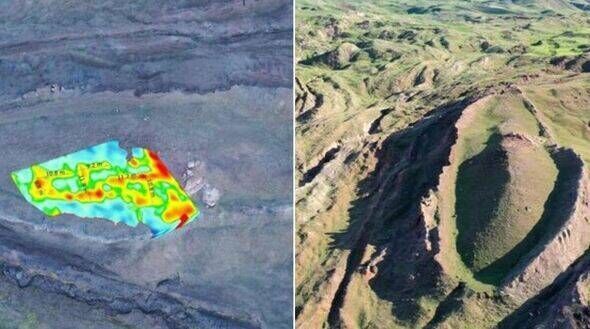
Archaeologists have made a significant discovery in Turkey, utilizing advanced radar technology to identify what they believe may be the remains of Noah’s Ark. The research team, associated with Noah’s Ark Scans, conducted Ground Penetrating Radar (GPR) analysis in the Durupinar Formation, situated approximately 18 miles south of Mount Ararat. Their findings include a “chemical imprint,” pieces of wood, and what appears to be the shape of a hall, suggesting a large structure consistent with ancient descriptions.
The team, led by independent researcher Andrew Jones, uncovered evidence of angular formations and a hollow space deep within the mountain. Their GPR data indicates the presence of a corridor measuring approximately 13 feet, along with central and side hallways that align with the Biblical account of Noah’s Ark. According to Genesis 6:16, the ark was designed with lower, second, and third decks, which the GPR scans seem to support.
In an interview with the Christian Broadcasting Network (CBN), Andrew Jones stated, “We’re not expecting something that’s fully preserved. What’s left is the chemical imprint, pieces of wood in the ground, and the shape of a hall.” This new evidence aligns with the narrative of Noah’s Ark, which is said to have saved mankind and animal species from a catastrophic flood over 4,300 years ago.
Significance of the Durupinar Formation
The Durupinar Formation, which has been known to modern science for less than a century, gained attention after heavy rains and seismic activity in May 1948 eroded the mud that concealed the formation. The site has long been associated with the Biblical story, which states that Noah’s Ark came to rest on the “mountains of Ararat” following a 150-day flood. Sacred texts describe the ark as measuring “300 cubits long, 50 cubits wide, and 30 cubits high,” roughly equivalent to 515 feet long, 86 feet wide, and 52 feet tall.
The ongoing debate about the formation’s origins has divided scholars. Some view it as a natural geological phenomenon, while others, including the researchers at Noah’s Ark Scans, assert that the evidence points to an extraordinary find. Andrew Jones emphasized that the structures observed through GPR are not what one would expect from natural formations, saying, “This is not what you’d expect to see if the site were simply a solid block of rock or the result of random mudflow debris.”
New Findings and Future Research Plans
Recent scans revealed angular structures extending as deep as 20 feet beneath the surface, suggesting compartments consistent with a man-made vessel. Andrew Jones noted that the team also conducted soil analysis, which yielded intriguing results. He pointed out that the grass within the boat-shaped formation displayed a different color compared to the surrounding area, implying a potential man-made origin.
William Crabtree, another researcher from Noah’s Ark Scans, highlighted the discovery of a passageway running from the tip of the formation toward its center, indicating it could accommodate a person. Soil tests have shown that the organic matter content within the formation is double that found in the adjacent earth. Crabtree explained that elevated potassium levels and changes in pH suggest the presence of decaying organic materials, which would be expected if this were indeed a wooden vessel.
Looking ahead, Andrew and his team plan to expand their soil testing beyond the current 22 samples and conduct core drilling to further investigate the site’s characteristics. “We want to compare what’s inside the formation to what’s outside,” Andrew stated, emphasizing that this could provide clearer evidence of whether the structure has man-made origins.
As investigations continue, the findings at the Durupinar Formation may contribute significantly to our understanding of one of history’s most enduring narratives. The ongoing research highlights the intersection of archaeology, biblical history, and modern technology, inviting further exploration into the mysteries of our past.

Robinhood Stock Surges 2.5% in Early Trading on March 17

Israel Intensifies Strikes as Global Energy Crisis Looms

CALV Offers Class on Communication Skills for Real Estate Professionals

Historic Bideford Pub Reopens as The Patch Wine Bar & Kitchen

Oscar Night Celebrations: Winners, Guests, and Exclusive After-Parties

Samsung Galaxy Watch 9 Set for Larger Battery Boost, Report Reveals

Kibble vs. Fresh Dog Food: What’s Best for Your Dog’s Health?

Acclaimed San Francisco Pizzeria Del Popolo to Close in May

‘Invincible’ Season 4 Launches on Prime Video with Epic Action

ALMA Discovers Companion Orbiting Giant Red Star π 1 Gruis

Doctoral Candidate Trivanni Yadav Advances Battery Research at UTulsa

Global Air Forces Ranked by Annual Defense Budgets in 2025

Rev. Bry Shields to Retire as McGill-Toolen President in 2026

Mass Production of F-35 Fighter Jet Drives Down Costs

Tucson Celebrates Life and Remembrance at 36th Annual All Souls Procession

Gold Investment Surge: Top Mutual Funds and ETF Alternatives

DirecTV to Launch AI-Driven Ads with User Likenesses in 2026

Paul Giamatti Reveals Villainous Role in Star Trek: Starfleet Academy
-
 Science9 months ago
ALMA Discovers Companion Orbiting Giant Red Star π 1 Gruis
-
 Science8 months ago
Doctoral Candidate Trivanni Yadav Advances Battery Research at UTulsa
-
 World10 months ago
Global Air Forces Ranked by Annual Defense Budgets in 2025
-
 Lifestyle10 months ago
Rev. Bry Shields to Retire as McGill-Toolen President in 2026
-
 World10 months ago
Mass Production of F-35 Fighter Jet Drives Down Costs
-
 Lifestyle9 months ago
Tucson Celebrates Life and Remembrance at 36th Annual All Souls Procession
-
 Business10 months ago
Gold Investment Surge: Top Mutual Funds and ETF Alternatives
-
 Top Stories10 months ago
DirecTV to Launch AI-Driven Ads with User Likenesses in 2026
-
 Entertainment10 months ago
Paul Giamatti Reveals Villainous Role in Star Trek: Starfleet Academy
-

 Lifestyle8 months ago
Maumee’s Shop With a Hero Event Delivers Joy to Local Children
-

 Top Stories10 months ago
New ‘Star Trek: Voyager’ Game Demo Released, Players Test Limits
-

 Lifestyle8 months ago
Cape May Shines as New Jersey’s Only Entry on Beach Town List