
Science
Researchers Explore Dark Matter’s Axions Through Dying Stars

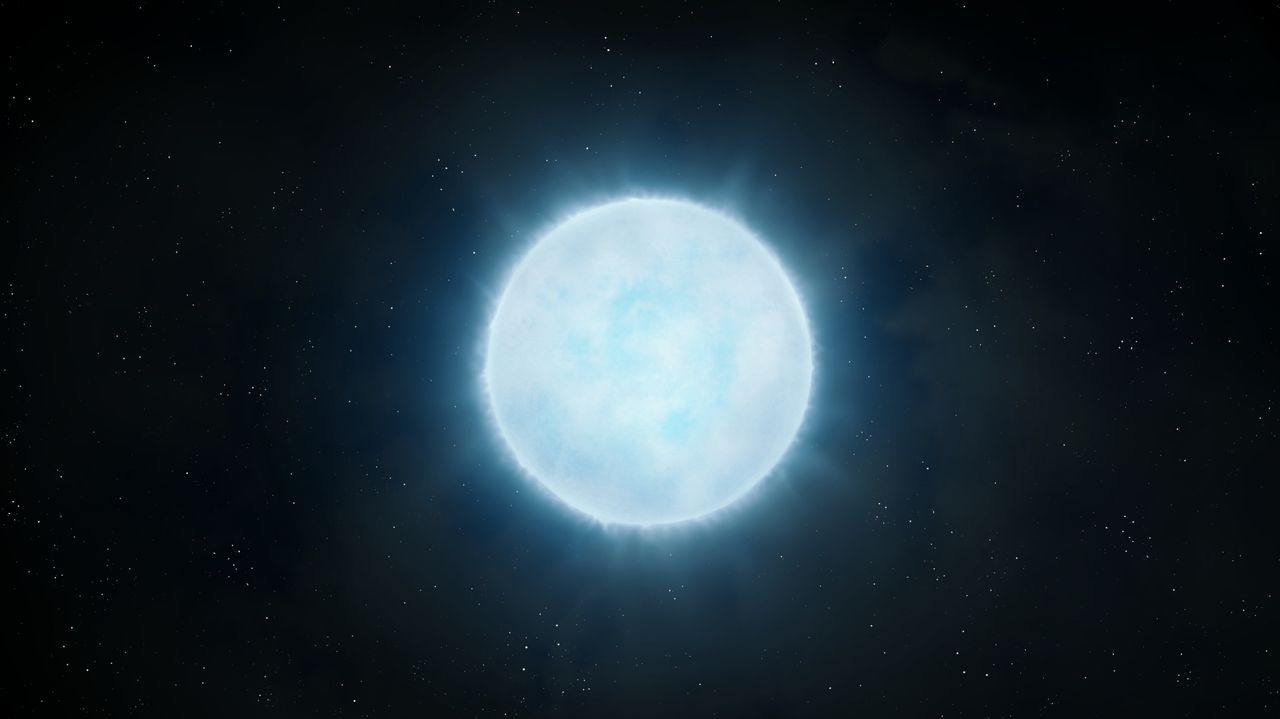
Astronomers are using old stellar remnants to investigate a mysterious particle known as the axion, a potential candidate for dark matter. A recent study published in November 2025 on the preprint server arXiv utilized archival data from the Hubble Space Telescope to explore the effects of axions on white dwarfs, the dense cores of dying stars. While researchers did not find direct evidence for axions, their findings provided crucial insights into the behavior of these elusive particles.
The search for axions began decades ago as a theoretical solution to challenges posed by the strong nuclear force. Initial attempts to detect axions through particle collider experiments proved fruitless, leading to a decline in research interest. However, recent studies have revived focus on axions as a possible explanation for dark matter, suggesting these particles might exist in abundance yet remain undetectable.
White dwarfs serve as an ideal laboratory for studying axions. These remnants can contain a mass equivalent to the sun compressed into a volume smaller than Earth. They remain stable due to a phenomenon known as electron degeneracy pressure, where a multitude of electrons resist collapse, adhering to the principles of quantum mechanics. Some theoretical models propose that axions could be produced when electrons move at extreme velocities, such as those found in the cores of white dwarfs.
In this context, the research team developed a model that predicts how the production of axions could influence the cooling rate of white dwarfs. If axions escape from these stars, they would remove energy, causing the white dwarfs to cool faster than expected. The researchers employed a sophisticated software suite to simulate the evolution of white dwarfs, examining their temperature and brightness over time while accounting for potential axion cooling.
To validate their model, the team analyzed data from the globular cluster 47 Tucanae, where all white dwarfs formed around the same time, providing a substantial sample for study. Despite their investigation, the researchers found no evidence supporting axion cooling among the white dwarf population. However, their results imposed new constraints on the production efficiency of axions by electrons, indicating that such interactions occur no more than once in a trillion opportunities.
While these findings do not completely rule out the existence of axions, they suggest that direct interactions between electrons and axions are unlikely. As a result, astronomers may need to adopt innovative approaches to continue the search for these hypothetical particles.
This research highlights the ongoing quest to unravel the mysteries of dark matter and its potential constituents. The insights gained from studying white dwarfs not only enhance our understanding of stellar evolution but also pave the way for future investigations into the fundamental nature of the universe.

Robinhood Stock Surges 2.5% in Early Trading on March 17

Israel Intensifies Strikes as Global Energy Crisis Looms

CALV Offers Class on Communication Skills for Real Estate Professionals

Historic Bideford Pub Reopens as The Patch Wine Bar & Kitchen

Oscar Night Celebrations: Winners, Guests, and Exclusive After-Parties

Samsung Galaxy Watch 9 Set for Larger Battery Boost, Report Reveals

Kibble vs. Fresh Dog Food: What’s Best for Your Dog’s Health?

Acclaimed San Francisco Pizzeria Del Popolo to Close in May

‘Invincible’ Season 4 Launches on Prime Video with Epic Action

ALMA Discovers Companion Orbiting Giant Red Star π 1 Gruis

Doctoral Candidate Trivanni Yadav Advances Battery Research at UTulsa

Global Air Forces Ranked by Annual Defense Budgets in 2025

Rev. Bry Shields to Retire as McGill-Toolen President in 2026

Mass Production of F-35 Fighter Jet Drives Down Costs

Tucson Celebrates Life and Remembrance at 36th Annual All Souls Procession

Gold Investment Surge: Top Mutual Funds and ETF Alternatives

DirecTV to Launch AI-Driven Ads with User Likenesses in 2026

Paul Giamatti Reveals Villainous Role in Star Trek: Starfleet Academy
-
 Science9 months ago
ALMA Discovers Companion Orbiting Giant Red Star π 1 Gruis
-
 Science8 months ago
Doctoral Candidate Trivanni Yadav Advances Battery Research at UTulsa
-
 World10 months ago
Global Air Forces Ranked by Annual Defense Budgets in 2025
-
 Lifestyle10 months ago
Rev. Bry Shields to Retire as McGill-Toolen President in 2026
-
 World10 months ago
Mass Production of F-35 Fighter Jet Drives Down Costs
-
 Lifestyle9 months ago
Tucson Celebrates Life and Remembrance at 36th Annual All Souls Procession
-
 Business10 months ago
Gold Investment Surge: Top Mutual Funds and ETF Alternatives
-
 Top Stories10 months ago
DirecTV to Launch AI-Driven Ads with User Likenesses in 2026
-
 Entertainment10 months ago
Paul Giamatti Reveals Villainous Role in Star Trek: Starfleet Academy
-

 Lifestyle8 months ago
Maumee’s Shop With a Hero Event Delivers Joy to Local Children
-

 Top Stories10 months ago
New ‘Star Trek: Voyager’ Game Demo Released, Players Test Limits
-

 Lifestyle8 months ago
Cape May Shines as New Jersey’s Only Entry on Beach Town List