
Science
Researchers Uncover New Insights into Fuel Cell Catalyst Dynamics

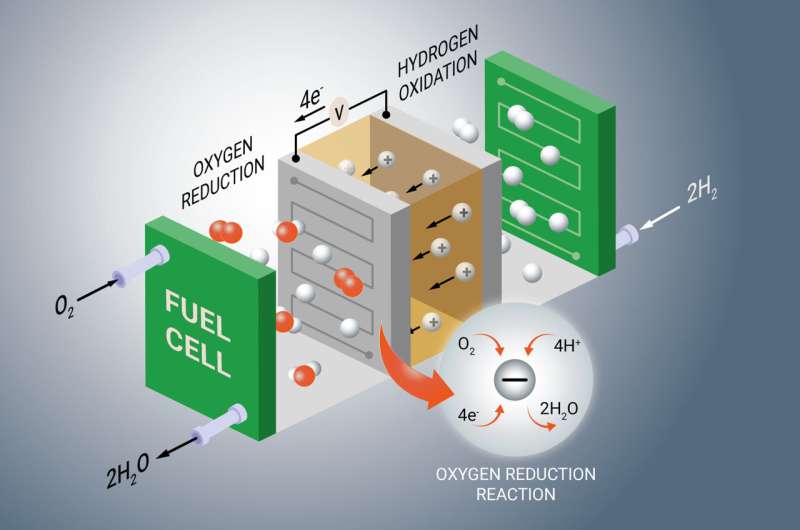
Researchers from the Fritz Haber Institute of the Max Planck Society have made significant advancements in understanding fuel cell catalyst mechanisms. Their study, published on January 5, 2026, in Nature Communications, reveals how various steps during the oxygen reduction reaction (ORR) influence catalyst kinetics, particularly in relation to changes at the catalyst-solution interface.
Key Findings on Catalyst Dynamics
The research, led by Dr. Öner and involving team members Dr. Silva and Jody Druce, focuses on the kinetics of the ORR across four different catalysts under conditions relevant to practical fuel cells. The team found that traditional views of catalyst activity, which typically simplify multi-step processes to a single rate-determining step, do not fully capture the complexity of these reactions. Instead, they identified that the rate-limiting steps vary with applied overpotential and oxygen pressure.
Dr. Öner states, “The traditional view in the community is that multi-step reactions can be reduced to one rate-determining intermediate. Our findings challenge this view.” The study highlights the dynamic nature of catalyst activity and emphasizes the need for a new perspective in electrocatalyst research.
Implications for Future Research
The results of this study provide vital insights into the interplay between overpotential, pressure, and catalyst activity, marking a shift in how future research may be approached. “We are now providing a kinetic framework to the findings of operando spectroscopy and microscopy that have observed bias-dependent structural and chemical changes for decades,” Dr. Öner explains.
Prof. Dr. Beatriz Roldán Cuenya, director of the Interface Science Department, underscores the importance of linking the observed changes at the catalyst-solution interface with the activation parameters that define catalyst performance. This research not only enhances understanding of catalyst functionality but also paves the way for improvements in energy conversion technologies.
The team aims to further investigate these findings, which could significantly impact the fields of energy and chemical conversion. As fuel cells continue to play a crucial role in the transition to sustainable energy solutions, such research is essential for advancing practical applications in long-range and heavy-duty transportation.
For more information, refer to the study: Alex Ricardo Silva Olaya et al, “Pressure and bias dependence of the rate-limiting steps of the oxygen reduction reaction,” Nature Communications (2025). DOI: 10.1038/s41467-025-67494-x.

Robinhood Stock Surges 2.5% in Early Trading on March 17

Israel Intensifies Strikes as Global Energy Crisis Looms

CALV Offers Class on Communication Skills for Real Estate Professionals

Historic Bideford Pub Reopens as The Patch Wine Bar & Kitchen

Oscar Night Celebrations: Winners, Guests, and Exclusive After-Parties

Samsung Galaxy Watch 9 Set for Larger Battery Boost, Report Reveals

Kibble vs. Fresh Dog Food: What’s Best for Your Dog’s Health?

Acclaimed San Francisco Pizzeria Del Popolo to Close in May

‘Invincible’ Season 4 Launches on Prime Video with Epic Action

ALMA Discovers Companion Orbiting Giant Red Star π 1 Gruis

Doctoral Candidate Trivanni Yadav Advances Battery Research at UTulsa

Global Air Forces Ranked by Annual Defense Budgets in 2025

Rev. Bry Shields to Retire as McGill-Toolen President in 2026

Mass Production of F-35 Fighter Jet Drives Down Costs

Tucson Celebrates Life and Remembrance at 36th Annual All Souls Procession

Gold Investment Surge: Top Mutual Funds and ETF Alternatives

DirecTV to Launch AI-Driven Ads with User Likenesses in 2026

Paul Giamatti Reveals Villainous Role in Star Trek: Starfleet Academy
-
 Science9 months ago
ALMA Discovers Companion Orbiting Giant Red Star π 1 Gruis
-
 Science8 months ago
Doctoral Candidate Trivanni Yadav Advances Battery Research at UTulsa
-
 World10 months ago
Global Air Forces Ranked by Annual Defense Budgets in 2025
-
 Lifestyle10 months ago
Rev. Bry Shields to Retire as McGill-Toolen President in 2026
-
 World10 months ago
Mass Production of F-35 Fighter Jet Drives Down Costs
-
 Lifestyle9 months ago
Tucson Celebrates Life and Remembrance at 36th Annual All Souls Procession
-
 Business10 months ago
Gold Investment Surge: Top Mutual Funds and ETF Alternatives
-
 Top Stories10 months ago
DirecTV to Launch AI-Driven Ads with User Likenesses in 2026
-
 Entertainment10 months ago
Paul Giamatti Reveals Villainous Role in Star Trek: Starfleet Academy
-

 Lifestyle8 months ago
Maumee’s Shop With a Hero Event Delivers Joy to Local Children
-

 Top Stories10 months ago
New ‘Star Trek: Voyager’ Game Demo Released, Players Test Limits
-

 Lifestyle8 months ago
Cape May Shines as New Jersey’s Only Entry on Beach Town List