
Science
Astronomers Discover Unusual Star System with Inside-Out Planet

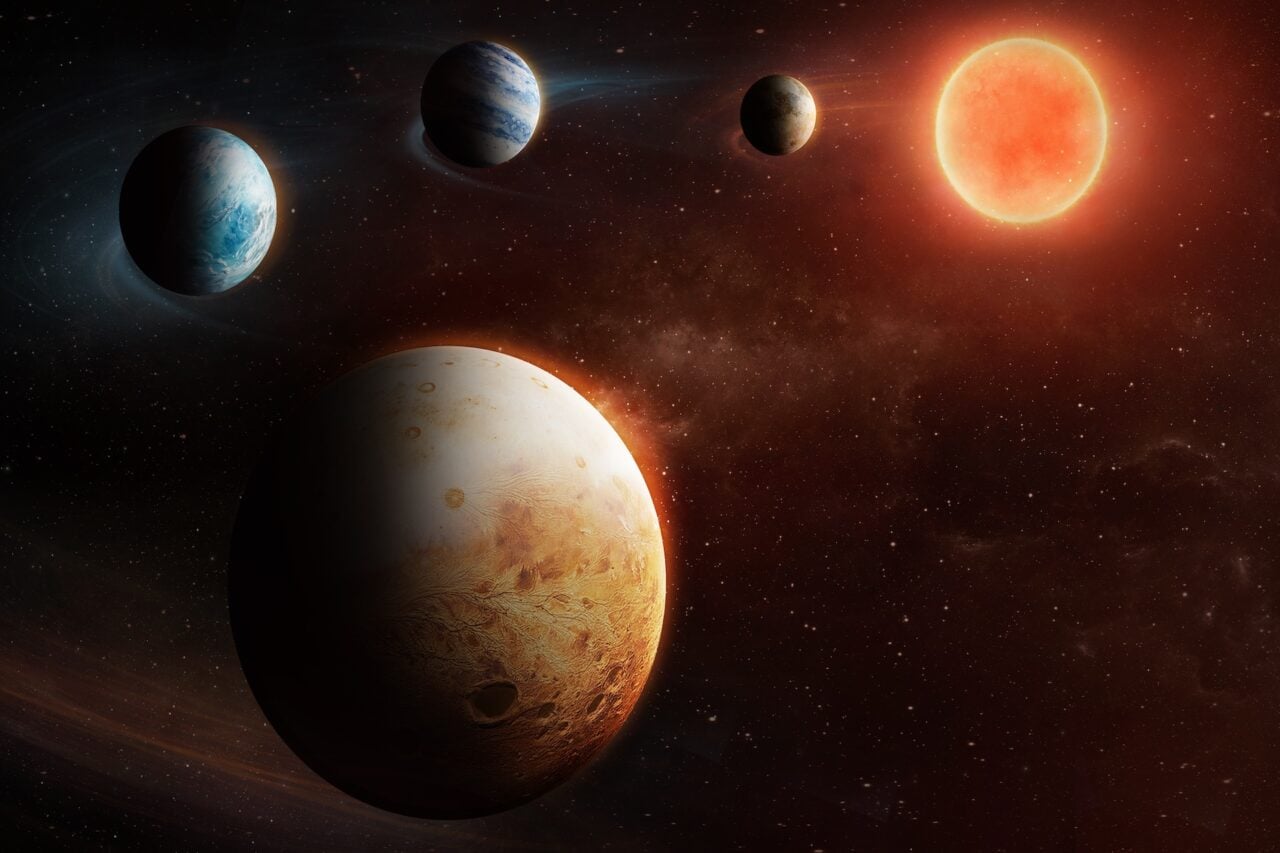
Astronomers have identified a unique star system, LHS 1903, that challenges established theories of planet formation. This discovery involves a rocky planet positioned far from its host star, contradicting the conventional understanding of how planets typically form within a star system.
The LHS 1903 system features an atypical arrangement: the closest planet is rocky, followed by two gas giants, while the outermost planet is also rocky. This configuration is unusual, as rocky planets generally form closer to their star, while gas giants are found further out. According to Thomas Wilson, a physics professor at the University of Warwick and lead author of the study, “This strange disorder makes it a unique inside-out system.”
Investigating LHS 1903
LHS 1903 is classified as a small red M-dwarf star, cooler and less luminous than the Sun. The research team utilized data from various space telescopes, including the European Space Agency’s CHEOPS telescope, to identify three planets orbiting the star. A subsequent analysis revealed a fourth planet, which was surprisingly rocky.
Current theories suggest that radiation from a star strips nearby planets of gas, leading to the formation of rocky worlds. In contrast, gas giants typically develop in cooler, outer regions where gas can accumulate. The rocky planet in LHS 1903 either lost its gaseous atmosphere or may not have formed one at all.
New Insights into Planet Formation
The researchers conducted simulations to explore various scenarios, including the possibility of the planets having swapped places or that the rocky planet had its atmosphere stripped away by an asteroid impact. These hypotheses did not hold up under scrutiny. Instead, the team found evidence suggesting that the planets did not form simultaneously.
Planets typically arise from protoplanetary discs of gas and dust around a star, emerging together. However, this study indicates that LHS 1903 may have delivered its planets sequentially. “By the time this final outer planet formed, the system may have already run out of gas, which is considered vital for planet formation,” said Wilson.
This discovery raises significant questions about existing planet formation theories. Isabel Rebollido, a research fellow at ESA, noted, “Historically, our planet formation theories are based on what we see and know about our solar system. As we are seeing more and more different exoplanet systems, we are starting to revisit these theories.”
The findings from LHS 1903 could either represent an anomaly in planetary formation or indicate a broader, previously unrecognized pattern in the universe. As astronomers continue to explore diverse star systems, the implications for our understanding of how planets form could be profound.

Robinhood Stock Surges 2.5% in Early Trading on March 17

Israel Intensifies Strikes as Global Energy Crisis Looms

CALV Offers Class on Communication Skills for Real Estate Professionals

Historic Bideford Pub Reopens as The Patch Wine Bar & Kitchen

Oscar Night Celebrations: Winners, Guests, and Exclusive After-Parties

Samsung Galaxy Watch 9 Set for Larger Battery Boost, Report Reveals

Kibble vs. Fresh Dog Food: What’s Best for Your Dog’s Health?

Acclaimed San Francisco Pizzeria Del Popolo to Close in May

‘Invincible’ Season 4 Launches on Prime Video with Epic Action

ALMA Discovers Companion Orbiting Giant Red Star π 1 Gruis

Doctoral Candidate Trivanni Yadav Advances Battery Research at UTulsa

Global Air Forces Ranked by Annual Defense Budgets in 2025

Rev. Bry Shields to Retire as McGill-Toolen President in 2026

Mass Production of F-35 Fighter Jet Drives Down Costs

Tucson Celebrates Life and Remembrance at 36th Annual All Souls Procession

Gold Investment Surge: Top Mutual Funds and ETF Alternatives

DirecTV to Launch AI-Driven Ads with User Likenesses in 2026

Paul Giamatti Reveals Villainous Role in Star Trek: Starfleet Academy
-
 Science9 months ago
ALMA Discovers Companion Orbiting Giant Red Star π 1 Gruis
-
 Science8 months ago
Doctoral Candidate Trivanni Yadav Advances Battery Research at UTulsa
-
 World10 months ago
Global Air Forces Ranked by Annual Defense Budgets in 2025
-
 Lifestyle9 months ago
Rev. Bry Shields to Retire as McGill-Toolen President in 2026
-
 World10 months ago
Mass Production of F-35 Fighter Jet Drives Down Costs
-
 Lifestyle9 months ago
Tucson Celebrates Life and Remembrance at 36th Annual All Souls Procession
-
 Business10 months ago
Gold Investment Surge: Top Mutual Funds and ETF Alternatives
-
 Top Stories10 months ago
DirecTV to Launch AI-Driven Ads with User Likenesses in 2026
-
 Entertainment10 months ago
Paul Giamatti Reveals Villainous Role in Star Trek: Starfleet Academy
-

 Top Stories10 months ago
New ‘Star Trek: Voyager’ Game Demo Released, Players Test Limits
-

 Lifestyle8 months ago
Maumee’s Shop With a Hero Event Delivers Joy to Local Children
-

 Lifestyle7 months ago
Cape May Shines as New Jersey’s Only Entry on Beach Town List