
Science
Yale Researchers Unveil Synthesis of Anticancer Compound Gukulenin A

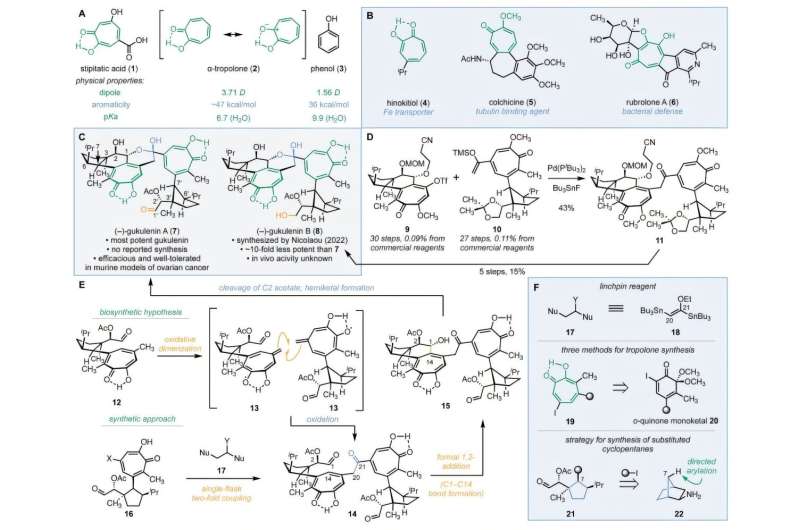
A team of researchers from Yale University has successfully achieved the first stereoselective synthesis of the complex natural product known as (–)-gukulenin A. This compound has shown significant cytotoxic effects against ovarian cancer, a particularly challenging type of cancer to treat. The accomplishment was reported on November 18, 2025, and marks a notable advancement in cancer research.
(–)-gukulenin A has long posed a challenge to chemists due to its intricate molecular structure, which includes two α-tropolones, ten distinct 3D stereocenters, and delicate functional groups such as a hemiketal and an aldehyde. To overcome these obstacles, the research team employed a novel three-component assembly method inspired by natural biosynthetic pathways. This innovative approach not only enabled the successful synthesis of (–)-gukulenin A but also led to the creation of 15 additional derivatives aimed at identifying the structural features responsible for its anticancer activity.
Insight into the Compound’s Origins and Efficacy
The journey to synthesizing (–)-gukulenin A began with research into α-tropolones, a class of molecules first theorized in the 1950s. These compounds have captivated scientists due to their unique structures and the diverse natural sources from which they have been extracted, such as tree barks, flowers, and bacteria. The specific family of molecules related to (–)-gukulenin A was discovered in the marine sponge Phorbas gukulensis, collected near Gageodo Island, South Korea. Subsequent studies revealed that gukulenins possess remarkable biological activities, with (–)-gukulenin A standing out as a potent cytotoxin, reducing ovarian tumor size by over 92% in mouse models.
In comparison to many other natural products, (–)-gukulenin A demonstrated a unique selectivity in targeting cancer cells while remaining well-tolerated in animal studies. The ability to synthesize this molecule on a larger scale could pave the way for new therapeutic options for ovarian cancer, filling a critical gap in current treatment strategies.
Innovative Synthesis Methodology
The research team tackled the synthesis of (–)-gukulenin A using a three-step process: constructing the two molecular halves, connecting them, and finalizing the delicate ring closures. For the initial phase, they utilized exo-2-norbornylamine, a rigid bicyclic molecule that naturally guided the 3D arrangement required for the synthesis. A novel ring-expansion technique was developed to transform a six-membered ring into the necessary seven-membered tropolone structure.
The two halves of the molecule were joined using a newly synthesized, previously unknown two-carbon linking reagent—(E)-1,2-di(tributylstannyl)-1-ethoxyethylene. The final step involved closing the fragile hemiketal ring, which the researchers achieved by heating the intermediate compound to 120 °C, initiating a precise reaction that completed the synthesis.
Following the successful creation of (–)-gukulenin A, the researchers applied the same methodology to design 15 additional derivatives. They evaluated the cytotoxicity of these compounds across four human cancer cell lines: lung, colon, leukemia, and ovarian. Remarkably, the derivatives featuring dimeric α-tropolone rings exhibited at least ten times greater potency than their monomeric counterparts, with some being as much as 200 times more effective.
The team hypothesizes that this heightened cytotoxicity may be linked to α-tropolone’s affinity for divalent metals, suggesting that (–)-gukulenin A could bind to two separate metal-containing proteins simultaneously. These findings not only enhance the understanding of (–)-gukulenin A’s mechanism but also lay the groundwork for future preclinical evaluations of its synthetic derivatives as potential anticancer agents.
In conclusion, the breakthrough in synthesizing (–)-gukulenin A represents a significant step forward in the field of cancer research. As the study is published in the journal Science, it underscores the potential for innovative solutions in the ongoing battle against ovarian cancer.

Robinhood Stock Surges 2.5% in Early Trading on March 17

Israel Intensifies Strikes as Global Energy Crisis Looms

CALV Offers Class on Communication Skills for Real Estate Professionals

Historic Bideford Pub Reopens as The Patch Wine Bar & Kitchen

Oscar Night Celebrations: Winners, Guests, and Exclusive After-Parties

Samsung Galaxy Watch 9 Set for Larger Battery Boost, Report Reveals

Kibble vs. Fresh Dog Food: What’s Best for Your Dog’s Health?

Acclaimed San Francisco Pizzeria Del Popolo to Close in May

‘Invincible’ Season 4 Launches on Prime Video with Epic Action

ALMA Discovers Companion Orbiting Giant Red Star π 1 Gruis

Doctoral Candidate Trivanni Yadav Advances Battery Research at UTulsa

Global Air Forces Ranked by Annual Defense Budgets in 2025

Rev. Bry Shields to Retire as McGill-Toolen President in 2026

Mass Production of F-35 Fighter Jet Drives Down Costs

Tucson Celebrates Life and Remembrance at 36th Annual All Souls Procession

Gold Investment Surge: Top Mutual Funds and ETF Alternatives

DirecTV to Launch AI-Driven Ads with User Likenesses in 2026

Paul Giamatti Reveals Villainous Role in Star Trek: Starfleet Academy
-
 Science9 months ago
ALMA Discovers Companion Orbiting Giant Red Star π 1 Gruis
-
 Science8 months ago
Doctoral Candidate Trivanni Yadav Advances Battery Research at UTulsa
-
 World10 months ago
Global Air Forces Ranked by Annual Defense Budgets in 2025
-
 Lifestyle9 months ago
Rev. Bry Shields to Retire as McGill-Toolen President in 2026
-
 World10 months ago
Mass Production of F-35 Fighter Jet Drives Down Costs
-
 Lifestyle9 months ago
Tucson Celebrates Life and Remembrance at 36th Annual All Souls Procession
-
 Business10 months ago
Gold Investment Surge: Top Mutual Funds and ETF Alternatives
-
 Top Stories10 months ago
DirecTV to Launch AI-Driven Ads with User Likenesses in 2026
-
 Entertainment10 months ago
Paul Giamatti Reveals Villainous Role in Star Trek: Starfleet Academy
-

 Top Stories10 months ago
New ‘Star Trek: Voyager’ Game Demo Released, Players Test Limits
-

 Lifestyle8 months ago
Maumee’s Shop With a Hero Event Delivers Joy to Local Children
-

 Lifestyle7 months ago
Cape May Shines as New Jersey’s Only Entry on Beach Town List