
Science
Ancient Burials Reveal Menga Dolmen’s Cultural Importance

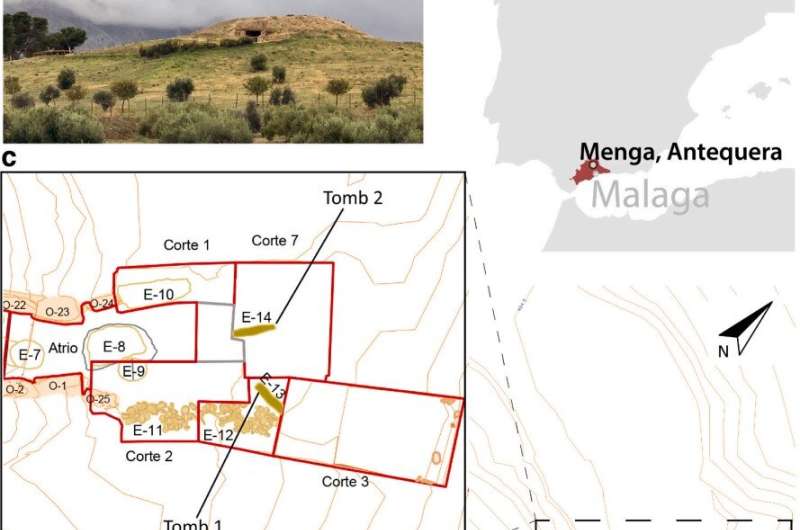
The recent study of medieval burials at the Menga dolmen in Antequera, Spain, has unveiled insights into its long-standing multicultural significance. This Neolithic monument, which dates back to the fourth millennium BCE, has served various communities for rituals and burials throughout the Bronze Age, Iron Age, Antiquity, and into medieval times. Published in the Journal of Archaeological Science: Reports, the research integrates DNA evidence from these burials with the historical and archaeological context of the region.
Continued Use of the Menga Dolmen
The Menga dolmen is distinguished by its megalithic structure, including a lengthy chamber and access corridor, originally used as a communal burial site for Neolithic populations. Previous studies have indicated its continued use in later periods, supported by findings of pottery and human remains. Analysis of faunal and human remains revealed significant funerary activity during the 2nd to 4th centuries AD, alongside a settlement phase from the 5th to 7th centuries AD.
This latest research, however, zeroes in on two distinct medieval burials, dated approximately to the 8th century AD and the 11th century AD, based on radiocarbon dating of the skeletal remains. The research team noted that the remains were poorly preserved, which hindered their ability to establish genetic connections between the individuals. Nonetheless, similarities in the positioning of the burials were apparent. Both individuals were found lying on their right sides, heads pointing southwest, aligning with the monument’s axis of symmetry, while their faces oriented southeast.
During the timeframe of these burials, the Iberian Peninsula was under Islamic rule, yet it also housed Christian, Jewish, and possibly pagan communities. The diverse burial practices observed suggest a blend of different ritualistic traditions. The researchers commented, “The position and orientation of the remains, together with the radiocarbon dates, could be indicative of Islamic burials. However, the apparent symbolic alignment of the inhumations with the axis of symmetry of the Menga megalithic monument complicates interpretation in such a multicultural and multi-faith society as medieval Iberia.”
Diverse Lineages Revealed Through DNA
The research team conducted DNA analysis on both individuals, managing to extract usable data only from the individual designated as “Menga1.” The analysis indicated that Menga1 was male and exhibited a European Y-chromosome lineage. Furthermore, mitochondrial DNA (mtDNA) suggested a connection to some modern North African populations. The autosomal DNA analysis revealed a blend of Iberian, North African, and Levantine ancestry, approximately comprising 44% Iberian, 18% North African, and 37% Levantine DNA.
According to the authors, “North African-related (as well as, to a lesser extent, Levantine related) ancestry was widespread across south Iberia since at least the third/fourth century CE, likely linked to regular movements of people across the Mediterranean facilitated by Greek, Phoenician, and Carthaginian trade, and later, the Roman Empire.” They noted that following the onset of the Islamic period in 711 CE, interactions with North Africa likely intensified, driven by political changes and shared cultural practices.
This comprehensive study not only highlights the cultural diversity present in medieval Spain but also underscores the enduring significance of the Menga dolmen as a burial site over millennia. The authors concluded, “Whoever these two individuals were—and regardless of what faith they practiced—their inhumations aligned with the axis of a megalithic monument in a site of remarkable prominence in the landscape of Antequera, approximately two centuries apart, illustrates the continuity of Menga as a symbolic location for over 5,000 years—and possibly even longer—well beyond the Neolithic period.”

Robinhood Stock Surges 2.5% in Early Trading on March 17

Israel Intensifies Strikes as Global Energy Crisis Looms

CALV Offers Class on Communication Skills for Real Estate Professionals

Historic Bideford Pub Reopens as The Patch Wine Bar & Kitchen

Oscar Night Celebrations: Winners, Guests, and Exclusive After-Parties

Samsung Galaxy Watch 9 Set for Larger Battery Boost, Report Reveals

Kibble vs. Fresh Dog Food: What’s Best for Your Dog’s Health?

Acclaimed San Francisco Pizzeria Del Popolo to Close in May

‘Invincible’ Season 4 Launches on Prime Video with Epic Action

ALMA Discovers Companion Orbiting Giant Red Star π 1 Gruis

Doctoral Candidate Trivanni Yadav Advances Battery Research at UTulsa

Global Air Forces Ranked by Annual Defense Budgets in 2025

Rev. Bry Shields to Retire as McGill-Toolen President in 2026

Mass Production of F-35 Fighter Jet Drives Down Costs

Tucson Celebrates Life and Remembrance at 36th Annual All Souls Procession

Gold Investment Surge: Top Mutual Funds and ETF Alternatives

DirecTV to Launch AI-Driven Ads with User Likenesses in 2026

Paul Giamatti Reveals Villainous Role in Star Trek: Starfleet Academy
-
 Science9 months ago
ALMA Discovers Companion Orbiting Giant Red Star π 1 Gruis
-
 Science8 months ago
Doctoral Candidate Trivanni Yadav Advances Battery Research at UTulsa
-
 World10 months ago
Global Air Forces Ranked by Annual Defense Budgets in 2025
-
 Lifestyle9 months ago
Rev. Bry Shields to Retire as McGill-Toolen President in 2026
-
 World10 months ago
Mass Production of F-35 Fighter Jet Drives Down Costs
-
 Lifestyle9 months ago
Tucson Celebrates Life and Remembrance at 36th Annual All Souls Procession
-
 Business10 months ago
Gold Investment Surge: Top Mutual Funds and ETF Alternatives
-
 Top Stories10 months ago
DirecTV to Launch AI-Driven Ads with User Likenesses in 2026
-
 Entertainment10 months ago
Paul Giamatti Reveals Villainous Role in Star Trek: Starfleet Academy
-

 Top Stories10 months ago
New ‘Star Trek: Voyager’ Game Demo Released, Players Test Limits
-

 Lifestyle8 months ago
Maumee’s Shop With a Hero Event Delivers Joy to Local Children
-

 Lifestyle7 months ago
Cape May Shines as New Jersey’s Only Entry on Beach Town List