
Science
Ancient Rock Art Dated Over 67,000 Years Unveils Human Migration

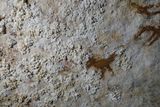
A newly published study reveals that the oldest known rock art, a human hand stencil, is over 67,000 years old. This discovery, made in a cave on a satellite island of Sulawesi, Indonesia, provides critical insights into early human migration patterns, particularly those of Homo sapiens as they ventured toward Australia. The findings, detailed in the journal Nature, indicate that this stencil predates previous rock art discoveries in the region by approximately 16,600 years.
The stencil, located in the Liang Metanduno cave, depicts a hand that appears claw-like, suggesting a rich artistic tradition among the island’s early inhabitants. According to study author Maxime Aubert from the Griffith Centre for Social and Cultural Research, “It is now evident from our new phase of research that Sulawesi was home to one of the world’s richest and most longstanding artistic cultures.” This culture dates back to at least 67,800 years ago, coinciding with some of the earliest human occupation of the island.
Sulawesi has long been recognized as a significant site for understanding human history. The island has preserved some of the oldest known cave art, which includes both human and animal figures. Previous studies published in Nature have suggested that these artistic expressions might depict hunting scenes, reflecting the life and activities of our ancestors.
The recent study not only highlights the artistic heritage of Sulawesi but also its role as a possible stepping stone for early human migrations. The research indicates that this island may have served as a crucial point for Homo sapiens moving from Asia to the ancient paleocontinent known as Sahul, which once united Australia, New Guinea, and Tasmania.
The 67,800-year-old stencil is among several stencils identified during the research, which also examined other ancient rock art throughout the region. The study employed advanced techniques such as uranium-series dating and mineral deposit analysis to confirm the age of these artworks. The claw-like stencil is attributed to an artist likely connected to the ancestors of modern Aboriginal Australians.
As noted by study co-author Adhi Agus Oktaviana from Indonesia’s National Research and Innovation Agency, “It is very likely that the people who made these paintings in Sulawesi were part of the broader population that would later spread through the region and ultimately reach Australia.” This supports the hypothesis that the ancestors of the First Australians were present in Sahul by approximately 65,000 years ago.
The research further elaborates on previous theories regarding the timelines of human arrival in Sahul. These theories generally propose two migration timelines: the “long chronology” around 65,000 years ago and the “short chronology” around 50,000 years ago. The study reinforces the idea that modern humans likely traveled to Sahul via two distinct island-hopping routes, one through Sulawesi and the other through Timor.
The Liang Metanduno cave also contains younger paintings, suggesting a prolonged period of human occupation that could span 35,000 years or more. As highlighted by Renaud Joannes-Boyau, a member of the Geoarchaeology and Archaeometry Research Group at Southern Cross University, “With the dating of this extremely ancient rock art in Sulawesi, we now have the oldest direct evidence for the presence of modern humans along this northern migration corridor into Sahul.”
Looking ahead, the research team aims to continue exploring ancient art and migration patterns across Indonesia, particularly on islands that lie between Sulawesi and New Guinea. Aubert emphasized the archaeological significance of these other islands, hinting at exciting potential for future discoveries.
This groundbreaking research not only sheds light on the artistic expressions of our ancestors but also provides a clearer understanding of the migration routes that shaped the early human presence in Australia. As the study unfolds, it highlights the importance of Sulawesi and its surrounding regions in piecing together the complex puzzle of human history.

Robinhood Stock Surges 2.5% in Early Trading on March 17

Israel Intensifies Strikes as Global Energy Crisis Looms

CALV Offers Class on Communication Skills for Real Estate Professionals

Historic Bideford Pub Reopens as The Patch Wine Bar & Kitchen

Oscar Night Celebrations: Winners, Guests, and Exclusive After-Parties

Samsung Galaxy Watch 9 Set for Larger Battery Boost, Report Reveals

Kibble vs. Fresh Dog Food: What’s Best for Your Dog’s Health?

Acclaimed San Francisco Pizzeria Del Popolo to Close in May

‘Invincible’ Season 4 Launches on Prime Video with Epic Action

ALMA Discovers Companion Orbiting Giant Red Star π 1 Gruis

Doctoral Candidate Trivanni Yadav Advances Battery Research at UTulsa

Global Air Forces Ranked by Annual Defense Budgets in 2025

Rev. Bry Shields to Retire as McGill-Toolen President in 2026

Mass Production of F-35 Fighter Jet Drives Down Costs

Tucson Celebrates Life and Remembrance at 36th Annual All Souls Procession

Gold Investment Surge: Top Mutual Funds and ETF Alternatives

DirecTV to Launch AI-Driven Ads with User Likenesses in 2026

Paul Giamatti Reveals Villainous Role in Star Trek: Starfleet Academy
-
 Science9 months ago
ALMA Discovers Companion Orbiting Giant Red Star π 1 Gruis
-
 Science8 months ago
Doctoral Candidate Trivanni Yadav Advances Battery Research at UTulsa
-
 World10 months ago
Global Air Forces Ranked by Annual Defense Budgets in 2025
-
 Lifestyle10 months ago
Rev. Bry Shields to Retire as McGill-Toolen President in 2026
-
 World10 months ago
Mass Production of F-35 Fighter Jet Drives Down Costs
-
 Lifestyle9 months ago
Tucson Celebrates Life and Remembrance at 36th Annual All Souls Procession
-
 Business10 months ago
Gold Investment Surge: Top Mutual Funds and ETF Alternatives
-
 Top Stories10 months ago
DirecTV to Launch AI-Driven Ads with User Likenesses in 2026
-
 Entertainment10 months ago
Paul Giamatti Reveals Villainous Role in Star Trek: Starfleet Academy
-

 Lifestyle8 months ago
Maumee’s Shop With a Hero Event Delivers Joy to Local Children
-

 Top Stories10 months ago
New ‘Star Trek: Voyager’ Game Demo Released, Players Test Limits
-

 Lifestyle7 months ago
Cape May Shines as New Jersey’s Only Entry on Beach Town List