
Science
Astronomers Uncover Massive Cosmic Sheet Surrounding Milky Way

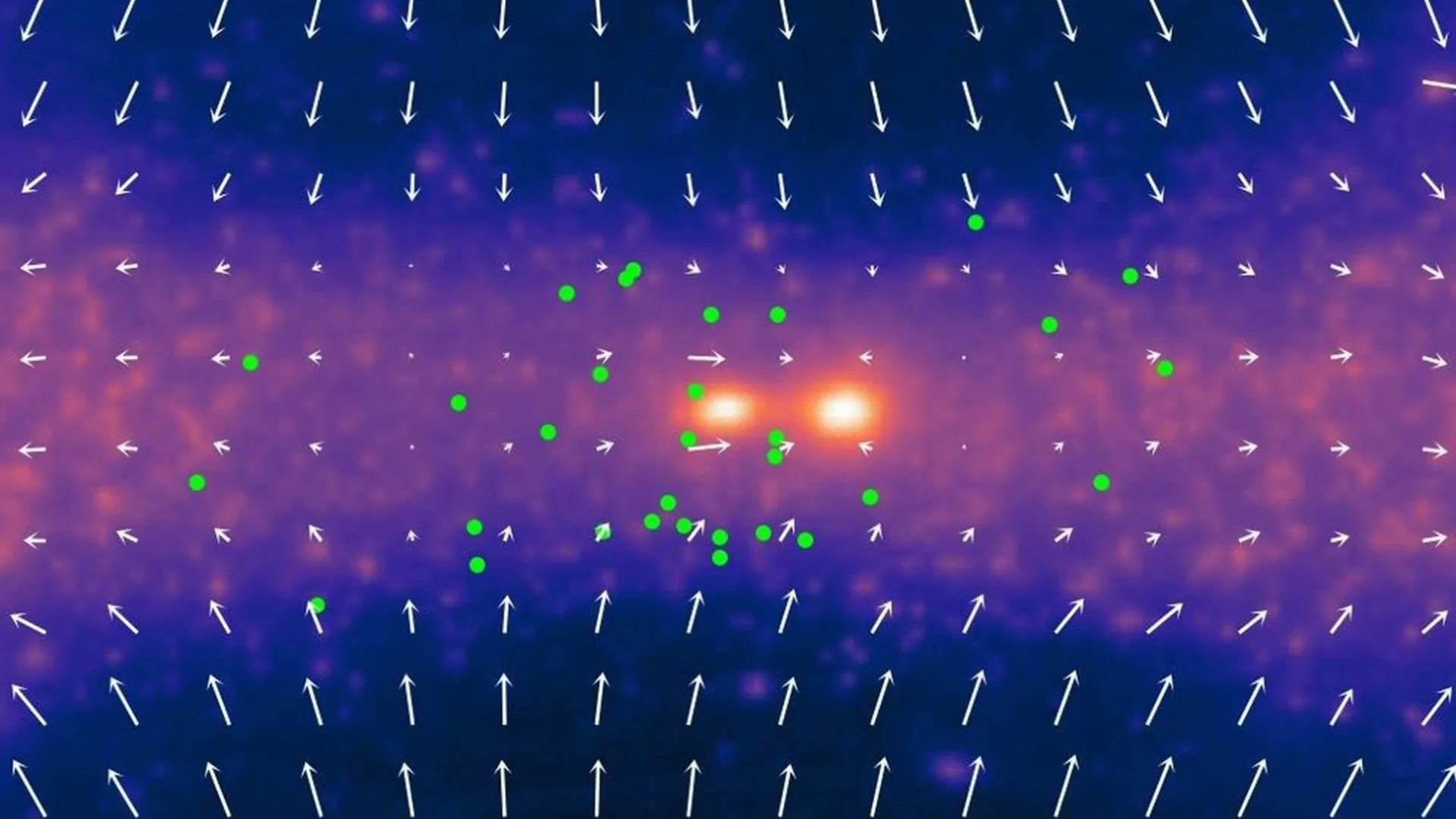
A team of researchers from the University of Groningen has made a groundbreaking discovery regarding the structure of the universe surrounding the Milky Way. They have identified a massive, flat sheet of matter that significantly influences the movement of nearby galaxies. This finding, published on March 6, 2026, provides a long-awaited explanation for why most neighboring galaxies are moving away from the Milky Way rather than being drawn closer by its gravitational pull.
Understanding the Cosmic Sheet
For decades, astronomers have grappled with the question of why galaxies in proximity to the Milky Way, aside from the Andromeda Galaxy, appear to be receding. This phenomenon contradicted the expectations based on gravitational forces. The research team, led by PhD graduate Ewoud Wempe of the Kapteyn Institute, utilized advanced computer simulations to reveal that the Local Group, which includes the Milky Way and Andromeda, is enveloped by a vast, flattened cosmic structure. This sheet extends across tens of millions of light-years and is primarily composed of dark matter.
The simulations indicate that the distribution of matter around the Local Group effectively balances gravitational forces, allowing galaxies to drift outward. The presence of large empty regions, known as cosmic voids, above and below this sheet contributes to the observed motion patterns of neighboring galaxies.
Simulating the Early Universe
To construct their model, the researchers began with conditions from the early universe, employing measurements of the cosmic microwave background to estimate matter distribution shortly after the Big Bang. By advancing this early universe through time using a powerful computer, they successfully recreated the current dynamics of the Local Group and its surroundings.
The resulting model closely mirrors the observed masses, positions, and velocities of the Milky Way, Andromeda, and 31 other galaxies in the vicinity. This accurate representation has led researchers to label it as a “virtual twin” of our cosmic neighborhood. The model includes a flat distribution of matter, which aligns with actual observations of galaxies moving away from the Milky Way at comparable speeds.
Despite the gravitational influence exerted by the Local Group, the galaxies within this cosmic sheet are also affected by the additional mass spread throughout the area. This distant mass counteracts the gravitational pull of the Local Group, providing a comprehensive explanation for the observed motions.
Wempe noted the significance of their findings, stating, “This study represents the first detailed attempt to understand the distribution and motion of dark matter around the Milky Way and Andromeda. We can now explore all possible local configurations of the early universe that could lead to our current understanding of the Local Group.”
Astronomer Amina Helmi expressed enthusiasm about the study, highlighting its importance in addressing a question that has perplexed scientists for years. “It is exciting to see that we can determine a mass distribution purely based on the motions of galaxies, which corresponds to the positions of galaxies within and just outside the Local Group,” she remarked.
This discovery not only enhances our understanding of galactic dynamics but also reinforces the framework of modern cosmology. By shedding light on the complex interactions between visible and dark matter, astronomers can better comprehend the evolution of the universe and the forces that shape it.

Robinhood Stock Surges 2.5% in Early Trading on March 17

Israel Intensifies Strikes as Global Energy Crisis Looms

CALV Offers Class on Communication Skills for Real Estate Professionals

Historic Bideford Pub Reopens as The Patch Wine Bar & Kitchen

Oscar Night Celebrations: Winners, Guests, and Exclusive After-Parties

Samsung Galaxy Watch 9 Set for Larger Battery Boost, Report Reveals

Kibble vs. Fresh Dog Food: What’s Best for Your Dog’s Health?

Acclaimed San Francisco Pizzeria Del Popolo to Close in May

‘Invincible’ Season 4 Launches on Prime Video with Epic Action

ALMA Discovers Companion Orbiting Giant Red Star π 1 Gruis

Doctoral Candidate Trivanni Yadav Advances Battery Research at UTulsa

Global Air Forces Ranked by Annual Defense Budgets in 2025

Rev. Bry Shields to Retire as McGill-Toolen President in 2026

Mass Production of F-35 Fighter Jet Drives Down Costs

Tucson Celebrates Life and Remembrance at 36th Annual All Souls Procession

DirecTV to Launch AI-Driven Ads with User Likenesses in 2026

Gold Investment Surge: Top Mutual Funds and ETF Alternatives

Paul Giamatti Reveals Villainous Role in Star Trek: Starfleet Academy
-
 Science9 months ago
ALMA Discovers Companion Orbiting Giant Red Star π 1 Gruis
-
 Science8 months ago
Doctoral Candidate Trivanni Yadav Advances Battery Research at UTulsa
-
 World10 months ago
Global Air Forces Ranked by Annual Defense Budgets in 2025
-
 Lifestyle9 months ago
Rev. Bry Shields to Retire as McGill-Toolen President in 2026
-
 World10 months ago
Mass Production of F-35 Fighter Jet Drives Down Costs
-
 Lifestyle9 months ago
Tucson Celebrates Life and Remembrance at 36th Annual All Souls Procession
-
 Top Stories10 months ago
DirecTV to Launch AI-Driven Ads with User Likenesses in 2026
-
 Business10 months ago
Gold Investment Surge: Top Mutual Funds and ETF Alternatives
-
 Entertainment10 months ago
Paul Giamatti Reveals Villainous Role in Star Trek: Starfleet Academy
-

 Top Stories10 months ago
New ‘Star Trek: Voyager’ Game Demo Released, Players Test Limits
-

 Lifestyle8 months ago
Maumee’s Shop With a Hero Event Delivers Joy to Local Children
-

 Lifestyle7 months ago
Cape May Shines as New Jersey’s Only Entry on Beach Town List