
Science
Astronomers Unravel Mysteries of Cosmic Radio Relics

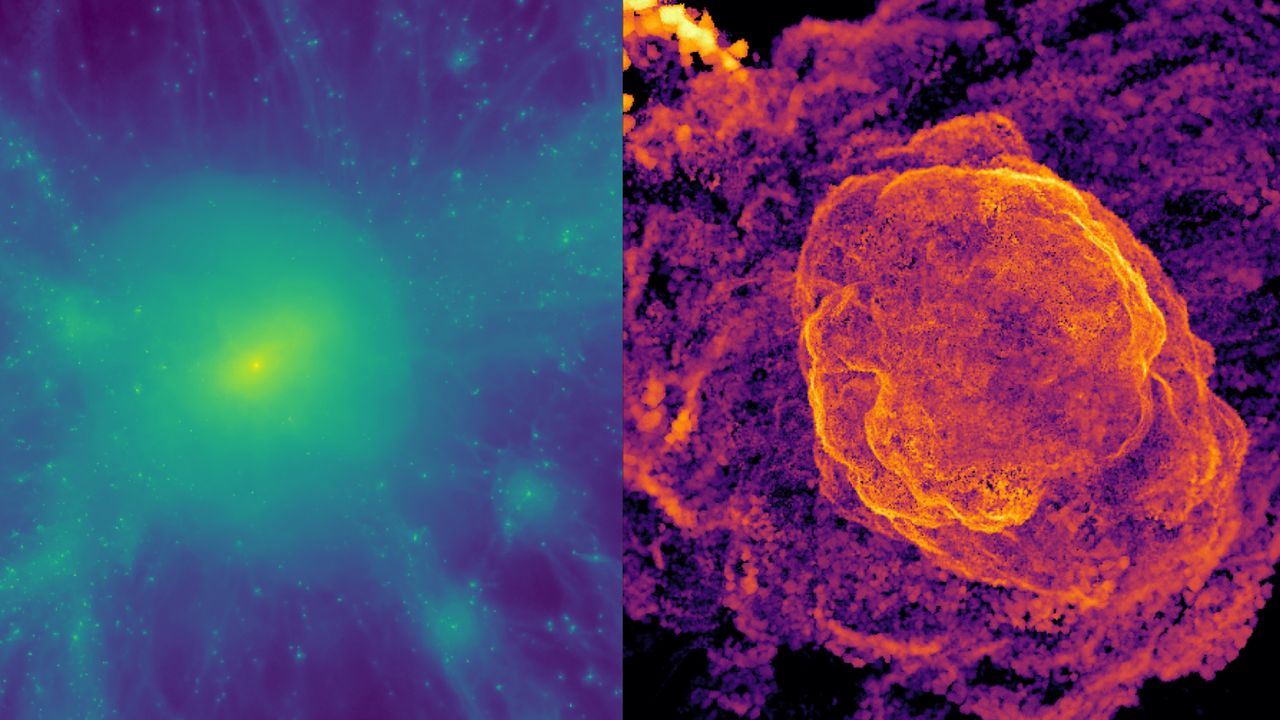
Astronomers have made significant strides in understanding the complex phenomena associated with cosmic structures known as “radio relics.” These vast arcs of diffuse radio emissions, which can stretch across millions of light-years, are the remnants of colossal galaxy cluster collisions. A new study led by researchers at the Leibniz Institute for Astrophysics Potsdam (AIP) in Germany has provided insights that may resolve longstanding questions regarding their formation and characteristics.
Radio relics are generated by shock waves that accelerate electrons to nearly the speed of light. Observations from various telescopes, including NASA’s Chandra X-ray Observatory and Europe’s XMM-Newton, have revealed that the magnetic fields associated with these relics are often stronger than theoretical models had predicted. Additionally, discrepancies between measurements taken in radio and X-ray wavelengths have puzzled scientists for years. In some cases, X-ray data suggested that shock waves were too weak to produce the observed radio emissions, challenging the very existence of these intriguing structures.
The recent study, published in the journal Astronomy & Astrophysics and made available on the pre-print repository arXiv on November 18, 2023, offers a comprehensive explanation of these phenomena. The research team utilized high-resolution simulations to analyze the formation and evolution of radio relics, successfully reproducing the puzzling behaviors observed in real-world data.
Innovative Simulations Shed Light on Cosmic Phenomena
Lead author Joseph Whittingham, a postdoctoral researcher at AIP, explained that the team’s approach involved a range of scales, allowing them to tackle the complexities of radio relic formation. By employing a suite of cosmological simulations, they modeled the growth and collision of galaxy clusters over billions of years. One particularly energetic merger examined involved two clusters, with one being approximately 2.5 times heavier than the other.
As these massive clusters merged, they produced enormous shock waves that expanded nearly 7 million light-years. Building on these results, the team conducted higher-resolution “shock-tube” simulations, enabling them to focus on the micro-physics of a single shock wave interacting with the turbulent outskirts of the galaxy clusters. This detailed analysis provided crucial insights into how electrons are accelerated at the shock front and the resultant radio emissions detected by telescopes.
The simulations revealed that as a shock wave propagates through a galaxy cluster, it interacts with additional shocks generated by cold gas falling from the cosmic web. This interaction creates a dense sheet of plasma that collides with smaller gas clumps, leading to turbulence that amplifies magnetic field strengths beyond what a single shock could produce. This finding aligns with the unexpectedly strong magnetic values observed in real radio relics.
Resolving Discrepancies in Observations
The study also clarifies that when a shock wave interacts with dense gas clumps, certain regions of the shock front accelerate electrons more efficiently, leading to bright, compact patches that dominate the radio signals. In contrast, X-ray measurements capture an average of the shock’s strength, including weaker areas, explaining the discrepancies that have perplexed astronomers.
The simulations indicate that only the most intense, localized segments of the shock front contribute significantly to the radio emissions. Thus, the lower average strengths derived from X-ray data do not undermine the underlying physics of radio relics.
The findings from this research provide a cohesive framework that reconciles various magnetic, radio, and X-ray features of real radio relics. “This success motivates us to build on our study to answer the remaining unresolved mysteries surrounding radio relics,” Whittingham stated.
As astronomers continue to explore the vastness of the universe, this breakthrough offers a clearer understanding of the intricate processes that shape the cosmos. The research not only enhances our knowledge of radio relics but also sets the stage for further investigations into the mysteries of galaxy clusters and their interactions.

Robinhood Stock Surges 2.5% in Early Trading on March 17

Israel Intensifies Strikes as Global Energy Crisis Looms

CALV Offers Class on Communication Skills for Real Estate Professionals

Historic Bideford Pub Reopens as The Patch Wine Bar & Kitchen

Oscar Night Celebrations: Winners, Guests, and Exclusive After-Parties

Samsung Galaxy Watch 9 Set for Larger Battery Boost, Report Reveals

Kibble vs. Fresh Dog Food: What’s Best for Your Dog’s Health?

Acclaimed San Francisco Pizzeria Del Popolo to Close in May

‘Invincible’ Season 4 Launches on Prime Video with Epic Action

ALMA Discovers Companion Orbiting Giant Red Star π 1 Gruis

Doctoral Candidate Trivanni Yadav Advances Battery Research at UTulsa

Global Air Forces Ranked by Annual Defense Budgets in 2025

Mass Production of F-35 Fighter Jet Drives Down Costs

Gold Investment Surge: Top Mutual Funds and ETF Alternatives

DirecTV to Launch AI-Driven Ads with User Likenesses in 2026

New ‘Star Trek: Voyager’ Game Demo Released, Players Test Limits

Paul Giamatti Reveals Villainous Role in Star Trek: Starfleet Academy

Freeport Art Gallery Transforms Waste into Creative Masterpieces
-
 Science6 months ago
ALMA Discovers Companion Orbiting Giant Red Star π 1 Gruis
-
 Science6 months ago
Doctoral Candidate Trivanni Yadav Advances Battery Research at UTulsa
-
 World7 months ago
Global Air Forces Ranked by Annual Defense Budgets in 2025
-
 World7 months ago
Mass Production of F-35 Fighter Jet Drives Down Costs
-
 Business7 months ago
Gold Investment Surge: Top Mutual Funds and ETF Alternatives
-
 Top Stories7 months ago
DirecTV to Launch AI-Driven Ads with User Likenesses in 2026
-
 Top Stories7 months ago
New ‘Star Trek: Voyager’ Game Demo Released, Players Test Limits
-
 Entertainment7 months ago
Paul Giamatti Reveals Villainous Role in Star Trek: Starfleet Academy
-
 Entertainment7 months ago
Freeport Art Gallery Transforms Waste into Creative Masterpieces
-
 Science7 months ago
NTSB Report Reveals Hull Damage Caused Titan Submersible Implosion
-

 Lifestyle7 months ago
Rev. Bry Shields to Retire as McGill-Toolen President in 2026
-
 Entertainment7 months ago
Fast & Furious Coaster Hits the Track at Universal Studios