
Science
Astronomers Unveil New Insights into Planet Formation Using SPAM

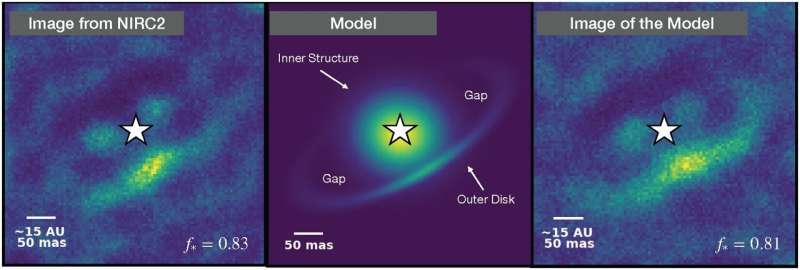
Researchers at the W. M. Keck Observatory in Maunakea, Hawaiʻi Island, have gained unprecedented insights into the formation of planets. Using advanced imaging techniques, they examined the dusty regions surrounding a young star, known as HD 34282, marking a significant step in understanding how planetary systems develop.
The study, which is part of a project called The Search for Protoplanets with Aperture Masking (SPAM), highlights the importance of examining protoplanetary disks. According to Christina Vides, a graduate student at the University of California Irvine and lead author of the research published in The Astrophysical Journal, “By studying systems like this, we can watch planet formation in action and learn what conditions give rise to worlds like our own.”
Detailed Observations of Planet Nurseries
The team utilized the Near-Infrared Camera (NIRC2) at the Keck Observatory, which enables astronomers to obtain clearer images closer to stars than traditional methods allow. HD 34282, located approximately 400 light-years from Earth, is surrounded by a dense ring of dust and gas, referred to as a “transition disk.” This structure is believed to be influenced by the gravitational effects of forming planets.
The observations revealed intricate clumpy structures and brightness patterns within the disk of HD 34282, suggesting potential planet-forming activity. Although the team did not detect any confirmed protoplanets, they were able to provide new constraints regarding where these young planets might be located. They also estimated the mass of the star and its accretion rate, both of which are crucial for understanding how the surrounding material could eventually form planets.
A Rare Opportunity to Understand Planetary Formation
Detecting protoplanets is a challenging task, with only two confirmed cases—PDS 70 b and PDS 70 c—previously imaged directly. Both of these protoplanets were identified in 2020 by researchers at Caltech using the same NIRC2 instrument. Each new observation offers further insights into the dynamics of planetary systems emerging from swirling disks of gas and dust.
“This work is pushing the boundaries of what we can see,” Vides noted. “Keck’s adaptive optics and masking capabilities make it possible to resolve features just a few astronomical units from the star—regions that are otherwise completely invisible.”
The team plans to continue its research, focusing on other young stars with promising disks and accumulating more data for the SPAM project. Furthermore, they are preparing for future observations with advanced instrumentation, such as SCALES, a next-generation high-contrast imager currently in development for the Keck Observatory.
Vides emphasized the importance of these ongoing studies: “Every new system we study helps us understand a little more about how planets form and evolve. It’s incredible that we can point a telescope at a young star hundreds of light-years away and actually see the conditions that could give rise to new worlds.”
For further details, refer to the study by Christina L. Vides et al. titled “NIRC2 Interferometric Imaging of the HD 34282 Transition Disk’s Small Grain Structure,” published in The Astrophysical Journal (2025). DOI: 10.3847/1538-4357/ae0932.

Robinhood Stock Surges 2.5% in Early Trading on March 17

Israel Intensifies Strikes as Global Energy Crisis Looms

CALV Offers Class on Communication Skills for Real Estate Professionals

Historic Bideford Pub Reopens as The Patch Wine Bar & Kitchen

Oscar Night Celebrations: Winners, Guests, and Exclusive After-Parties

Samsung Galaxy Watch 9 Set for Larger Battery Boost, Report Reveals

Kibble vs. Fresh Dog Food: What’s Best for Your Dog’s Health?

Acclaimed San Francisco Pizzeria Del Popolo to Close in May

‘Invincible’ Season 4 Launches on Prime Video with Epic Action

ALMA Discovers Companion Orbiting Giant Red Star π 1 Gruis

Doctoral Candidate Trivanni Yadav Advances Battery Research at UTulsa

Global Air Forces Ranked by Annual Defense Budgets in 2025

Rev. Bry Shields to Retire as McGill-Toolen President in 2026

Mass Production of F-35 Fighter Jet Drives Down Costs

Tucson Celebrates Life and Remembrance at 36th Annual All Souls Procession

Gold Investment Surge: Top Mutual Funds and ETF Alternatives

DirecTV to Launch AI-Driven Ads with User Likenesses in 2026

Paul Giamatti Reveals Villainous Role in Star Trek: Starfleet Academy
-
 Science9 months ago
ALMA Discovers Companion Orbiting Giant Red Star π 1 Gruis
-
 Science8 months ago
Doctoral Candidate Trivanni Yadav Advances Battery Research at UTulsa
-
 World10 months ago
Global Air Forces Ranked by Annual Defense Budgets in 2025
-
 Lifestyle9 months ago
Rev. Bry Shields to Retire as McGill-Toolen President in 2026
-
 World10 months ago
Mass Production of F-35 Fighter Jet Drives Down Costs
-
 Lifestyle9 months ago
Tucson Celebrates Life and Remembrance at 36th Annual All Souls Procession
-
 Business10 months ago
Gold Investment Surge: Top Mutual Funds and ETF Alternatives
-
 Top Stories10 months ago
DirecTV to Launch AI-Driven Ads with User Likenesses in 2026
-
 Entertainment10 months ago
Paul Giamatti Reveals Villainous Role in Star Trek: Starfleet Academy
-

 Top Stories10 months ago
New ‘Star Trek: Voyager’ Game Demo Released, Players Test Limits
-

 Lifestyle8 months ago
Maumee’s Shop With a Hero Event Delivers Joy to Local Children
-

 Lifestyle7 months ago
Cape May Shines as New Jersey’s Only Entry on Beach Town List