
Science
Cosmic Rays from Nearby Supernova May Explain Earth-like Planets

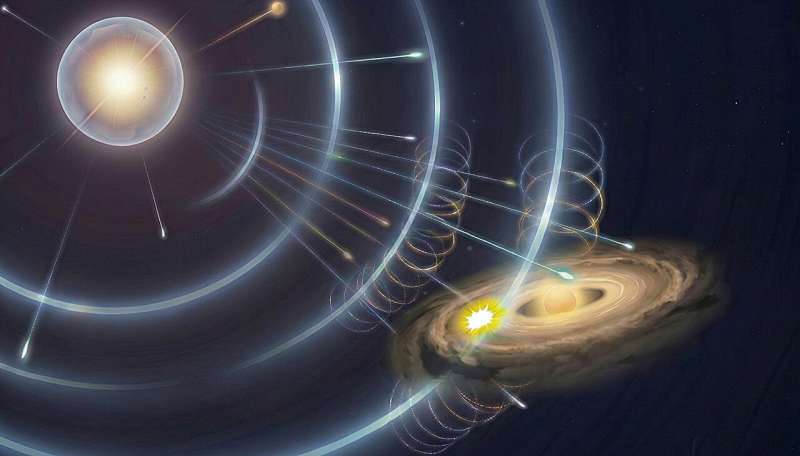
Recent research suggests that cosmic rays emitted from nearby supernovae may play a crucial role in the formation of Earth-like planets. A study led by astrophysicist Ryo Sawada from the Institute for Cosmic Ray Research at the University of Tokyo reveals that the early solar system could have been enriched with essential radioactive elements through interactions with cosmic rays, rather than relying solely on the less likely scenario of direct supernova explosions.
For decades, scientists have theorized that short-lived radioactive elements, notably aluminum-26, were introduced into the early solar system by a supernova. This enrichment is believed to have influenced the formation of rocky planets like Earth by heating young planetesimals and causing them to lose significant amounts of water and volatile materials. However, the traditional understanding of this mechanism hinges on an extraordinary coincidence: the supernova must explode at a precise distance to deliver radioactive material without destroying the fragile protoplanetary disk.
Sawada’s new study, published on December 21, 2025, in the journal Science Advances, challenges this notion. He proposes that instead of relying on a rare injection event, the young solar system may have been surrounded by a “cosmic-ray bath.” These cosmic rays, produced by the shock waves of supernovae, serve as powerful accelerators that generate high-energy particles. When these particles interact with the protosolar disk, they can induce nuclear reactions that create short-lived radioactive elements, including aluminum-26.
The research team conducted numerical simulations to investigate this process. They discovered that the necessary amounts of radioactive elements could be generated at distances of about one parsec from a supernova, a common distance in star clusters. This finding indicates that the early solar system could have formed in a stellar nursery containing massive stars, which is a more prevalent scenario than previously considered.
The implications of this research extend beyond just the formation of Earth-like planets. If the process of cosmic-ray immersion is common, then the thermal histories that shaped Earth’s interior may also be typical in environments where sun-like stars form. This suggests that water-depleted rocky planets might be more common in the universe than previously thought.
While the study does not claim that every habitable planet must have experienced a supernova, it indicates that many factors, such as disk lifetime and stellar dynamics, still play significant roles in planetary formation. Sawada emphasizes that understanding how interconnected astrophysical processes are can lead to insights into planetary science and habitability.
In conclusion, this research shifts the focus from rare supernova encounters to the more universal phenomenon of cosmic-ray baths, potentially reshaping our understanding of how Earth-like planets come into existence. As researchers continue to explore these connections, they may uncover vital information about the conditions necessary for life in the universe.

Robinhood Stock Surges 2.5% in Early Trading on March 17

Israel Intensifies Strikes as Global Energy Crisis Looms

CALV Offers Class on Communication Skills for Real Estate Professionals

Historic Bideford Pub Reopens as The Patch Wine Bar & Kitchen

Oscar Night Celebrations: Winners, Guests, and Exclusive After-Parties

Samsung Galaxy Watch 9 Set for Larger Battery Boost, Report Reveals

Kibble vs. Fresh Dog Food: What’s Best for Your Dog’s Health?

Acclaimed San Francisco Pizzeria Del Popolo to Close in May

‘Invincible’ Season 4 Launches on Prime Video with Epic Action

ALMA Discovers Companion Orbiting Giant Red Star π 1 Gruis

Doctoral Candidate Trivanni Yadav Advances Battery Research at UTulsa

Global Air Forces Ranked by Annual Defense Budgets in 2025

Rev. Bry Shields to Retire as McGill-Toolen President in 2026

Mass Production of F-35 Fighter Jet Drives Down Costs

Tucson Celebrates Life and Remembrance at 36th Annual All Souls Procession

Gold Investment Surge: Top Mutual Funds and ETF Alternatives

DirecTV to Launch AI-Driven Ads with User Likenesses in 2026

Paul Giamatti Reveals Villainous Role in Star Trek: Starfleet Academy
-
 Science9 months ago
ALMA Discovers Companion Orbiting Giant Red Star π 1 Gruis
-
 Science8 months ago
Doctoral Candidate Trivanni Yadav Advances Battery Research at UTulsa
-
 World10 months ago
Global Air Forces Ranked by Annual Defense Budgets in 2025
-
 Lifestyle10 months ago
Rev. Bry Shields to Retire as McGill-Toolen President in 2026
-
 World10 months ago
Mass Production of F-35 Fighter Jet Drives Down Costs
-
 Lifestyle9 months ago
Tucson Celebrates Life and Remembrance at 36th Annual All Souls Procession
-
 Business10 months ago
Gold Investment Surge: Top Mutual Funds and ETF Alternatives
-
 Top Stories10 months ago
DirecTV to Launch AI-Driven Ads with User Likenesses in 2026
-
 Entertainment10 months ago
Paul Giamatti Reveals Villainous Role in Star Trek: Starfleet Academy
-

 Lifestyle8 months ago
Maumee’s Shop With a Hero Event Delivers Joy to Local Children
-

 Top Stories10 months ago
New ‘Star Trek: Voyager’ Game Demo Released, Players Test Limits
-

 Lifestyle8 months ago
Cape May Shines as New Jersey’s Only Entry on Beach Town List