
Science
Doctoral Candidate Trivanni Yadav Advances Battery Research at UTulsa

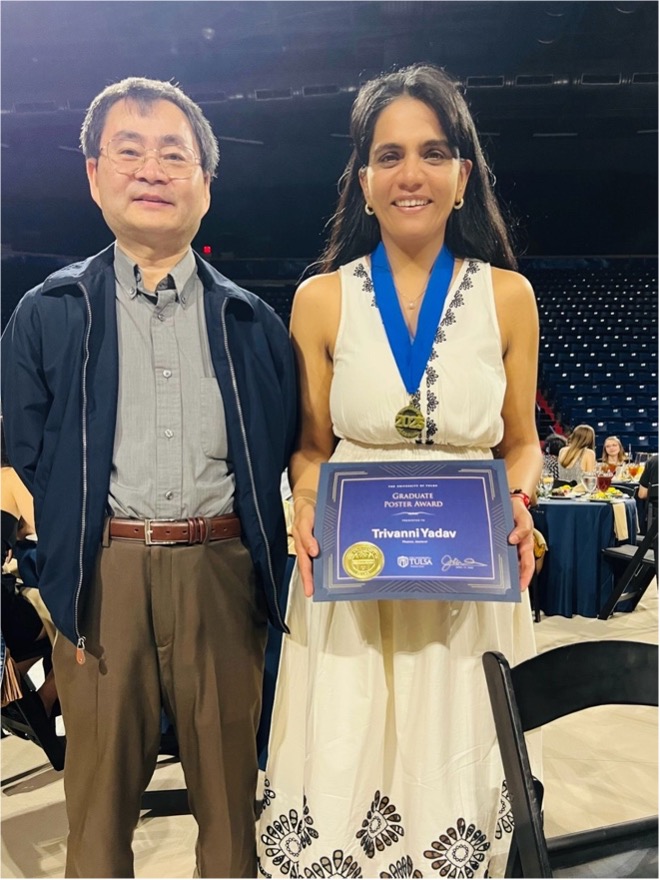
Trivanni Yadav, a doctoral candidate at the University of Tulsa (UTulsa), is making significant strides in battery research, focusing on safer and more efficient energy storage solutions. After completing her master’s degree at Central Michigan University, Yadav sought a graduate program that aligned with her academic ambitions. She found that UTulsa offered a range of research opportunities in its Department of Physics & Engineering Physics, ultimately leading her to apply and receive a graduate assistantship.
Yadav’s experience at UTulsa has been transformative. She has published peer-reviewed papers and presented her findings to esteemed audiences, including a presentation in Washington, D.C., in September 2025. Scheduled to present again in Denver in 2026, Yadav has established herself as a prominent figure in her field. As an international student from Delhi, India, she has also found a supportive community in Tulsa, serving as president of the Physics Graduate Student Association and representing UTulsa as one of 118 American Physical Society (APS) Student Ambassadors.
Transformative Research and Community Impact
Yadav’s research centers on Lithium Lanthanum Zirconium Oxide (LLZO), a solid electrolyte that promises to enhance battery safety and performance. Conventional lithium-ion batteries are known for their flammability and degradation over time, which limits their efficiency. In contrast, LLZO is non-flammable and stable even under extreme conditions, allowing for better performance.
Using first-principles quantum simulations, Yadav investigates atomic-scale defects within LLZO that affect lithium ion mobility. “I aim to understand how certain defects can act as ‘express lanes’ that enhance ion mobility, an essential factor in improving battery performance,” she explained. This research has broader implications, particularly for space exploration, where radiation can create defects that may influence battery functionality in extreme environments.
Yadav’s findings could lead to advancements in various industries, including the development of long-lasting smartphones and electric vehicles that charge in minutes. Her work has garnered attention, leading to publications in esteemed journals like the Journal of Applied Physics and Ceramics International. She has received accolades such as the Distinguished Graduate Research Poster Award, where she was the top recipient out of 70 graduate students across disciplines at UTulsa.
Mentorship and Teaching Contributions
Yadav attributes much of her success to the mentorship of Sanwu Wang, Ph.D., the Ruth and William Kistler Jr. Endowed Chair in Physics & Engineering Physics, and Scott Holmstrom, Ph.D., dean of the Graduate School and professor of physics & engineering physics. Their guidance has been instrumental in her academic and personal development.
In addition to her research, Yadav actively contributes to the academic community through teaching. She has instructed General Physics I for several years and developed online supplemental learning materials that have been accessed by over 300 undergraduate students. “The entire Physics Department feels like a second family to me,” she said, highlighting the supportive atmosphere at UTulsa.
Yadav’s journey is a testament to resilience and dedication. She encourages aspiring researchers to embrace their challenges, emphasizing the importance of perseverance, communication, and self-confidence. “You have to show up and be vocal about your work, because doing a doctorate isn’t just about research and papers; it’s also about learning to communicate your science,” she stated.
As she prepares for the APS Annual Leadership Meeting on Capitol Hill in February 2026, Yadav represents not only her university but also the potential for innovation in battery technology. Her journey underscores the importance of support, mentorship, and community in achieving academic success and contributing to meaningful advancements in science and technology.

Stocks Surge as S&P 500 Rebounds from Volatile Week

Groundbreaking Study Explores Public Scrutiny’s Impact on Sleep

Chicago Mayor’s Immigration Order Faces Fierce Legal Backlash

Retired Astronauts Celebrate Film’s Impact Decades After Release

Trump Deletes Controversial Video Depicting Obamas as Primates

Titan Missile’s Historic Launch: A Cold War Breakthrough on Feb 6, 1959

Massachusetts Mother Files Urgent Lawsuit Against Tesla After Son’s Tragic Death

Wolves Sell Defender Emmanuel Agbadou to Beşiktaş for £17.5 Million

Trump Administration Launches Prescription Drug Discount Portal

ALMA Discovers Companion Orbiting Giant Red Star π 1 Gruis

Doctoral Candidate Trivanni Yadav Advances Battery Research at UTulsa

Global Air Forces Ranked by Annual Defense Budgets in 2025

New ‘Star Trek: Voyager’ Game Demo Released, Players Test Limits

Mass Production of F-35 Fighter Jet Drives Down Costs

NASCAR Faces Fan Backlash as Steve Phelps’ Texts Surface

Gold Investment Surge: Top Mutual Funds and ETF Alternatives

DirecTV to Launch AI-Driven Ads with User Likenesses in 2026

SEVENTEEN’s Mingyu Faces Backlash Over Alcohol Incident at Concert
-
 Science3 months ago
ALMA Discovers Companion Orbiting Giant Red Star π 1 Gruis
-
 World4 months ago
Global Air Forces Ranked by Annual Defense Budgets in 2025
-
 Top Stories4 months ago
New ‘Star Trek: Voyager’ Game Demo Released, Players Test Limits
-
 World4 months ago
Mass Production of F-35 Fighter Jet Drives Down Costs
-
 Sports3 months ago
NASCAR Faces Fan Backlash as Steve Phelps’ Texts Surface
-
 Business4 months ago
Gold Investment Surge: Top Mutual Funds and ETF Alternatives
-
 Top Stories4 months ago
DirecTV to Launch AI-Driven Ads with User Likenesses in 2026
-
 Politics4 months ago
SEVENTEEN’s Mingyu Faces Backlash Over Alcohol Incident at Concert
-

 Science4 months ago
Time Crystals Revolutionize Quantum Computing Potential
-

 Entertainment4 months ago
Freeport Art Gallery Transforms Waste into Creative Masterpieces
-

 Science4 months ago
Remembering David E. Brest: A Life Dedicated to Nature and Family
-

 Entertainment4 months ago
Paul Giamatti Reveals Villainous Role in Star Trek: Starfleet Academy