
Science
Earth’s Magnetic Field Transports Atmospheric Particles to Moon

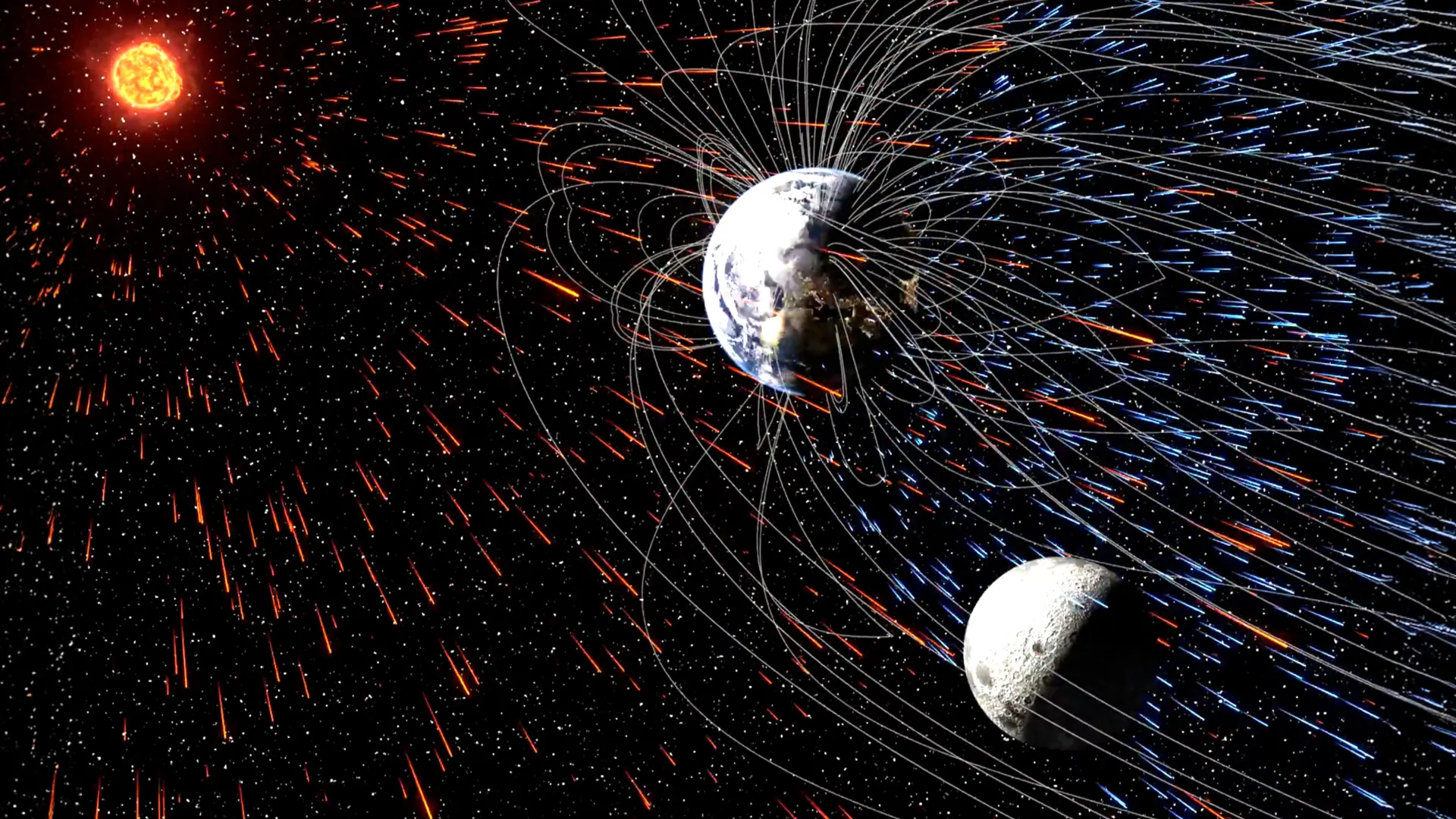
Researchers at the University of Rochester have discovered that tiny fragments of Earth’s atmosphere have been reaching the moon for billions of years, aided by the planet’s magnetic field. This new understanding challenges previous notions about lunar composition, suggesting that the moon holds a long-term archive of Earth’s atmospheric history, which could also serve as a valuable resource for future lunar missions.
The study, published on January 5, 2026, in *Nature Communications Earth and Environment*, reveals that rather than blocking particles, Earth’s magnetic field funnels atmospheric materials outward toward the moon. This finding explains the presence of certain gases in lunar soil samples collected during the Apollo missions and suggests that the moon’s surface may contain useful materials that could support human activity.
For decades, the moon has been perceived as a barren and lifeless body. Yet, the analysis of lunar soil has unveiled a more complex narrative. The research team, led by Eric Blackman, a professor in the Department of Physics and Astronomy, utilized data from lunar samples alongside sophisticated computational models to trace how atmospheric particles could travel across vast distances to reach the moon.
The results indicate that the solar wind, a stream of charged particles emitted by the sun, can propel atmospheric particles from Earth. These particles are then guided along magnetic field lines that extend into space, some of which intersect the moon’s orbit. This mechanism has likely facilitated a slow and steady transfer of materials from Earth to the moon over billions of years.
Shubhonkar Paramanick, a graduate student involved in the research, explained, “By combining data from particles preserved in lunar soil with computational modeling of how solar wind interacts with Earth’s atmosphere, we can trace the history of Earth’s atmosphere and its magnetic field.” This work not only enhances our understanding of Earth’s atmospheric history but also raises the possibility that the moon contains resources that could aid future explorers.
During the Apollo missions in the 1970s, astronauts collected lunar rocks and soil that have been pivotal in this research. Analyses of these samples revealed the moon’s surface contains volatile substances such as water, carbon dioxide, helium, argon, and nitrogen. While some of these materials are known to originate from the solar wind, the quantities found, particularly nitrogen, exceed what could be explained solely by this process.
In 2005, researchers from the University of Tokyo proposed that some volatiles came from Earth’s atmosphere during its early history, before the development of a protective magnetic field. They believed that once the magnetic field formed, it would obstruct atmospheric particles from escaping into space. The University of Rochester team, however, arrived at a different conclusion.
To better understand the journey of atmospheric particles to the moon, researchers conducted advanced computer simulations to compare two scenarios: an early Earth without a magnetic field and a modern Earth with a robust magnetic field. Their findings demonstrated that the transfer of particles was significantly more effective in the contemporary scenario, where the magnetic field facilitates the release of charged particles from the upper atmosphere.
Over time, this process acts like a slow funnel, allowing small amounts of Earth’s atmosphere to accumulate on the lunar surface. As a result, the moon may preserve a comprehensive chemical record of Earth’s atmospheric history. The implications of this exchange extend beyond Earth; studying lunar soil could provide insights into how Earth’s climate, oceans, and life evolved.
Furthermore, the steady influx of atmospheric particles suggests that the moon may harbor more valuable resources than previously believed. Elements such as water and nitrogen could play a crucial role in supporting long-term human activity on the lunar surface, reducing reliance on supplies transported from Earth and enhancing the feasibility of future exploration.
Paramanick also noted the broader implications of this research, stating, “Our study may also have broader implications for understanding early atmospheric escape on planets like Mars, which lacks a global magnetic field today but had one similar to Earth in the past, along with a likely thicker atmosphere.” By examining planetary evolution and atmospheric escape, scientists can gain insights into how these processes shape habitability on other celestial bodies.
This research was supported in part by funding from NASA and the National Science Foundation. As scientists continue to explore the connections between Earth and the moon, the findings underscore the significance of lunar exploration in unraveling the history of our planet.

Robinhood Stock Surges 2.5% in Early Trading on March 17

Israel Intensifies Strikes as Global Energy Crisis Looms

CALV Offers Class on Communication Skills for Real Estate Professionals

Historic Bideford Pub Reopens as The Patch Wine Bar & Kitchen

Oscar Night Celebrations: Winners, Guests, and Exclusive After-Parties

Samsung Galaxy Watch 9 Set for Larger Battery Boost, Report Reveals

Kibble vs. Fresh Dog Food: What’s Best for Your Dog’s Health?

Acclaimed San Francisco Pizzeria Del Popolo to Close in May

‘Invincible’ Season 4 Launches on Prime Video with Epic Action

ALMA Discovers Companion Orbiting Giant Red Star π 1 Gruis

Doctoral Candidate Trivanni Yadav Advances Battery Research at UTulsa

Global Air Forces Ranked by Annual Defense Budgets in 2025

Rev. Bry Shields to Retire as McGill-Toolen President in 2026

Mass Production of F-35 Fighter Jet Drives Down Costs

Tucson Celebrates Life and Remembrance at 36th Annual All Souls Procession

Gold Investment Surge: Top Mutual Funds and ETF Alternatives

DirecTV to Launch AI-Driven Ads with User Likenesses in 2026

Paul Giamatti Reveals Villainous Role in Star Trek: Starfleet Academy
-
 Science9 months ago
ALMA Discovers Companion Orbiting Giant Red Star π 1 Gruis
-
 Science8 months ago
Doctoral Candidate Trivanni Yadav Advances Battery Research at UTulsa
-
 World10 months ago
Global Air Forces Ranked by Annual Defense Budgets in 2025
-
 Lifestyle10 months ago
Rev. Bry Shields to Retire as McGill-Toolen President in 2026
-
 World10 months ago
Mass Production of F-35 Fighter Jet Drives Down Costs
-
 Lifestyle9 months ago
Tucson Celebrates Life and Remembrance at 36th Annual All Souls Procession
-
 Business10 months ago
Gold Investment Surge: Top Mutual Funds and ETF Alternatives
-
 Top Stories10 months ago
DirecTV to Launch AI-Driven Ads with User Likenesses in 2026
-
 Entertainment10 months ago
Paul Giamatti Reveals Villainous Role in Star Trek: Starfleet Academy
-

 Lifestyle8 months ago
Maumee’s Shop With a Hero Event Delivers Joy to Local Children
-

 Top Stories10 months ago
New ‘Star Trek: Voyager’ Game Demo Released, Players Test Limits
-

 Lifestyle8 months ago
Cape May Shines as New Jersey’s Only Entry on Beach Town List