
Science
Exploring the Multiverse: Physics Theories Challenge Reality

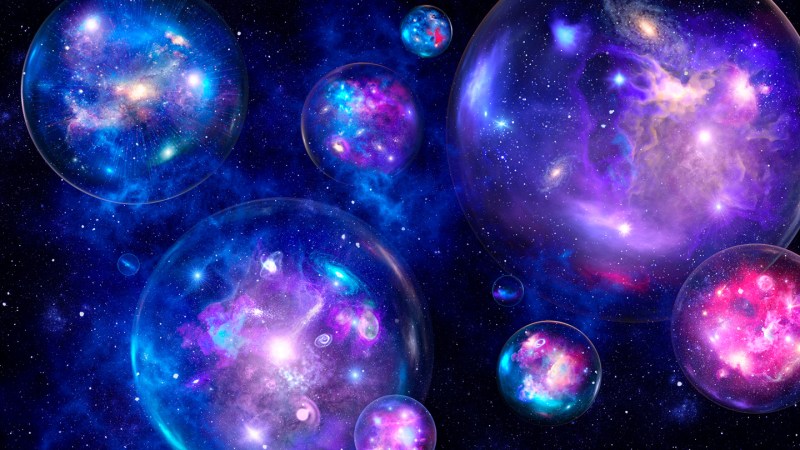
The concept of a multiverse, where numerous parallel universes coexist, has captured the imagination of both scientists and writers. Recent discussions among physicists suggest that theories about the multiverse may provide insights into fundamental questions about our own universe. These theories, rooted in cosmology and quantum mechanics, propose that multiple realms could exist beyond our observable universe, potentially explaining why certain physical constants appear finely tuned for life.
Theories from Cosmology and Quantum Mechanics
According to physicist Andrei Linde from Stanford University, the idea of a multiverse is not merely the stuff of science fiction. After the Big Bang, the universe underwent a rapid expansion known as inflation. This period of extreme growth stretched tiny quantum fluctuations to significant scales, leading to variations in density that ultimately seeded the formation of galaxies. Linde explains that, at scales far beyond what we can observe, these fluctuations could have produced regions with entirely different physical properties. For instance, in some of these unseen areas, particles might have different masses, and the forces of nature could behave unpredictably.
Linde theorizes that life in those regions may be impossible due to these differing conditions. Furthermore, while inflation has ceased in our observable universe, it might still be occurring elsewhere, creating “bubbles” of space with unique properties. This scenario could help resolve the cosmological question of why the constants in our universe seem so well-suited for life. If a multiverse exists, the emergence of life is less remarkable, as it could arise in one of many possible bubble universes.
Testing these multiverse theories poses substantial challenges. Linde suggests that if our universe is indeed one of many, there may be evidence in the form of scars left from collisions with other universes during the early moments following the Big Bang. “No one has seen yet the rings that would represent the scars of bubble collisions,” notes Paul Halpern, a physicist at Saint Joseph’s University in Philadelphia.
Quantum Interpretations and Their Implications
Another compelling theory arises from quantum mechanics, which asserts that particles exist in a superposition of states until observed. According to Halpern, traditional understanding holds that measurement causes this superposition to collapse into a single outcome, a concept that raises questions about the role of consciousness in the universe.
In 1957, physicist Hugh Everett III proposed an alternative view. Instead of a collapse, all possible outcomes may unfold across parallel realities. In this model, an observer might split into multiple versions of themselves, each experiencing a different outcome. Halpern describes this as a seamless separation where each version exists independently in parallel universes, making interaction between them impossible.
While this theory aligns closely with popular culture depictions of the multiverse, such as the television series *Community*, where characters encounter their alternate selves, it presents significant testing difficulties. Halpern explains, “We can’t have somebody split in an experiment between two possibilities and ask each one what it was like.” If the theory holds, the implications of existence without direct observation might fundamentally change our understanding of reality.
Moreover, the prospect of visiting these alternate universes remains speculative. Hypothetical constructs known as wormholes could theoretically connect different realities, but Halpern cautions that current technology does not allow for the creation of such structures. “If they were possible to create, they would require so much energy and mass that they would be well beyond current technology,” he states.
The fascination with the multiverse reflects a broader human desire to explore the unknown. While the idea of teaming up with alternate selves to tackle challenges may remain a dream for now, the scientific inquiry into these theories continues to enrich our understanding of the universe and our place within it. As physicists delve deeper into these intriguing concepts, the multiverse may shift from a fantastical notion to a legitimate area of scientific exploration.

Robinhood Stock Surges 2.5% in Early Trading on March 17

Israel Intensifies Strikes as Global Energy Crisis Looms

CALV Offers Class on Communication Skills for Real Estate Professionals

Historic Bideford Pub Reopens as The Patch Wine Bar & Kitchen

Oscar Night Celebrations: Winners, Guests, and Exclusive After-Parties

Samsung Galaxy Watch 9 Set for Larger Battery Boost, Report Reveals

Kibble vs. Fresh Dog Food: What’s Best for Your Dog’s Health?

Acclaimed San Francisco Pizzeria Del Popolo to Close in May

‘Invincible’ Season 4 Launches on Prime Video with Epic Action

ALMA Discovers Companion Orbiting Giant Red Star π 1 Gruis

Doctoral Candidate Trivanni Yadav Advances Battery Research at UTulsa

Global Air Forces Ranked by Annual Defense Budgets in 2025

Rev. Bry Shields to Retire as McGill-Toolen President in 2026

Mass Production of F-35 Fighter Jet Drives Down Costs

Tucson Celebrates Life and Remembrance at 36th Annual All Souls Procession

Gold Investment Surge: Top Mutual Funds and ETF Alternatives

DirecTV to Launch AI-Driven Ads with User Likenesses in 2026

Paul Giamatti Reveals Villainous Role in Star Trek: Starfleet Academy
-
 Science9 months ago
ALMA Discovers Companion Orbiting Giant Red Star π 1 Gruis
-
 Science9 months ago
Doctoral Candidate Trivanni Yadav Advances Battery Research at UTulsa
-
 World10 months ago
Global Air Forces Ranked by Annual Defense Budgets in 2025
-
 Lifestyle10 months ago
Rev. Bry Shields to Retire as McGill-Toolen President in 2026
-
 World10 months ago
Mass Production of F-35 Fighter Jet Drives Down Costs
-
 Lifestyle9 months ago
Tucson Celebrates Life and Remembrance at 36th Annual All Souls Procession
-
 Business10 months ago
Gold Investment Surge: Top Mutual Funds and ETF Alternatives
-
 Top Stories10 months ago
DirecTV to Launch AI-Driven Ads with User Likenesses in 2026
-
 Entertainment10 months ago
Paul Giamatti Reveals Villainous Role in Star Trek: Starfleet Academy
-

 Lifestyle8 months ago
Maumee’s Shop With a Hero Event Delivers Joy to Local Children
-

 Top Stories10 months ago
New ‘Star Trek: Voyager’ Game Demo Released, Players Test Limits
-

 Lifestyle8 months ago
Cape May Shines as New Jersey’s Only Entry on Beach Town List