
Science
Hubble and Euclid Telescopes Uncover Rare Dark Galaxy CDG-2

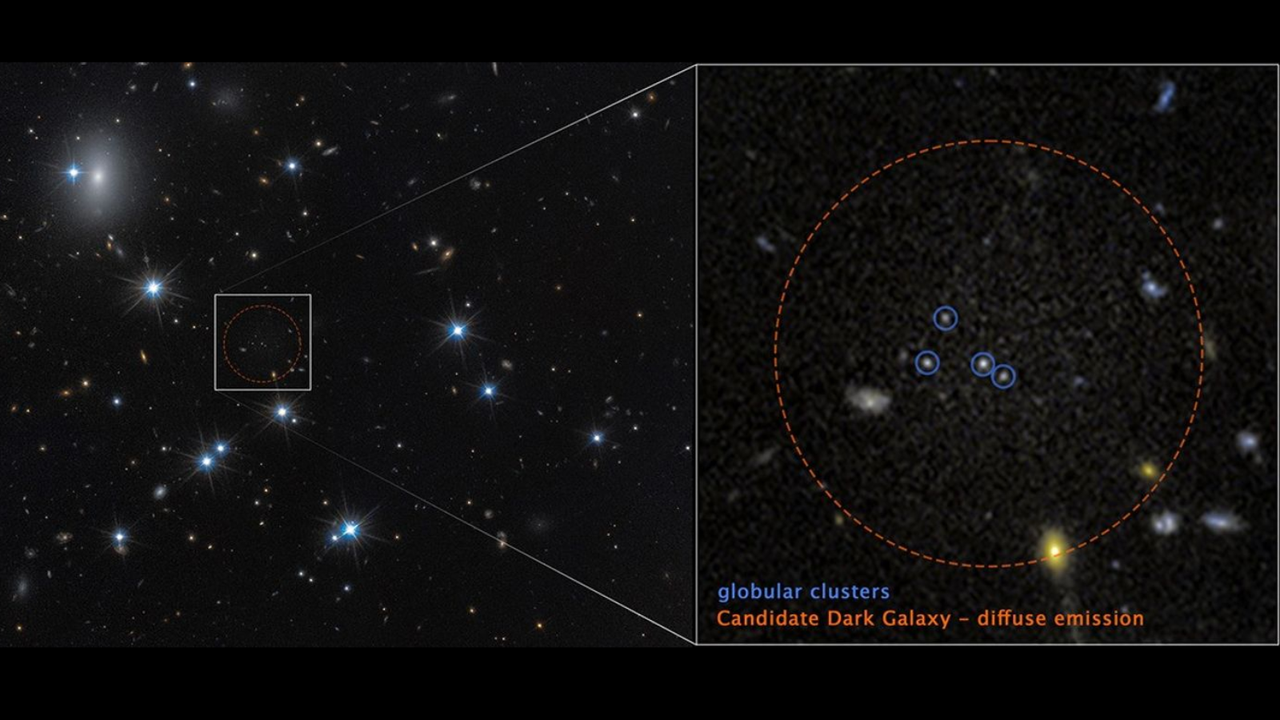
Astronomers have discovered a rare galaxy, officially designated CDG-2, which is composed of an astonishing 99% dark matter. This discovery, made using the Hubble Space Telescope alongside the Euclid Space Telescope, reveals a galaxy that is largely invisible, located approximately 245 million light-years from Earth.
All galaxies contain dark matter, a mysterious substance that outweighs all visible matter, including stars and planets, by a factor of five to one. However, CDG-2 takes this phenomenon to an extreme, with dark matter constituting almost the entirety of its mass. Unlike typical galaxies that shine brightly due to their star populations, dark galaxies like CDG-2 are faint and elusive, making them challenging to detect.
Initial investigations into the galaxy began when a team of astronomers studied tight groupings of stars known as globular clusters. These clusters often suggest the presence of additional, dim stars nearby. This research led to the identification of ten faint galaxies with low brightness, including two candidates for dark galaxies. To verify the existence of one of these candidates, the researchers utilized data from Hubble, Euclid, and the Subaru Telescope in Hawaii.
Through Hubble’s observations, astronomers confirmed a tight grouping of four globular clusters within the Perseus galaxy cluster, situated about 300 million light-years away. Further analysis, incorporating data from the other telescopes, revealed a faint glow surrounding these clusters, hinting at the presence of the dark galaxy CDG-2.
“This is the first galaxy detected solely through its globular cluster population,” said David Li, the team leader from the University of Toronto. He emphasized that under conservative assumptions, the four clusters represent the entirety of CDG-2’s globular cluster population.
Upon deeper examination, the team discovered that CDG-2 has a brightness equivalent to around 6 million sun-like stars, with approximately 16% of that brightness attributed to the globular clusters themselves. Research suggests that normal matter within CDG-2 could have previously enabled star formation. However, gravitational interactions with other galaxies likely stripped these stars away over time, leaving behind a ghostly galaxy primarily composed of dark matter.
The globular clusters, resilient due to their dense star compositions, remained as the only indicators of CDG-2’s existence. The findings were published in The Astrophysical Journal Letters, contributing to our understanding of the complex dynamics of dark matter and its role in galaxy formation.
This significant discovery not only sheds light on the nature of dark matter but also illustrates the innovative capabilities of modern astronomical tools, paving the way for future research in the field of astrophysics.

Robinhood Stock Surges 2.5% in Early Trading on March 17

Israel Intensifies Strikes as Global Energy Crisis Looms

CALV Offers Class on Communication Skills for Real Estate Professionals

Historic Bideford Pub Reopens as The Patch Wine Bar & Kitchen

Oscar Night Celebrations: Winners, Guests, and Exclusive After-Parties

Samsung Galaxy Watch 9 Set for Larger Battery Boost, Report Reveals

Kibble vs. Fresh Dog Food: What’s Best for Your Dog’s Health?

Acclaimed San Francisco Pizzeria Del Popolo to Close in May

‘Invincible’ Season 4 Launches on Prime Video with Epic Action

ALMA Discovers Companion Orbiting Giant Red Star π 1 Gruis

Doctoral Candidate Trivanni Yadav Advances Battery Research at UTulsa

Global Air Forces Ranked by Annual Defense Budgets in 2025

Rev. Bry Shields to Retire as McGill-Toolen President in 2026

Mass Production of F-35 Fighter Jet Drives Down Costs

Tucson Celebrates Life and Remembrance at 36th Annual All Souls Procession

Gold Investment Surge: Top Mutual Funds and ETF Alternatives

DirecTV to Launch AI-Driven Ads with User Likenesses in 2026

Paul Giamatti Reveals Villainous Role in Star Trek: Starfleet Academy
-
 Science9 months ago
ALMA Discovers Companion Orbiting Giant Red Star π 1 Gruis
-
 Science8 months ago
Doctoral Candidate Trivanni Yadav Advances Battery Research at UTulsa
-
 World10 months ago
Global Air Forces Ranked by Annual Defense Budgets in 2025
-
 Lifestyle9 months ago
Rev. Bry Shields to Retire as McGill-Toolen President in 2026
-
 World10 months ago
Mass Production of F-35 Fighter Jet Drives Down Costs
-
 Lifestyle9 months ago
Tucson Celebrates Life and Remembrance at 36th Annual All Souls Procession
-
 Business10 months ago
Gold Investment Surge: Top Mutual Funds and ETF Alternatives
-
 Top Stories10 months ago
DirecTV to Launch AI-Driven Ads with User Likenesses in 2026
-
 Entertainment10 months ago
Paul Giamatti Reveals Villainous Role in Star Trek: Starfleet Academy
-

 Top Stories10 months ago
New ‘Star Trek: Voyager’ Game Demo Released, Players Test Limits
-

 Lifestyle8 months ago
Maumee’s Shop With a Hero Event Delivers Joy to Local Children
-

 Lifestyle7 months ago
Cape May Shines as New Jersey’s Only Entry on Beach Town List