
Science
Interstellar Object 3I/ATLAS Shows Unusual Acceleration and Color Change

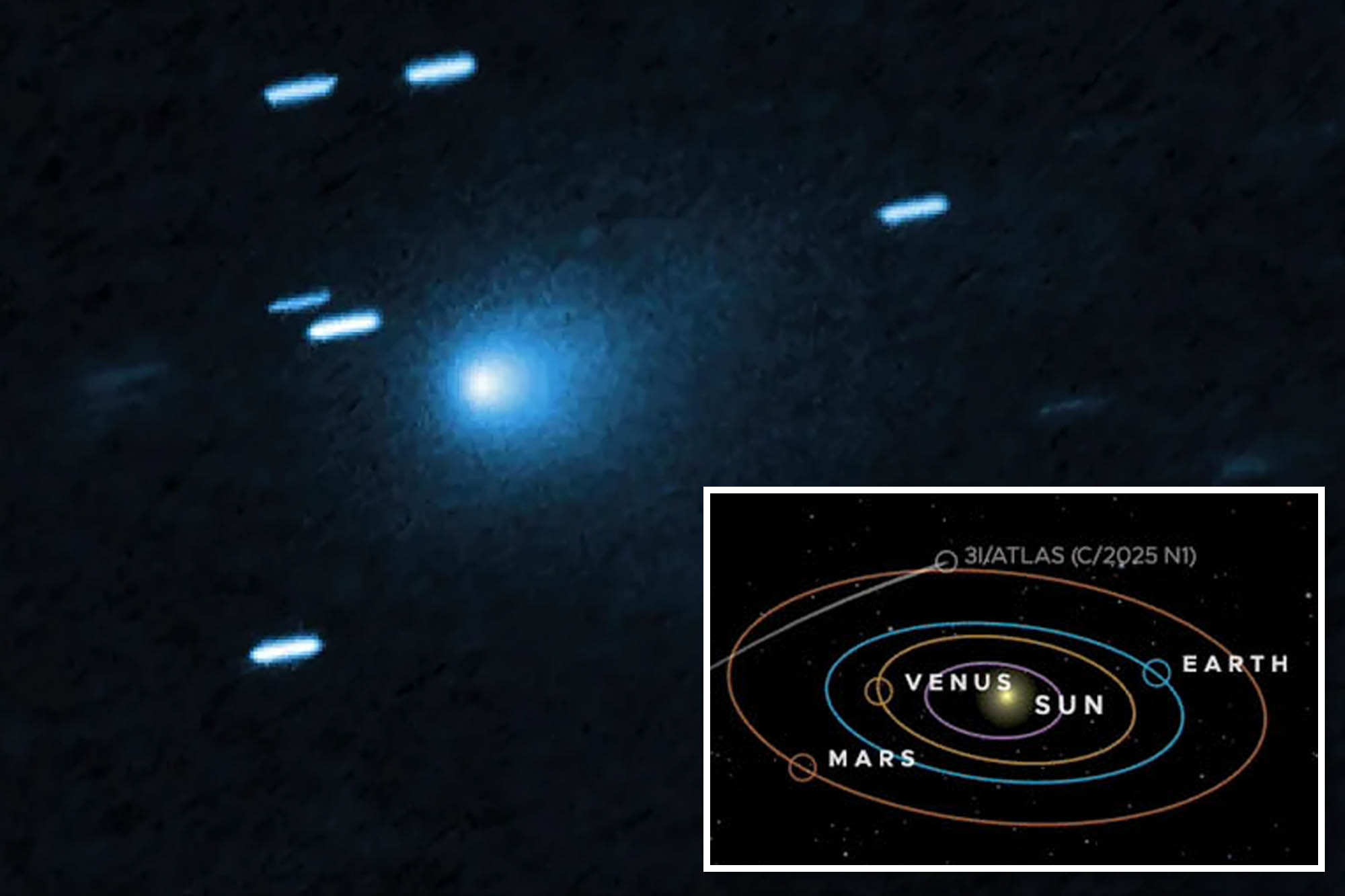
The interstellar object known as 3I/ATLAS has displayed unexpected characteristics, including non-gravitational acceleration and a distinct blue hue, as it passed near the Sun. These phenomena have prompted speculation from Harvard astrophysicist Avi Loeb regarding the possibility of an artificial origin, potentially suggesting it could be linked to an alien craft.
NASA recently reported that 3I/ATLAS accelerated without the influence of gravitational forces, indicating a significant outgassing event typical of comets. This process could result in the object losing approximately half its mass and generating a substantial debris plume in the coming months. Loeb proposed in a paper that the combination of acceleration and the object’s unusual color might point to an artificial propulsion system. He noted on Medium, “This might also explain the report on 3I/ATLAS getting ‘bluer than the Sun.’”
While Earth’s telescopes were unable to directly observe 3I/ATLAS during its closest approach—approximately 172 million miles from the Sun—spacecraft positioned ahead of Earth were able to capture data. The US Naval Research Lab documented a rapid brightening of the object, which appeared “distinctly bluer than the Sun.” This color change is particularly notable, considering previous observations indicated the object was red before shifting to green.
Upcoming Close Pass and Continued Observations
3I/ATLAS is anticipated to make its closest approach to Earth on December 19, 2023, passing at a distance of around 167 million miles. This event will present an opportunity for researchers on Earth to gather more data, potentially clarifying whether the object is indeed a comet or an artificial construct. Loeb stated, “If we do not observe a massive cloud of gas around 3I/ATLAS in December, it could be an indicator of a propulsion system.”
In the context of these developments, Loeb expressed his frustration with NASA for not releasing images from the Mars Reconnaissance Orbiter’s HiRISE camera taken during its close approach to Mars in early October. Sources indicated that these anticipated images will not be published until after the government reopens.
Navigating Speculation and Reassuring the Public
Despite the excitement surrounding 3I/ATLAS, NASA’s Acting Administrator Sean Duffy has attempted to mitigate fears about the object, asserting that it poses no threat. Duffy, who also serves as the transportation secretary, addressed concerns via social media, stating, “NASA’s observations show that this is the third interstellar comet to pass through our solar system. No aliens. No threat to life here on Earth.”
As the scientific community continues to analyze the data from 3I/ATLAS, it remains to be seen what further observations will reveal about this intriguing interstellar visitor. The upcoming close pass in December promises to be a key moment for understanding its true nature and origin.

Robinhood Stock Surges 2.5% in Early Trading on March 17

Israel Intensifies Strikes as Global Energy Crisis Looms

CALV Offers Class on Communication Skills for Real Estate Professionals

Historic Bideford Pub Reopens as The Patch Wine Bar & Kitchen

Oscar Night Celebrations: Winners, Guests, and Exclusive After-Parties

Samsung Galaxy Watch 9 Set for Larger Battery Boost, Report Reveals

Kibble vs. Fresh Dog Food: What’s Best for Your Dog’s Health?

Acclaimed San Francisco Pizzeria Del Popolo to Close in May

‘Invincible’ Season 4 Launches on Prime Video with Epic Action

ALMA Discovers Companion Orbiting Giant Red Star π 1 Gruis

Doctoral Candidate Trivanni Yadav Advances Battery Research at UTulsa

Global Air Forces Ranked by Annual Defense Budgets in 2025

Rev. Bry Shields to Retire as McGill-Toolen President in 2026

Mass Production of F-35 Fighter Jet Drives Down Costs

Tucson Celebrates Life and Remembrance at 36th Annual All Souls Procession

Gold Investment Surge: Top Mutual Funds and ETF Alternatives

DirecTV to Launch AI-Driven Ads with User Likenesses in 2026

Paul Giamatti Reveals Villainous Role in Star Trek: Starfleet Academy
-
 Science9 months ago
ALMA Discovers Companion Orbiting Giant Red Star π 1 Gruis
-
 Science8 months ago
Doctoral Candidate Trivanni Yadav Advances Battery Research at UTulsa
-
 World10 months ago
Global Air Forces Ranked by Annual Defense Budgets in 2025
-
 Lifestyle9 months ago
Rev. Bry Shields to Retire as McGill-Toolen President in 2026
-
 World10 months ago
Mass Production of F-35 Fighter Jet Drives Down Costs
-
 Lifestyle9 months ago
Tucson Celebrates Life and Remembrance at 36th Annual All Souls Procession
-
 Business10 months ago
Gold Investment Surge: Top Mutual Funds and ETF Alternatives
-
 Top Stories10 months ago
DirecTV to Launch AI-Driven Ads with User Likenesses in 2026
-
 Entertainment10 months ago
Paul Giamatti Reveals Villainous Role in Star Trek: Starfleet Academy
-

 Top Stories10 months ago
New ‘Star Trek: Voyager’ Game Demo Released, Players Test Limits
-

 Lifestyle8 months ago
Maumee’s Shop With a Hero Event Delivers Joy to Local Children
-

 Lifestyle7 months ago
Cape May Shines as New Jersey’s Only Entry on Beach Town List