
Science
NASA Aims for March Launch of Moon Rocket After Fuel Leak Setback

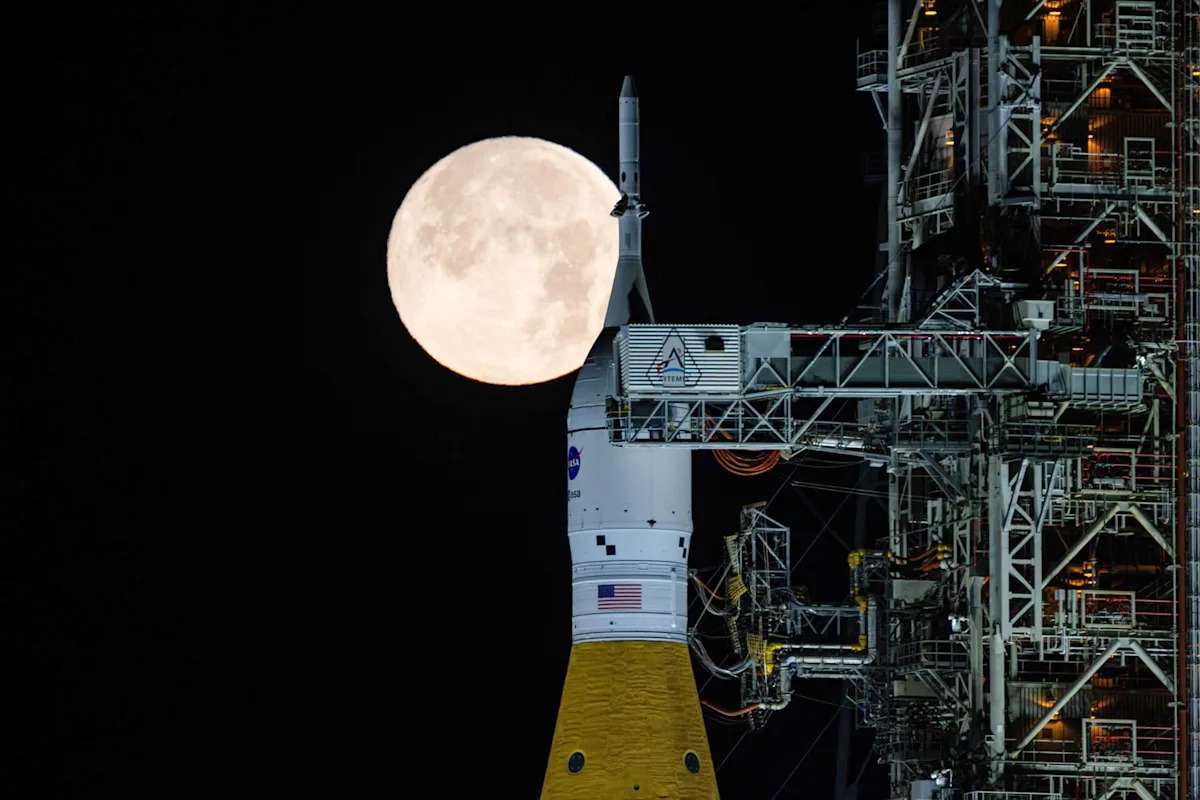
NASA has targeted a launch window in March 2024 for its new moon rocket after encountering significant fuel leaks during a critical test on March 4. This setback occurred just hours into the fueling operation at the Kennedy Space Center in Cape Canaveral, Florida, raising concerns about the timeline for sending astronauts on a lunar mission.
The space agency announced that the delay will provide teams with ample time to review the data from the test and conduct a second wet dress rehearsal ahead of the flight. Previously, similar fuel leak issues delayed the rocket’s debut three years ago. NASA has not specified an exact launch date in March, stating that teams must first address all identified problems before proceeding with further testing.
During the test, the 322-foot (98-meter) rocket was filled with super-cooled hydrogen and oxygen. Approximately 700,000 gallons (2.6 million liters) of fuel needed to be loaded and maintained onboard for several hours, simulating the final countdown stages. However, excessive hydrogen accumulation near the base of the rocket prompted launch controllers to halt the loading process multiple times as they implemented strategies developed during the prior Space Launch System countdown in 2022.
NASA’s statement also noted delays in operations during the test and recurring audio communication issues that affected ground crew interactions. The astronauts selected for the mission—three Americans and one Canadian—monitored the rehearsal remotely from Houston, where the Johnson Space Center is located.
The Artemis program aims to establish a sustained human presence on the moon, with this upcoming mission designed to send the crew past the moon and around its far side before returning to Earth. The flight will test the capsule’s life support and other crucial systems, although it will not include a lunar orbit or landing attempt.
With limited launch opportunities each month, the extreme cold weather also reduced the available window in February by two days. The countdown for the March launch began on March 2, allowing controllers to conduct motions and address any remaining rocket issues. The countdown clocks were set to pause just before engine ignition, stopping a half-minute before reaching zero.
NASA last sent astronauts to the moon during the Apollo program in the 1960s and 1970s. The Artemis program represents a new era of lunar exploration, with the upcoming mission laying the groundwork for future moon landings by other astronauts.
According to the Associated Press Health and Science Department, which receives support from the Howard Hughes Medical Institute’s Department of Science Education and the Robert Wood Johnson Foundation, all content is independently produced by the AP.

Robinhood Stock Surges 2.5% in Early Trading on March 17

Israel Intensifies Strikes as Global Energy Crisis Looms

CALV Offers Class on Communication Skills for Real Estate Professionals

Historic Bideford Pub Reopens as The Patch Wine Bar & Kitchen

Oscar Night Celebrations: Winners, Guests, and Exclusive After-Parties

Samsung Galaxy Watch 9 Set for Larger Battery Boost, Report Reveals

Kibble vs. Fresh Dog Food: What’s Best for Your Dog’s Health?

Acclaimed San Francisco Pizzeria Del Popolo to Close in May

‘Invincible’ Season 4 Launches on Prime Video with Epic Action

ALMA Discovers Companion Orbiting Giant Red Star π 1 Gruis

Doctoral Candidate Trivanni Yadav Advances Battery Research at UTulsa

Global Air Forces Ranked by Annual Defense Budgets in 2025

Rev. Bry Shields to Retire as McGill-Toolen President in 2026

Mass Production of F-35 Fighter Jet Drives Down Costs

Tucson Celebrates Life and Remembrance at 36th Annual All Souls Procession

Gold Investment Surge: Top Mutual Funds and ETF Alternatives

DirecTV to Launch AI-Driven Ads with User Likenesses in 2026

Paul Giamatti Reveals Villainous Role in Star Trek: Starfleet Academy
-
 Science9 months ago
ALMA Discovers Companion Orbiting Giant Red Star π 1 Gruis
-
 Science8 months ago
Doctoral Candidate Trivanni Yadav Advances Battery Research at UTulsa
-
 World10 months ago
Global Air Forces Ranked by Annual Defense Budgets in 2025
-
 Lifestyle9 months ago
Rev. Bry Shields to Retire as McGill-Toolen President in 2026
-
 World10 months ago
Mass Production of F-35 Fighter Jet Drives Down Costs
-
 Lifestyle9 months ago
Tucson Celebrates Life and Remembrance at 36th Annual All Souls Procession
-
 Business10 months ago
Gold Investment Surge: Top Mutual Funds and ETF Alternatives
-
 Top Stories10 months ago
DirecTV to Launch AI-Driven Ads with User Likenesses in 2026
-
 Entertainment10 months ago
Paul Giamatti Reveals Villainous Role in Star Trek: Starfleet Academy
-

 Top Stories10 months ago
New ‘Star Trek: Voyager’ Game Demo Released, Players Test Limits
-

 Lifestyle8 months ago
Maumee’s Shop With a Hero Event Delivers Joy to Local Children
-

 Lifestyle7 months ago
Cape May Shines as New Jersey’s Only Entry on Beach Town List