
Science
NASA Unveils Stunning 25-Year Video of Kepler’s Supernova Remnant

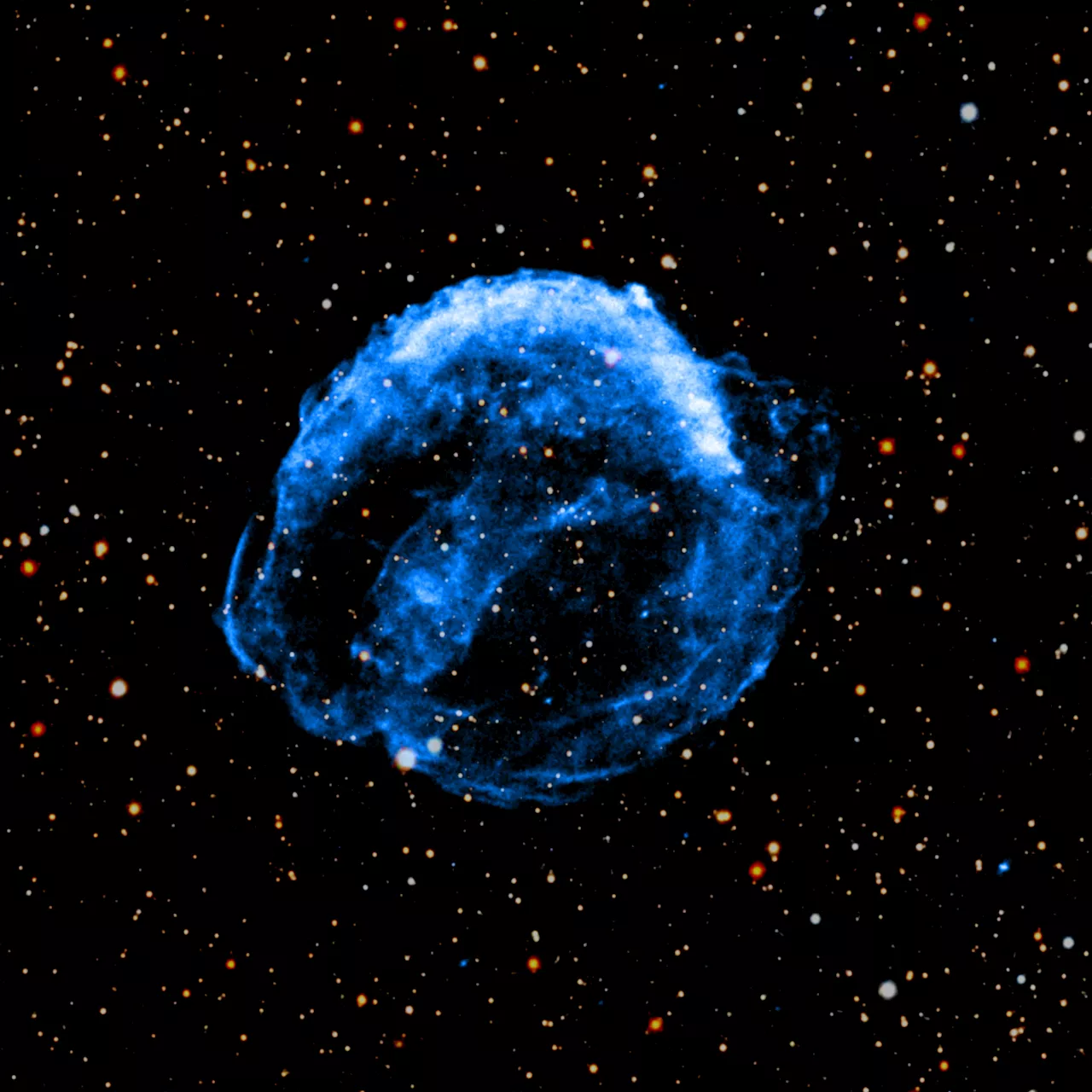
A remarkable new video released by NASA illustrates the evolution of Kepler’s Supernova Remnant over a span of more than 25 years. Utilizing data from the Chandra X-ray Observatory, the video combines X-ray images captured in various years—2000, 2004, 2006, 2014, and 2025—marking it as the longest-duration video Chandra has ever produced.
Kepler’s Supernova Remnant, named in honor of the German astronomer Johannes Kepler, was first observed in 1604. It is believed to have formed when a white dwarf star exploded after reaching a critical mass, potentially due to pulling material from a companion star or merging with another white dwarf. This type of explosion, classified as a Type Ia supernova, plays a crucial role in measuring the universe’s expansion.
Insights from the Video
The video presents a stunning visual representation of the remnant, located approximately 17,000 light-years from Earth. The X-ray emissions, combined with optical images from Pan-STARRS, reveal the intricate changes in the remnant’s structure over time. It resembles a luminous blue ring, expanding visibly throughout the decades.
The fastest-moving portions of the remnant are traveling at about 13.8 million miles per hour toward the bottom of the image. In contrast, the slowest parts are moving at about 4 million miles per hour toward the top. This significant speed variation is attributed to the density of the gas the remnant is encountering. Jessye Gassel, a graduate student at George Mason University, who led the project, commented, “The plot of Kepler’s story is just now beginning to unfold. It’s remarkable that we can watch as these remains from this shattered star crash into material already thrown out into space.”
Gassel presented the video and its findings at the 247th meeting of the American Astronomical Society in Phoenix. The research aims to provide deeper insights into the environments surrounding the supernova explosion, enhancing scientists’ understanding of stellar evolution.
Understanding Cosmic History
The implications of studying supernova remnants extend beyond mere observation. According to Brian Williams from NASA’s Goddard Space Flight Center, “Supernova explosions and the elements they hurl into space are the lifeblood of new stars and planets. Understanding exactly how they behave is crucial to knowing our cosmic history.”
The research team also focused on the characteristics of the blast wave, the leading edge of the explosion that first interacts with external material. By measuring the width and speed of this wave, astronomers can extract valuable information regarding the explosion’s dynamics and its surrounding environment.
NASA’s Marshall Space Flight Center in Huntsville, Alabama, manages the Chandra program, while operations are overseen by the Smithsonian Astrophysical Observatory’s Chandra X-ray Center in Cambridge, Massachusetts.
The final product—a ten-second silent video—serves as both a scientific tool and a captivating visual experience. As viewers witness the expanding remnant, they gain a better understanding of the life cycle of stars and the complex processes that govern our universe. The video effectively captures the ongoing transformation of Kepler’s Supernova Remnant, making it an essential resource for both researchers and the public alike.

Robinhood Stock Surges 2.5% in Early Trading on March 17

Israel Intensifies Strikes as Global Energy Crisis Looms

CALV Offers Class on Communication Skills for Real Estate Professionals

Historic Bideford Pub Reopens as The Patch Wine Bar & Kitchen

Oscar Night Celebrations: Winners, Guests, and Exclusive After-Parties

Samsung Galaxy Watch 9 Set for Larger Battery Boost, Report Reveals

Kibble vs. Fresh Dog Food: What’s Best for Your Dog’s Health?

Acclaimed San Francisco Pizzeria Del Popolo to Close in May

‘Invincible’ Season 4 Launches on Prime Video with Epic Action

ALMA Discovers Companion Orbiting Giant Red Star π 1 Gruis

Doctoral Candidate Trivanni Yadav Advances Battery Research at UTulsa

Global Air Forces Ranked by Annual Defense Budgets in 2025

Rev. Bry Shields to Retire as McGill-Toolen President in 2026

Mass Production of F-35 Fighter Jet Drives Down Costs

Tucson Celebrates Life and Remembrance at 36th Annual All Souls Procession

Gold Investment Surge: Top Mutual Funds and ETF Alternatives

DirecTV to Launch AI-Driven Ads with User Likenesses in 2026

Paul Giamatti Reveals Villainous Role in Star Trek: Starfleet Academy
-
 Science9 months ago
ALMA Discovers Companion Orbiting Giant Red Star π 1 Gruis
-
 Science8 months ago
Doctoral Candidate Trivanni Yadav Advances Battery Research at UTulsa
-
 World10 months ago
Global Air Forces Ranked by Annual Defense Budgets in 2025
-
 Lifestyle10 months ago
Rev. Bry Shields to Retire as McGill-Toolen President in 2026
-
 World10 months ago
Mass Production of F-35 Fighter Jet Drives Down Costs
-
 Lifestyle9 months ago
Tucson Celebrates Life and Remembrance at 36th Annual All Souls Procession
-
 Business10 months ago
Gold Investment Surge: Top Mutual Funds and ETF Alternatives
-
 Top Stories10 months ago
DirecTV to Launch AI-Driven Ads with User Likenesses in 2026
-
 Entertainment10 months ago
Paul Giamatti Reveals Villainous Role in Star Trek: Starfleet Academy
-

 Lifestyle8 months ago
Maumee’s Shop With a Hero Event Delivers Joy to Local Children
-

 Top Stories10 months ago
New ‘Star Trek: Voyager’ Game Demo Released, Players Test Limits
-

 Lifestyle8 months ago
Cape May Shines as New Jersey’s Only Entry on Beach Town List