
Science
NASA’s Webb Telescope Unveils Surprising Insights in Circinus Galaxy

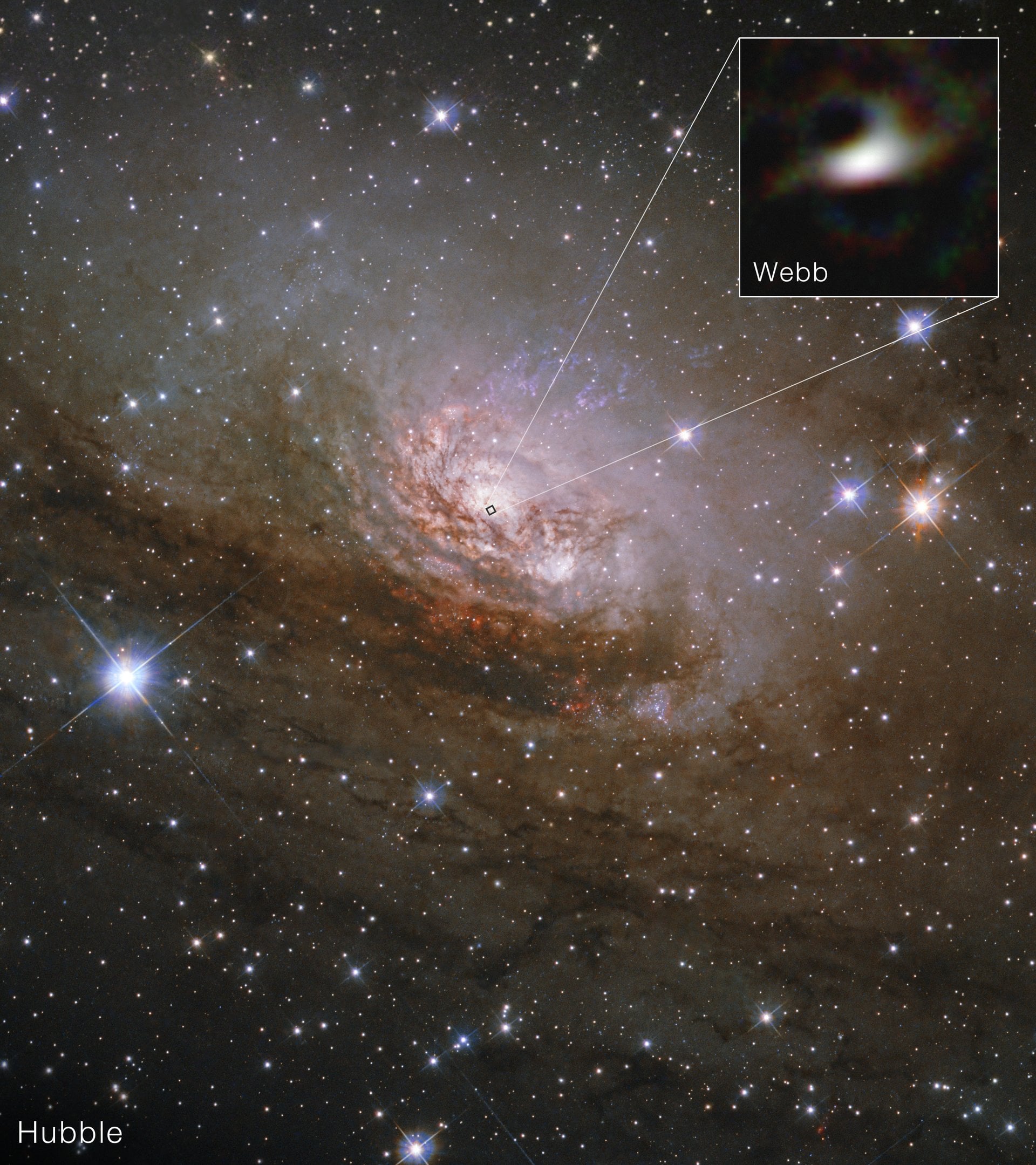
Recent observations by the NASA/ESA/CSA James Webb Space Telescope (JWST) have provided groundbreaking insights into the Circinus Galaxy, located approximately 13 million light-years from Earth. This research offers the deepest and clearest views into its core, home to a supermassive black hole (SMBH). The findings challenge long-held theories regarding the sources of infrared light emanating from the galaxy’s center.
Traditionally, scientists believed that the majority of infrared emissions from the core of the Circinus Galaxy arose from outflows of superheated material. However, the latest observations suggest that most of this material is actually being consumed by the black hole itself. This revelation marks a significant shift in understanding the dynamics of active galactic nuclei (AGNs), which can outshine all stars in a galaxy’s disk.
Unprecedented Observations and Techniques
The study, led by Enrique Lopez-Rodriguez from the University of South Carolina, highlights the challenges researchers face when studying AGNs. The intense brightness of these disks obscures finer details in the galaxy’s interior, complicating the analysis of their structure. In the case of Circinus, interference from bright starlight further complicates observations.
To tackle these challenges, astronomers utilized the Aperture Masking Interferometer on JWST’s Near-Infrared Imager and Slitless Spectrograph (NIRISS). This instrument employs a unique aperture with seven hexagonal holes, allowing it to combine light from multiple sources. The resulting interference patterns enable researchers to reconstruct detailed images of distant objects.
The research team successfully captured the first extragalactic observation from a space-based infrared interferometer, achieving the sharpest image of a black hole’s surroundings to date. Co-author Joel Sanchez-Bermudez from the National University of Mexico emphasized that these observations revealed a significant departure from previous models, showing that only less than 1% of the infrared emission is attributed to hot dusty outflows, while 87% originates from regions nearest to the SMBH.
Implications for Future Research
This innovative technique not only sheds light on the Circinus Galaxy but also holds promise for studying other nearby black holes. The ability to analyze outflow and accretion components using similar methods could help astronomers create a comprehensive catalog of emission data. This data could ultimately clarify whether the Circinus Galaxy’s behavior is unique or part of a broader cosmic pattern.
Co-author Julien Girard, a senior research scientist at the Space Telescope Science Institute (STScI), expressed hope that this work will encourage other astronomers to leverage the Aperture Masking Interferometer mode to explore faint, dusty structures around bright celestial objects.
The team’s findings were published on January 13, 2024, in *Nature Communications*, marking a significant milestone in astronomical research. As scientists continue to unravel the mysteries surrounding supermassive black holes, the insights gained from the Circinus Galaxy may pave the way for future discoveries that deepen our understanding of the universe.

Robinhood Stock Surges 2.5% in Early Trading on March 17

Israel Intensifies Strikes as Global Energy Crisis Looms

CALV Offers Class on Communication Skills for Real Estate Professionals

Historic Bideford Pub Reopens as The Patch Wine Bar & Kitchen

Oscar Night Celebrations: Winners, Guests, and Exclusive After-Parties

Samsung Galaxy Watch 9 Set for Larger Battery Boost, Report Reveals

Kibble vs. Fresh Dog Food: What’s Best for Your Dog’s Health?

Acclaimed San Francisco Pizzeria Del Popolo to Close in May

‘Invincible’ Season 4 Launches on Prime Video with Epic Action

ALMA Discovers Companion Orbiting Giant Red Star π 1 Gruis

Doctoral Candidate Trivanni Yadav Advances Battery Research at UTulsa

Global Air Forces Ranked by Annual Defense Budgets in 2025

Rev. Bry Shields to Retire as McGill-Toolen President in 2026

Mass Production of F-35 Fighter Jet Drives Down Costs

Tucson Celebrates Life and Remembrance at 36th Annual All Souls Procession

Gold Investment Surge: Top Mutual Funds and ETF Alternatives

DirecTV to Launch AI-Driven Ads with User Likenesses in 2026

Paul Giamatti Reveals Villainous Role in Star Trek: Starfleet Academy
-
 Science9 months ago
ALMA Discovers Companion Orbiting Giant Red Star π 1 Gruis
-
 Science8 months ago
Doctoral Candidate Trivanni Yadav Advances Battery Research at UTulsa
-
 World10 months ago
Global Air Forces Ranked by Annual Defense Budgets in 2025
-
 Lifestyle9 months ago
Rev. Bry Shields to Retire as McGill-Toolen President in 2026
-
 World10 months ago
Mass Production of F-35 Fighter Jet Drives Down Costs
-
 Lifestyle9 months ago
Tucson Celebrates Life and Remembrance at 36th Annual All Souls Procession
-
 Business10 months ago
Gold Investment Surge: Top Mutual Funds and ETF Alternatives
-
 Top Stories10 months ago
DirecTV to Launch AI-Driven Ads with User Likenesses in 2026
-
 Entertainment10 months ago
Paul Giamatti Reveals Villainous Role in Star Trek: Starfleet Academy
-

 Top Stories10 months ago
New ‘Star Trek: Voyager’ Game Demo Released, Players Test Limits
-

 Lifestyle8 months ago
Maumee’s Shop With a Hero Event Delivers Joy to Local Children
-

 Lifestyle7 months ago
Cape May Shines as New Jersey’s Only Entry on Beach Town List