
Science
New AI Framework Revolutionizes RNA Aptamer Evolution Process

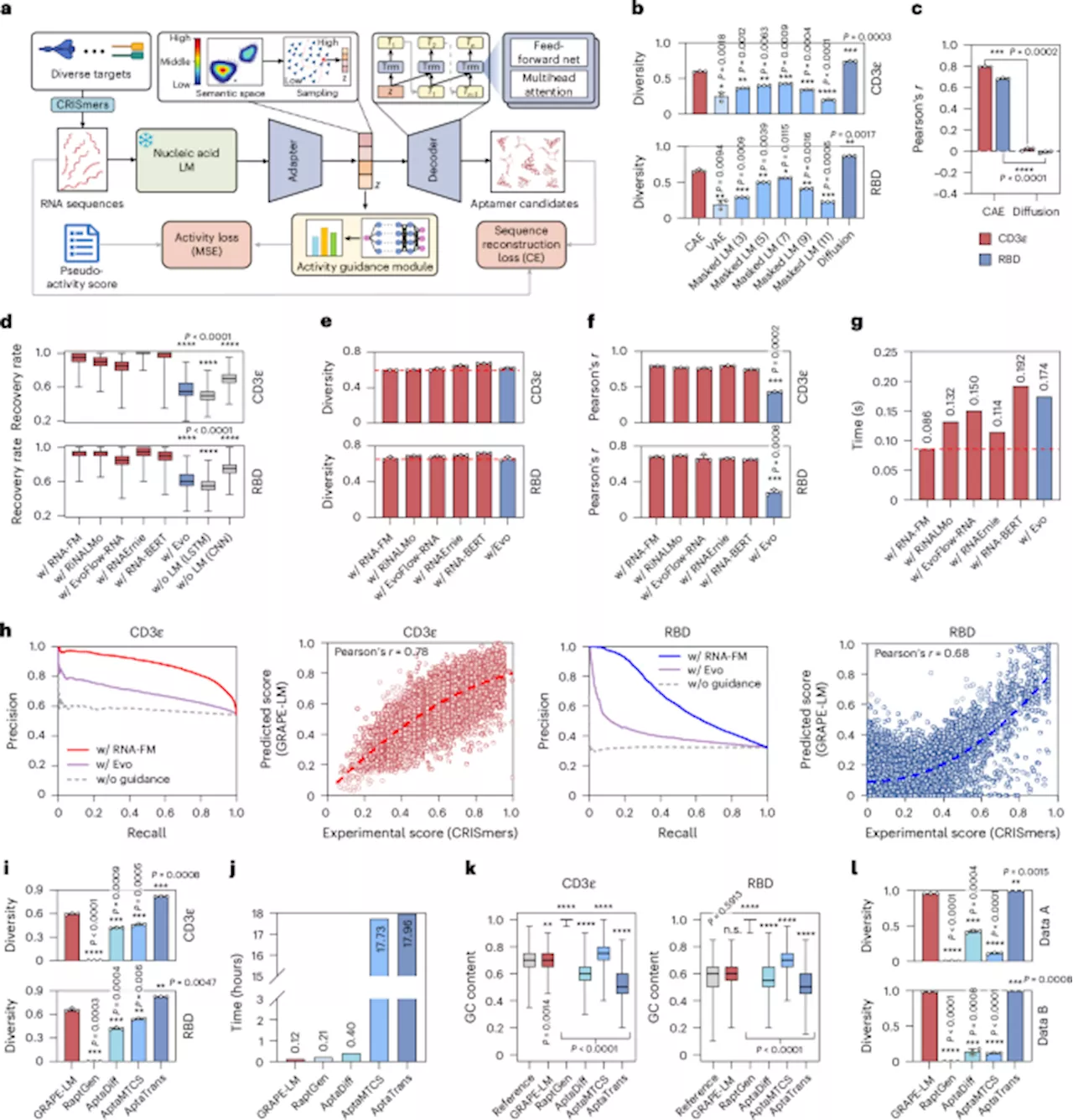
Recent advancements in artificial intelligence have led to a significant breakthrough in the field of molecular biology with the introduction of GRAPE-LM. This innovative framework facilitates the one-round evolution of RNA aptamers, addressing longstanding challenges in the effective evolution of RNA. Traditional methods have relied heavily on labor-intensive, multi-round screening processes, making GRAPE-LM a game-changer in aptamer discovery.
The directed evolution of biomolecules typically requires multiple iterations. While language models have accelerated protein evolution, generating effective RNA remains a complex task. RNA aptamers, which are selected based on their binding properties, present an ideal system for addressing this challenge. The new framework employs a transformer-based conditional autoencoder integrated with nucleic acid language models, leveraging CRISPR−Cas-based aptamer screening data from intracellular environments.
Validation of GRAPE-LM involved testing on three distinct targets: the human T cell receptor CD3ε, the receptor-binding domain of the SARS-CoV-2 spike protein, and the human oncogenic transcription factor c-Myc. Remarkably, GRAPE-LM achieved the successful acquisition of RNA aptamers that outperformed those obtained through traditional multi-round human selection methods, demonstrating its efficiency and potential for rapid aptamer discovery.
The framework is informed by data derived from a single round of CRISPR−Cas screening. This singular approach allows for a focused sampling of functional aptamers, contrasting with the randomness often associated with conventional methods. The results indicate that GRAPE-LM can generate aptamers with high specificity and affinity for their targets, thus paving the way for significant advancements in therapeutic and diagnostic applications involving RNA aptamers.
The collaborative research was supported by several prestigious organizations, including the National Key Research and Development Program of China and the National Natural Science Foundation of China. The study was conducted at the Shenzhen Institute of Advanced Technology, part of the Chinese Academy of Sciences. The findings were made possible thanks to the combined efforts of researchers, including Y.W., Y.Z., and Jun Zhang, who played pivotal roles in the design and execution of the study.
As the scientific community continues to explore the implications of GRAPE-LM, it is clear that this framework could redefine the landscape of RNA aptamer evolution. The results not only highlight the potential for swift and effective aptamer development but also suggest that innovative AI-driven methodologies might become the standard in biomolecular research.
This research marks a significant step forward, not only in the field of synthetic biology but also in the broader context of drug development and molecular diagnostics. The ability to efficiently evolve RNA aptamers could lead to new breakthroughs in treating diseases and developing targeted therapies in the near future.

Robinhood Stock Surges 2.5% in Early Trading on March 17

Israel Intensifies Strikes as Global Energy Crisis Looms

CALV Offers Class on Communication Skills for Real Estate Professionals

Historic Bideford Pub Reopens as The Patch Wine Bar & Kitchen

Oscar Night Celebrations: Winners, Guests, and Exclusive After-Parties

Samsung Galaxy Watch 9 Set for Larger Battery Boost, Report Reveals

Kibble vs. Fresh Dog Food: What’s Best for Your Dog’s Health?

Acclaimed San Francisco Pizzeria Del Popolo to Close in May

‘Invincible’ Season 4 Launches on Prime Video with Epic Action

ALMA Discovers Companion Orbiting Giant Red Star π 1 Gruis

Doctoral Candidate Trivanni Yadav Advances Battery Research at UTulsa

Global Air Forces Ranked by Annual Defense Budgets in 2025

Rev. Bry Shields to Retire as McGill-Toolen President in 2026

Mass Production of F-35 Fighter Jet Drives Down Costs

Tucson Celebrates Life and Remembrance at 36th Annual All Souls Procession

Gold Investment Surge: Top Mutual Funds and ETF Alternatives

DirecTV to Launch AI-Driven Ads with User Likenesses in 2026

Paul Giamatti Reveals Villainous Role in Star Trek: Starfleet Academy
-
 Science9 months ago
ALMA Discovers Companion Orbiting Giant Red Star π 1 Gruis
-
 Science8 months ago
Doctoral Candidate Trivanni Yadav Advances Battery Research at UTulsa
-
 World10 months ago
Global Air Forces Ranked by Annual Defense Budgets in 2025
-
 Lifestyle9 months ago
Rev. Bry Shields to Retire as McGill-Toolen President in 2026
-
 World10 months ago
Mass Production of F-35 Fighter Jet Drives Down Costs
-
 Lifestyle9 months ago
Tucson Celebrates Life and Remembrance at 36th Annual All Souls Procession
-
 Business10 months ago
Gold Investment Surge: Top Mutual Funds and ETF Alternatives
-
 Top Stories10 months ago
DirecTV to Launch AI-Driven Ads with User Likenesses in 2026
-
 Entertainment10 months ago
Paul Giamatti Reveals Villainous Role in Star Trek: Starfleet Academy
-

 Top Stories10 months ago
New ‘Star Trek: Voyager’ Game Demo Released, Players Test Limits
-

 Lifestyle8 months ago
Maumee’s Shop With a Hero Event Delivers Joy to Local Children
-

 Lifestyle7 months ago
Cape May Shines as New Jersey’s Only Entry on Beach Town List