
Science
New Study Identifies Key Stars for Potential Life Beyond Earth

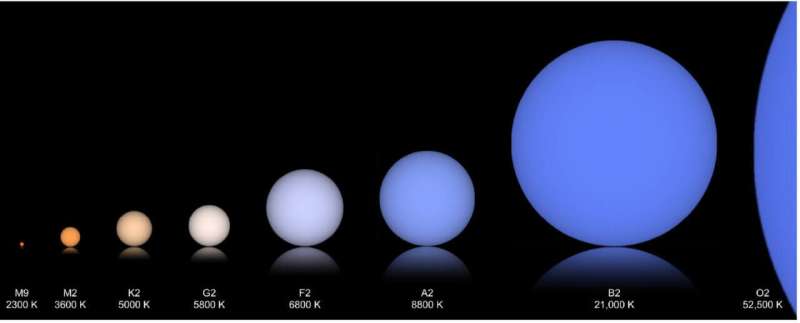
A groundbreaking study led by graduate student Sebastián Carrazco-Gaxiola from Georgia State University has identified a new set of stars that may serve as ideal hosts for planets capable of supporting life. The findings were presented on January 6, 2026, at the American Astronomical Society meeting in Phoenix, Arizona, marking a significant step in the quest to find Earth-like environments beyond our solar system.
Carrazco-Gaxiola’s research focuses on over 2,000 stars known as K dwarfs, which are located within 130 light-years of Earth. These stars, which are slightly cooler and fainter than the Sun, are abundant in the solar neighborhood, with approximately twice as many K dwarfs compared to sun-like stars. Their long lifespans provide stable conditions that could enable life to thrive on orbiting planets.
Survey Methodology and Observational Techniques
The study employed advanced observational techniques to gather precise measurements of the spectral data emitted by these stars. Utilizing state-of-the-art spectrographs on the SMARTS 60-inch mirror telescope at the Cerro Tololo Interamerican Observatory in the Chilean Andes and the Tillinghast Telescope at the Fred Lawrence Whipple Observatory in Arizona, the team was able to create a comprehensive survey of K dwarfs across the entire sky.
According to Allyson Bieryla, an astronomer at the Center for Astrophysics | Harvard & Smithsonian, “The power of having these two telescopes in opposite hemispheres is that it gives us access to all the K dwarfs across the entire sky.” This dual approach allowed for a thorough examination of these stars, making it possible to derive crucial estimations about their temperature, age, rotation, and motion through space.
The detailed analysis of the spectral data not only aids in understanding the characteristics of K dwarfs but also reveals information about the heated upper layers of these stars, which are influenced by magnetic fields. Such factors are vital in assessing the potential habitability of orbiting planets.
Future Implications and Scientific Importance
The implications of this survey are far-reaching. Todd Henry, a Distinguished University Professor of Physics and Astronomy and Carrazco-Gaxiola’s advisor, stated, “This survey will be the foundation for studies of nearby stars for decades to come.” The research sets the stage for future exploration, as these stars and their potential planets may become targets for spacecraft missions aimed at exploring life beyond Earth.
The survey, titled “An All-Sky Spectroscopic Reconnaissance of More Than 2,100 K Dwarfs Within 40 Parsecs Using High-Resolution Spectra,” showcases new, unpublished findings that garnered significant interest, leading to its selection for presentation at the AAS press conference. This research not only enhances our understanding of the cosmos but also ignites curiosity about the potential for life in distant star systems.
As the search for extraterrestrial life continues, studies like this highlight the importance of K dwarfs as potential havens for life, paving the way for more in-depth explorations of our neighboring stars. The findings emphasize the need for ongoing research and observation in this uncharted territory of astronomy.

Robinhood Stock Surges 2.5% in Early Trading on March 17

Israel Intensifies Strikes as Global Energy Crisis Looms

CALV Offers Class on Communication Skills for Real Estate Professionals

Historic Bideford Pub Reopens as The Patch Wine Bar & Kitchen

Oscar Night Celebrations: Winners, Guests, and Exclusive After-Parties

Samsung Galaxy Watch 9 Set for Larger Battery Boost, Report Reveals

Kibble vs. Fresh Dog Food: What’s Best for Your Dog’s Health?

Acclaimed San Francisco Pizzeria Del Popolo to Close in May

‘Invincible’ Season 4 Launches on Prime Video with Epic Action

ALMA Discovers Companion Orbiting Giant Red Star π 1 Gruis

Doctoral Candidate Trivanni Yadav Advances Battery Research at UTulsa

Global Air Forces Ranked by Annual Defense Budgets in 2025

Rev. Bry Shields to Retire as McGill-Toolen President in 2026

Mass Production of F-35 Fighter Jet Drives Down Costs

Tucson Celebrates Life and Remembrance at 36th Annual All Souls Procession

Gold Investment Surge: Top Mutual Funds and ETF Alternatives

DirecTV to Launch AI-Driven Ads with User Likenesses in 2026

Paul Giamatti Reveals Villainous Role in Star Trek: Starfleet Academy
-
 Science9 months ago
ALMA Discovers Companion Orbiting Giant Red Star π 1 Gruis
-
 Science8 months ago
Doctoral Candidate Trivanni Yadav Advances Battery Research at UTulsa
-
 World10 months ago
Global Air Forces Ranked by Annual Defense Budgets in 2025
-
 Lifestyle10 months ago
Rev. Bry Shields to Retire as McGill-Toolen President in 2026
-
 World10 months ago
Mass Production of F-35 Fighter Jet Drives Down Costs
-
 Lifestyle9 months ago
Tucson Celebrates Life and Remembrance at 36th Annual All Souls Procession
-
 Business10 months ago
Gold Investment Surge: Top Mutual Funds and ETF Alternatives
-
 Top Stories10 months ago
DirecTV to Launch AI-Driven Ads with User Likenesses in 2026
-
 Entertainment10 months ago
Paul Giamatti Reveals Villainous Role in Star Trek: Starfleet Academy
-

 Lifestyle8 months ago
Maumee’s Shop With a Hero Event Delivers Joy to Local Children
-

 Top Stories10 months ago
New ‘Star Trek: Voyager’ Game Demo Released, Players Test Limits
-

 Lifestyle8 months ago
Cape May Shines as New Jersey’s Only Entry on Beach Town List