
Science
Researchers Uncover Black Death Mass Grave Near Erfurt, Germany

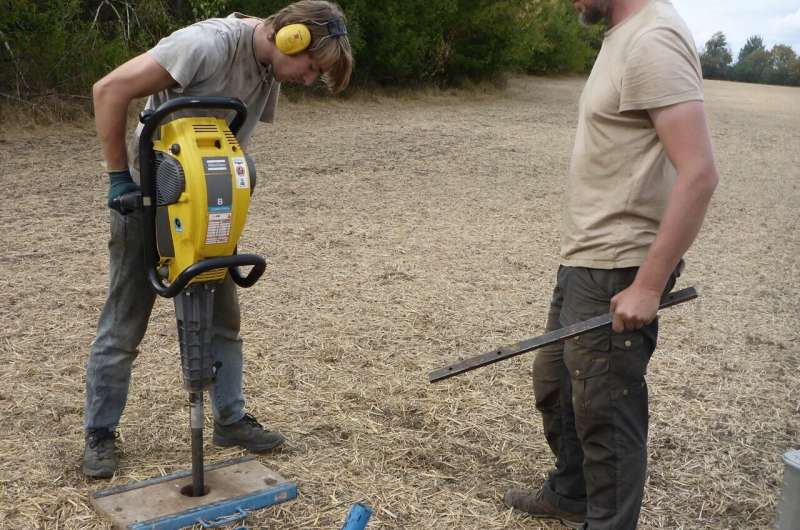
An interdisciplinary research team from **Leipzig University** has discovered significant evidence of a **Black Death** mass grave near the abandoned medieval village of Neuses, located outside **Erfurt**, Germany. This finding marks the first systematically identified burial site linked to plague fatalities in Europe, offering crucial insights into one of the continent’s deadliest pandemics.
The study, led by Leipzig University in collaboration with the **Leibniz Institute for the History and Culture of Eastern Europe** (GWZO) and the **Helmholtz Center for Environmental Research** (UFZ), was published in the journal **PLOS One**. Researchers utilized a combination of historical documents, geophysical measurements, and sediment coring to confirm the existence of a burial structure that aligns with descriptions of plague pits found in **14th-century** records.
A New Insight into Europe’s Devastating Pandemic
Between **1346 and 1353**, the Black Death pandemic is estimated to have claimed the lives of up to half of Europe’s population, with **Thuringia** being one of the regions heavily impacted. Historical chronicles indicate that in **1350**, around **12,000 individuals** were buried in eleven large pits near Erfurt, but the precise locations of these burial sites had remained elusive.
Through advanced techniques such as electrical resistivity mapping and sediment coring, the research team reconstructed the medieval landscape and identified a substantial subsurface structure measuring approximately **10 m × 15 m × 3.5 m**. This structure contained a mix of sediments and fragments of human remains, with radiocarbon dating indicating that the remains date back to the **14th century**.
“Our results strongly suggest that we have pinpointed one of the plague mass graves described in the Erfurt chronicles,” said **Dr. Michael Hein**, the lead author and a geographer at Leipzig University. He emphasized that definitive confirmation would require planned archaeological excavations.
Dr. **Ulrike Werban** from the Helmholtz Center noted, “A major achievement of this study is that the find was made through an interdisciplinary prospection approach combining historical research with natural science methods—rather than through accidental discovery.”
Understanding Historical Burial Practices
The research highlights how natural soil conditions influenced settlement patterns and burial practices during the Middle Ages. The site of the former village of Neuses, along with the identified burial pit, lies in a drier zone characterized by fertile **chernozem** soils. In contrast, wetter floodplain soils were typically avoided for burials because decomposition occurs more slowly in such environments.
“This finding aligns with both modern soil science and the medieval ‘miasma theory,’ which suggested that diseases spread through ‘bad air’ and vapors from decaying organic matter,” explained **Dr. Martin Bauch** of the GWZO. He noted that from a medieval perspective, it would have been more challenging to contain the plague in damp areas, which also contributed to the decision to bury the deceased far from city walls.
By integrating historical, geophysical, and soil science methods, the team effectively utilized the landscape as an archive, which could guide future efforts to locate and protect other mass graves related to epidemics or conflicts.
The discovery of the mass grave near Erfurt is significant not only for its archaeological and historical value but also for its potential contributions to genetic and anthropological research. Fewer than ten confirmed and precisely dated Black Death mass graves exist across Europe, making this find particularly noteworthy.
Future excavations, planned in collaboration with the **Thuringian State Office for Heritage Management and Archaeology**, aim to provide material for genetic analyses at the **Max Planck Institute for Evolutionary Anthropology** (MPI-EVA) in Leipzig.
“This discovery is not only of archaeological and historical importance,” stated **Professor Christoph Zielhofer**, head of the Historical Anthropospheres research group at Leipzig University’s LeipzigLab. “It helps us understand how societies cope with mass mortality and demonstrates how modern interdisciplinary science can contribute to locating mass graves—topics that remain relevant even in the 21st century.”
The implications of this research extend beyond history, offering insights into societal responses to epidemic crises, which can inform contemporary discussions about public health and community resilience.

Robinhood Stock Surges 2.5% in Early Trading on March 17

Israel Intensifies Strikes as Global Energy Crisis Looms

CALV Offers Class on Communication Skills for Real Estate Professionals

Historic Bideford Pub Reopens as The Patch Wine Bar & Kitchen

Oscar Night Celebrations: Winners, Guests, and Exclusive After-Parties

Samsung Galaxy Watch 9 Set for Larger Battery Boost, Report Reveals

Kibble vs. Fresh Dog Food: What’s Best for Your Dog’s Health?

Acclaimed San Francisco Pizzeria Del Popolo to Close in May

‘Invincible’ Season 4 Launches on Prime Video with Epic Action

ALMA Discovers Companion Orbiting Giant Red Star π 1 Gruis

Doctoral Candidate Trivanni Yadav Advances Battery Research at UTulsa

Global Air Forces Ranked by Annual Defense Budgets in 2025

Rev. Bry Shields to Retire as McGill-Toolen President in 2026

Mass Production of F-35 Fighter Jet Drives Down Costs

Tucson Celebrates Life and Remembrance at 36th Annual All Souls Procession

Gold Investment Surge: Top Mutual Funds and ETF Alternatives

DirecTV to Launch AI-Driven Ads with User Likenesses in 2026

Paul Giamatti Reveals Villainous Role in Star Trek: Starfleet Academy
-
 Science9 months ago
ALMA Discovers Companion Orbiting Giant Red Star π 1 Gruis
-
 Science8 months ago
Doctoral Candidate Trivanni Yadav Advances Battery Research at UTulsa
-
 World10 months ago
Global Air Forces Ranked by Annual Defense Budgets in 2025
-
 Lifestyle9 months ago
Rev. Bry Shields to Retire as McGill-Toolen President in 2026
-
 World10 months ago
Mass Production of F-35 Fighter Jet Drives Down Costs
-
 Lifestyle9 months ago
Tucson Celebrates Life and Remembrance at 36th Annual All Souls Procession
-
 Business10 months ago
Gold Investment Surge: Top Mutual Funds and ETF Alternatives
-
 Top Stories10 months ago
DirecTV to Launch AI-Driven Ads with User Likenesses in 2026
-
 Entertainment10 months ago
Paul Giamatti Reveals Villainous Role in Star Trek: Starfleet Academy
-

 Top Stories10 months ago
New ‘Star Trek: Voyager’ Game Demo Released, Players Test Limits
-

 Lifestyle8 months ago
Maumee’s Shop With a Hero Event Delivers Joy to Local Children
-

 Lifestyle7 months ago
Cape May Shines as New Jersey’s Only Entry on Beach Town List