
Science
Researchers Unlock Secrets of Hops to Enhance Beer Flavor

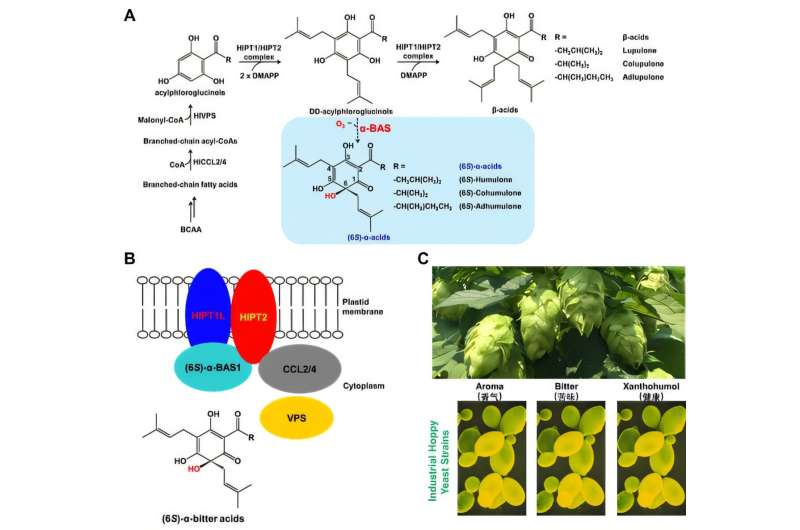
Hops have long been recognized as a vital ingredient in brewing beer, contributing not only to its flavor but also to its preservation. Recent research from a team led by Prof. Wang Guodong at the Institute of Genetics and Developmental Biology of the Chinese Academy of Sciences has made significant strides in understanding how hops produce chiral α-bitter acids, which impart the characteristic bitterness to beer.
The study, published in Plant Communications, details the role of specific enzymes in the biosynthesis of these acids, an area that had remained unclear for over a decade. While the overall biosynthetic pathway had been established, the exact function of the enzyme known as α-bitter acid synthase (α-BAS) was not confirmed until now.
Breakthrough in Hops Research
The researchers developed a sensitive liquid chromatography–mass spectrometry (LC–MS) detection method to distinguish between two chiral forms of α-bitter acids, known as 6S and 6R. Their findings indicated that hop glandular trichomes predominantly accumulate the 6S-type α-bitter acid. This discovery is pivotal, as it clarifies the biochemical processes involved in hop flavor development.
The precursor to these acids, deoxy-α-bitter acid, undergoes spontaneous oxidation when exposed to air, creating a racemic mixture of both chiral forms. This chemical reaction had previously obstructed efforts to verify the function of α-BAS. By overcoming this challenge, the team created a yeast heterologous expression system and examined more than ten candidate genes, identifying HlMO18 as the crucial enzyme that catalyzes the conversion of deoxy-α-bitter acid to the 6S form.
Implications for the Brewing Industry
The research not only maps the biosynthetic pathways of α-bitter acids but also highlights the specific amino acid residues essential for the enzyme’s activity. The findings reveal that the 6S-type α-bitter acid synthase forms a metabolic complex with upstream enzymes, which explains the accumulation of the 6S form in hop glandular trichomes.
With this understanding, the researchers aim to leverage synthetic biology to engineer industrial yeast strains capable of producing “hoppy beer.” This innovation promises to create authentic hop flavors without the need for actual hop plants, potentially reducing production costs and allowing for the development of customized, flavor-rich beers.
The outcomes of this study not only advance the scientific understanding of hops but also pave the way for exciting new possibilities in the brewing industry. As the team continues its research, the future of beer production may see significant transformations, driven by these groundbreaking discoveries.

Robinhood Stock Surges 2.5% in Early Trading on March 17

Israel Intensifies Strikes as Global Energy Crisis Looms

CALV Offers Class on Communication Skills for Real Estate Professionals

Historic Bideford Pub Reopens as The Patch Wine Bar & Kitchen

Oscar Night Celebrations: Winners, Guests, and Exclusive After-Parties

Samsung Galaxy Watch 9 Set for Larger Battery Boost, Report Reveals

Kibble vs. Fresh Dog Food: What’s Best for Your Dog’s Health?

Acclaimed San Francisco Pizzeria Del Popolo to Close in May

‘Invincible’ Season 4 Launches on Prime Video with Epic Action

ALMA Discovers Companion Orbiting Giant Red Star π 1 Gruis

Doctoral Candidate Trivanni Yadav Advances Battery Research at UTulsa

Global Air Forces Ranked by Annual Defense Budgets in 2025

Rev. Bry Shields to Retire as McGill-Toolen President in 2026

Mass Production of F-35 Fighter Jet Drives Down Costs

Tucson Celebrates Life and Remembrance at 36th Annual All Souls Procession

Gold Investment Surge: Top Mutual Funds and ETF Alternatives

DirecTV to Launch AI-Driven Ads with User Likenesses in 2026

Paul Giamatti Reveals Villainous Role in Star Trek: Starfleet Academy
-
 Science9 months ago
ALMA Discovers Companion Orbiting Giant Red Star π 1 Gruis
-
 Science8 months ago
Doctoral Candidate Trivanni Yadav Advances Battery Research at UTulsa
-
 World10 months ago
Global Air Forces Ranked by Annual Defense Budgets in 2025
-
 Lifestyle9 months ago
Rev. Bry Shields to Retire as McGill-Toolen President in 2026
-
 World10 months ago
Mass Production of F-35 Fighter Jet Drives Down Costs
-
 Lifestyle9 months ago
Tucson Celebrates Life and Remembrance at 36th Annual All Souls Procession
-
 Business10 months ago
Gold Investment Surge: Top Mutual Funds and ETF Alternatives
-
 Top Stories10 months ago
DirecTV to Launch AI-Driven Ads with User Likenesses in 2026
-
 Entertainment10 months ago
Paul Giamatti Reveals Villainous Role in Star Trek: Starfleet Academy
-

 Top Stories10 months ago
New ‘Star Trek: Voyager’ Game Demo Released, Players Test Limits
-

 Lifestyle8 months ago
Maumee’s Shop With a Hero Event Delivers Joy to Local Children
-

 Lifestyle7 months ago
Cape May Shines as New Jersey’s Only Entry on Beach Town List